Particle in equilibrium (balancing forces on an object on an incline)

Click For Summary

Homework Help Overview

The discussion revolves around a problem involving a particle in equilibrium on an incline, focusing on balancing forces and understanding the conditions for equilibrium when only magnitudes are provided.

Discussion Character

  • Conceptual clarification, Assumption checking, Problem interpretation

Approaches and Questions Raised

  • Participants explore the implications of equilibrium, questioning the net force condition and the role of angles in force components. There is discussion about the correct application of force equations and the necessity of defining a coordinate system.

Discussion Status

Participants are actively engaging with the problem, offering insights into the definitions and implications of equilibrium. Some have provided guidance on interpreting force components and the importance of coordinate systems, while others are questioning the assumptions made in the original setup.

Contextual Notes

There is a noted lack of specific information regarding the angle of incline and the coordinate system being used, which is affecting the clarity of the discussion.

Justin_Lahey
Messages
1
Reaction score
0
Homework Statement
Find the magnitude and angle
Relevant Equations
F1= cos(theta)38.4i+ sin(theta)38.4j
F2= cos(theta)52.7i + sin(theta)52.7j
Hi, I’m wondering if someone can help me understand this question. I can find a resultant force/vector when given an initial angle but I’m stuck here when the only information is the two magnitudes. I think I’m solving for the unknowns but a little lost on how or what equation I should be using. In the pic this is how I normally start by finding the x and y components but without theta I’m a bit lost. Thanks for any help.
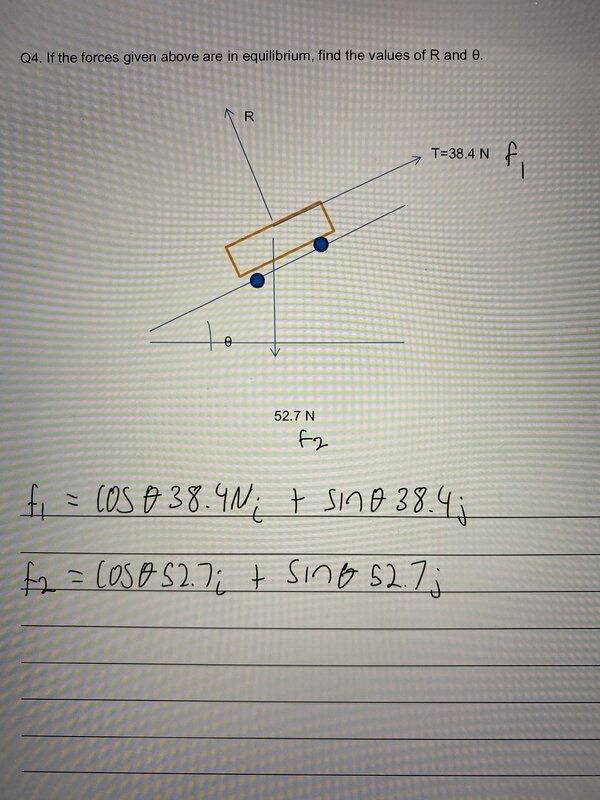
0B71EB58-E39E-4864-8B94-D0ADFFA07733.jpeg
 
Last edited by a moderator:
Physics news on Phys.org
If I am understanding the term "equilibrium" (in this context) correctly, shouldn't the net force simply be 0? So you know that F1 + F2 + R = 0.

Can you find ##\theta## from there?
 
  • Like
Likes   Reactions: SammyS
First of all you got to tell us your coordinate system. I think none of your two equations are correct (especially if we take the coordinate system with the i-direction parallel to the incline and the j direction perpendicular to the incline).

I assume you have been taught the following equation $$\vec{F}=|\vec{F}|\cos\theta\hat i+|\vec{F}|\sin\theta\hat j$$
which you apply it in a wrong way in this problem. You got to be careful what the angle ##\theta## is in this equation. It is the angle that the force vector ##\vec{F}## makes with the x-axis (or i-axis should i say, and that's why i asked what is your coordinate system). It is not the same ##\theta## for all forces (each force has its own ##\theta## in other words ) and it is not the angle ##\theta## that is given in the problem statement as the angle of the incline.
 
Last edited:
Delta2 said:
I think none of your two equations are correct
Well, the F1 equation is right if ##\hat i## is horizontally to the right and ##\hat j## is vertically up; the F2 equation is right if ##\hat i## is normal to the slope and down to the right, and ##\hat j## is parallel to the slope and down to the left.
 
haruspex said:
Well, the F1 equation is right if ##\hat i## is horizontally to the right and ##\hat j## is vertically up; the F2 equation is right if ##\hat i## is normal to the slope and down to the right, and ##\hat j## is parallel to the slope and down to the left.
E hehe @haruspex you did some sort of reverse engineering to find coordinate systems ( you got me, i could never think of the i direction as normal to the slope, good one) that each equation is true, Still there is no single coordinate system that both simultaneously are true . Thats my main point that's why i first asked what is the coordinate system he is using.
 
Welcome, Justin!
The way I would see this problem:
There would not be equilibrium for the case of a slope with very little θ angle, since ##F_1## would accelerate the car.
The magnitude of ##F_2## remains always the same.
As the angle of the slope increases little by little, a component of ##F_2## that is parallel to the surface of the slope an in line with ##F_1## appears and also increases little by little.

Your angle is the angle at which the magnitude of that component reaches the magnitude of ##F_1## and the balance is achieved, so the car does not accelerate in any direction.

Force R and the component of F2 that is perpendicular to the surface of the slope will naturally balance each other (Third law of Newton).
 
Last edited:

Similar threads

Replies
43
Views
3K
Replies
11
Views
1K
  • · Replies 1 ·
Replies
1
Views
1K
  • · Replies 5 ·
Replies
5
Views
2K
  • · Replies 7 ·
Replies
7
Views
5K
  • · Replies 2 ·
Replies
2
Views
2K
  • · Replies 36 ·
2
Replies
36
Views
6K
Replies
46
Views
7K
  • · Replies 6 ·
Replies
6
Views
3K