Discussion Overview
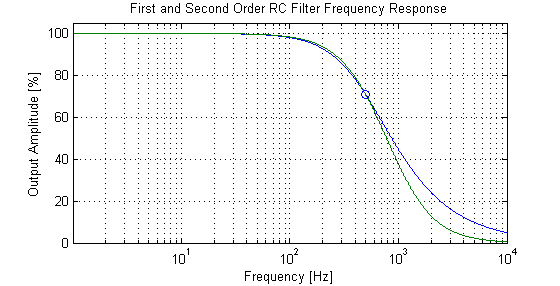
The discussion revolves around the effects of loading on a second order passive RC filter used to attenuate noise in thermocouple signals. Participants explore theoretical responses, practical implementations, and the implications of cascading filters, focusing on both passive and active filter designs.
Discussion Character
- Exploratory
- Technical explanation
- Debate/contested
- Mathematical reasoning
Main Points Raised
- Some participants note that cascading two passive RC filters without a buffer can lead to loading effects that alter the expected output response.
- One participant suggests that to achieve an ideal frequency response, a buffer stage with infinite input impedance and zero output impedance is necessary.
- Another participant proposes that minimizing loading effects involves configuring the first stage with low impedance and the second stage with high impedance, although this may not always be practical.
- There are suggestions to consider active low-pass filters as they may provide a more ideal response in the lower frequency range.
- Participants discuss the importance of understanding the output load requirements, as this can significantly affect filter performance.
- One participant emphasizes the need for simulation software to better understand circuit responses, while another mentions the possibility of building the circuit for experimental quantification.
- There is a discussion about the theoretical aspects of filter design, including transfer functions and frequency response, and how these relate to practical implementations.
- Some participants express uncertainty about how loading specifically changes the filter response, questioning whether it becomes more aggressive, less aggressive, or just different.
Areas of Agreement / Disagreement
Participants generally agree that loading effects can alter the response of cascaded filters, but there is no consensus on the best approach to mitigate these effects or on the specifics of how the response changes. Multiple competing views on the use of passive versus active filters remain present.
Contextual Notes
Participants mention the importance of component values and the output impedance of the thermocouple, indicating that these factors can complicate the design and performance of passive filters. There is also a recognition that theoretical models may not fully account for non-ideal responses in practical applications.
Who May Find This Useful
This discussion may be useful for electrical engineers, students in electronics courses, and practitioners interested in filter design and noise attenuation in signal processing applications.
 You could easily scale up to be 1:100 as I suggested.