Phase Transitions in the Van Der Waals Gas

Click For Summary
SUMMARY

The discussion focuses on the behavior of isothermal compressibility (κ_T) in the context of Van Der Waals gas when the free energy (F) reaches a minimum. The equation κ_T = (1/V)(∂²F/∂V²)⁻¹_T is utilized to analyze the stability of the system. It is concluded that if the free energy is minimal, the second derivative of F with respect to volume (V) is positive, indicating that κ_T must remain positive for system stability. The participant identifies that all sketched isotherms pose a problem except for isotherm E, which is continuously left-curved.

PREREQUISITES
  • Understanding of Van Der Waals gas behavior
  • Familiarity with thermodynamic concepts such as free energy and isothermal compressibility
  • Knowledge of calculus, particularly derivatives
  • Experience with stability analysis in thermodynamic systems
NEXT STEPS
  • Study the implications of the Van Der Waals equation on phase transitions
  • Learn about the significance of isothermal compressibility in thermodynamic stability
  • Explore the mathematical derivation of free energy and its derivatives
  • Investigate the characteristics of different isotherms in phase diagrams
USEFUL FOR

Students and researchers in thermodynamics, physicists studying phase transitions, and anyone interested in the stability analysis of Van Der Waals gases.

GravityX
Messages
19
Reaction score
1
Homework Statement
What does a minimum free energy mean for isothermal compressibility?
Relevant Equations
##\kappa_T=-\frac{1}{V}\Bigl( \frac{\partial V}{\partial P} \Bigr)_T=\frac{1}{V}\Bigl( \frac{\partial^2 F}{\partial V^2} \Bigr)^{-1}_T##
Hi,

I am not quite sure if I have understood the second task correctly, but I proceeded as follows.
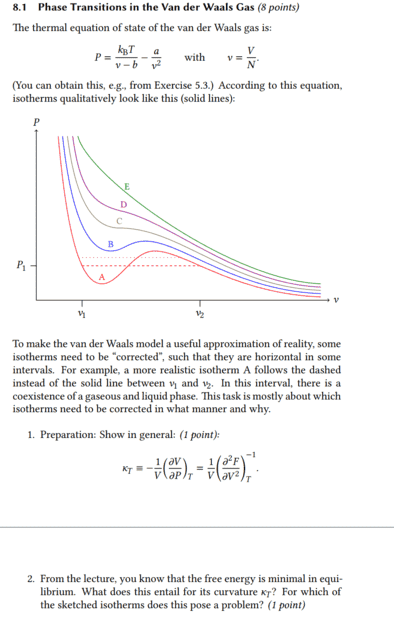
Bildschirmfoto 2022-12-02 um 11.45.28.png


It's about what happens to the isothermal compressibility when the free energy becomes minimal. In the first task there was already the equation ##\kappa_T=\frac{1}{V}\Bigl( \frac{\partial^2 F}{\partial V^2} \Bigr)^{-1}_T## and I assume that this was not given without reason, but that one can use it to solve the second task.

If the free energy becomes minimal, then surely it means that the difference with ##F_2## < ##F_1## is therefore ##F_2-F_1## negative and thus also its derivative. Then the isothermal compressibility would be negative and thus left-curved.
 
Physics news on Phys.org
If the free energy is minimal for an isotherm, it means that the 2nd derivative of F with respect to V is positive.
 
  • Like
Likes   Reactions: GravityX
Thanks Chestermiller for your help 👍

That would then mean that ##\kappa_T## would be curved to the left. If I have understood correctly, then ##\kappa_T## must always be positive for the system to be stable.

The problem says "For which of
the sketched isotherms does this pose a problem?" I would say for all but E, as this is continuously left curved.
 

Similar threads

  • · Replies 2 ·
Replies
2
Views
1K
  • · Replies 10 ·
Replies
10
Views
22K
  • · Replies 6 ·
Replies
6
Views
3K
Replies
6
Views
3K
  • · Replies 10 ·
Replies
10
Views
6K
  • · Replies 9 ·
Replies
9
Views
4K
Replies
1
Views
2K
  • · Replies 1 ·
Replies
1
Views
2K
Replies
8
Views
3K
  • · Replies 1 ·
Replies
1
Views
10K