Phase Velocity of a Water Wave?

Click For Summary

Discussion Overview

The discussion revolves around the concepts of phase velocity and group velocity in the context of water waves. Participants explore the differences between these two types of velocities, their physical implications, and the phenomenon of dispersion in wave propagation.

Discussion Character

  • Exploratory
  • Technical explanation
  • Conceptual clarification
  • Debate/contested
  • Mathematical reasoning

Main Points Raised

  • Some participants express confusion about the definition and physical meaning of phase velocity compared to group velocity, particularly in the context of water waves.
  • Others clarify that water particles do not merely move up and down but actually move in circular paths, which relates to the concept of phase velocity.
  • A participant questions how phase velocity can exist if water waves appear as a continuous wave rather than discrete waveforms, seeking clarity on the concept of zero phase-angle.
  • There is a discussion about dispersion, with some participants suggesting that it refers to the phenomenon where different frequencies travel at different speeds, leading to changes in the overall shape of the wave as it propagates.
  • Some participants propose that a water wave can be viewed as a superposition of many waves with different phase velocities, raising questions about how to define phase velocity in such a context.
  • One participant mentions that pure sine waves do not disperse, contrasting them with more complex waveforms that do exhibit dispersion.
  • Links to external resources are shared to illustrate concepts and provide further examples of dispersion and phase velocity.

Areas of Agreement / Disagreement

Participants generally agree on the existence of both phase and group velocities, but there is no consensus on the precise physical interpretation of phase velocity in the context of water waves. Multiple competing views regarding the implications of dispersion and the nature of wave propagation remain unresolved.

Contextual Notes

Participants express uncertainty about the definitions and implications of phase velocity and dispersion, indicating a reliance on specific examples and visual aids to clarify these concepts. The discussion highlights the complexity of wave behavior in different media and the challenges in conceptualizing wave interactions.

Who May Find This Useful

This discussion may be useful for students and enthusiasts of physics, particularly those studying wave mechanics, dispersion, and the mathematical modeling of waves.

Hertz
Messages
180
Reaction score
8
Hi, I've been reading a lot today about waves and how they have both a phase velocity and a group velocity. The group velocity makes perfect sense to me, I would phrase it as the speed at which the wave is propagating. The phase velocity on the other hand is quite confusing to me. What exactly is it? How can it have a different speed than the group velocity? Don't water particles in a water wave just move up and down as the wave traverses over them?

All I know is, a water wave does not look like this by any means!:
Wave_opposite-group-phase-velocity.gif
 
Last edited by a moderator:
Physics news on Phys.org
Water is quite complicated and the particles do not just go up and down - the particles actually go in circles.
However - even if they did just go up and down, the phase velocity still makes sense.

In your animated gif you can see the group velocity at the motion of the peak in the envelope shape - the overall shape of wavy lines moves to the right. Now take a couple of bits of card or paper or something and cover the top and bottom of the gif so you can only see the part of the waves that cross the x-axis ... see?

That is the motion of the part of the wave that has zero phase-angle (or pi phase angle).
And yet each particle in the simulation is only going up and down.

More realistic application to water waves:
http://en.wikipedia.org/wiki/Dispersion_(water_waves )

Real life example in a speedboat wake:
 
Last edited by a moderator:
I can see the two velocities, I'm just a bit confused by what they mean. Like I said, water doesn't look like the picture I posted above, if it did, I would see why it has a phase velocity. Since water just looks like one large wave after another, I see where group velocity comes in, but I don't see how a real water wave has a phase velocity. You say that it's the part that has zero phase-angle, what do you mean by that, and how does it apply to water?

Also, does a water wave increase in wavelength over time? Does it spread out at it gets further away from the source? Why or why not?
 
Well water waves don't normally have the phase velocity in the opposite direction to the group velocity.
But you can see the dispersion in the video I gave you.

Water waves disperse because different frequencies travel at different speeds.
You can see it happen in a bathtub - just make a pulse and watch it travel to the other end.
OTOH: pure sine waves do not disperse.

You can demonstrate it under controlled circumstances in a ripple tank:
http://scitation.aip.org/content/aapt/journal/ajp/79/6/10.1119/1.3556140

It should be possible to find a video on it...
 
Ok, well I appreciate the information. Let me try to reword my question though..

Firstly, even if water waves don't have a phase velocity in the opposite direction, they have a phase velocity in general right? What does this "phase velocity" represent physically? The movement of the individual particles? Or are water waves in general just a complicated superposition of many waves with many phase velocities? I'm not quite sure..

As you know, a cross section of a water wave doesn't look at all like the picture I posted above BECAUSE the "phase velocity" isn't so pronounced as in the picture. In fact, as I said, I'm having trouble putting my finger on what the phase velocity even is physically... That is the meat of my question.

Secondly, I'm not sure what "dispersion" means. I have an idea, but I like to be sure. Is dispersion the phenomena where a water wave increases in wavelength as it propagates? You said waves disperse because different frequencies travel at different speeds? I don't see why this matters? Of course, you have miniature waves traveling at a different speed and a different velocity, but shouldn't they simply be superimposed on the large wave that a "non-scientist" would simply call "the wave"? It seems to me like the miniature waves and the largest wave (the group) wouldn't interfere with each other at all. Why do different (superimposed) waves traveling at different speeds cause the largest of the wavelengths to become even larger? This doesn't make sense to me from a mathematic or physical perspective :\
 
The phase velocity manifests as a general spreading of the water wave.
You'll be able to see it more clearly when there's a pulse instead of a wave-train.
http://www.acs.psu.edu/drussell/Demos/Dispersion/dispersion.html

OTOH: you do get varying amplitude waves coming at you in water.

Dispersion is where the characteristic length of a pulse increases as it propagates.

You seem to be thinking of all waves as having a definite wavelength ... like a sine wave does.
This is incorrect.

A water wave, or any wave for that matter, is any solution to the wave equation.
Sine waves are solutions to the wave equation, but they are not the only solutions.

General solutions to the wave equation can be expressed as linear sums of pure sine waves.

A pure sine wave has a specific wavelength and wave speed - the wave speed depends on the medium, and, in a "dispersive medium" the wave speed depends on the wavelength.

A pure sine wave is the only kind of wave which can be characterized by having a specific, single, wavelength.
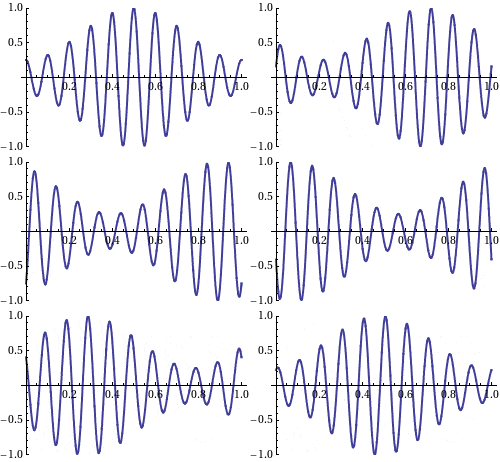
The waves in your example, for instance, exhibit two clear wavelengths and would be typically composed of around 100 individual sine waves.

The wavelength of a pure sine wave does not change as it propagates.

A general wave cannot be characterized by having a single wavelength - but it can be characterized by the mixture of pure sine waves that make up it's overall shape.

Since these sine waves will each travel at a different speed, the overall shape of the wave will change st it propagates. The overall shape of a general wave is a transient.

The dispersion relations tell you how the shape changes.

The examples, like the ones you've seen in animations, are for simple situations where the math is not too hard and it is easier to see specific effects.
A real life wave in Nature (take a close look at the surface of the sea sometime) tends to be very complicated and it is harder to see particular effects.
That is why you do not generally associate the shape in post #1 with water waves.
But you will see wave-trains like that in the wakes of boats - you have to look carefully.

You'll notice that the wave in your example does not change it's overall shape so much - this is because a lot of small changes cancel out to an overall impression of a wiggly shape moving. This is an emergent phenomenon - what is happening is that lots of sine waves are moving at different speeds and they interfere constructively and destructively with each other.

So - in general - dispersion is the emergent phenomenon arising from the components of waves and pulses moving at different speeds through the same media.
 
Last edited:
  • Like
Likes   Reactions: 1 person
Ahh, it clicked! Thank you so much. Reminding me that we are talking about "the general solution to a wave equation" I realized exactly why a wave might need to be represented as the superposition of many other waves. I am studying PDEs this semester so it falls together nicely :)

Also, I know you mentioned this earlier, but the link you posted also explains how, depending on the medium, wave propagation speed could depend on the wavelength, as in the case of water. Voila! Dispersion makes sense! Thank you!

So then how exactly do you define phase velocity in consideration of this? Since a water wave could be a superposition of many other waves, would the phase velocity just be the velocity of a specific one of those smaller wavelengths? I.e. Are there many many many phase velocities in a complicated system, each corresponding to a particular wavelength?
 
The following link has an example using waves with only two components.
http://www.phy.duke.edu/research/photon/qelectron/proj/infv/fast_tut.php
... Here they show you phase velocity as the velocity of each component.

You should experiment with the transparencies they suggest.
You can also go to the math if you are that way inclined.
 

Similar threads

  • · Replies 15 ·
Replies
15
Views
7K
  • · Replies 2 ·
Replies
2
Views
2K
  • · Replies 14 ·
Replies
14
Views
4K
  • · Replies 4 ·
Replies
4
Views
2K
  • · Replies 3 ·
Replies
3
Views
2K
  • · Replies 4 ·
Replies
4
Views
18K
  • · Replies 1 ·
Replies
1
Views
2K
  • · Replies 6 ·
Replies
6
Views
2K
  • · Replies 2 ·
Replies
2
Views
5K
  • · Replies 6 ·
Replies
6
Views
5K