Phosphor screen, hazards and demonstrations?

  • Thread starter Thread starter mishima
  • Start date Start date
  • Tags Tags
    Screen
Click For Summary

Discussion Overview

The discussion revolves around the potential hazards and applications of a phosphor screen from an old CRT television, specifically in a school setting. Participants explore the risks associated with the phosphor materials and consider various physics demonstrations that could utilize the screen.

Discussion Character

  • Exploratory
  • Technical explanation
  • Debate/contested
  • Experimental/applied

Main Points Raised

  • One participant raises concerns about the risks posed by the phosphor in a school environment and questions the safety of using the screen for demonstrations.
  • Another participant suggests consulting the Material Safety Data Sheet (MSDS) for phosphorous and provides a link to a relevant paper.
  • A different participant shares information on the composition of common phosphors used in CRTs, noting potential inhalation dangers due to particle size and suggesting caution when handling the materials.
  • Some participants mention the long persistence of certain phosphors and reference other types of phosphor-coated tubes that could be used for demonstrations.
  • One participant details several unsuccessful attempts to excite the phosphors using various light sources and electrical discharges, expressing concern about the unknown compounds in the phosphors.
  • Another participant discusses the energy requirements for exciting the phosphors, indicating that the energy levels needed may be significantly higher than what has been attempted.

Areas of Agreement / Disagreement

Participants express varying levels of concern regarding the safety of handling phosphors and the feasibility of using the screen for demonstrations. There is no consensus on the appropriate methods for excitation or the risks involved, indicating ongoing debate and uncertainty.

Contextual Notes

Participants note limitations in their knowledge regarding the toxicity of the phosphors and the specific energy requirements for excitation, suggesting that further research or expert consultation may be necessary.

mishima
Messages
576
Reaction score
43
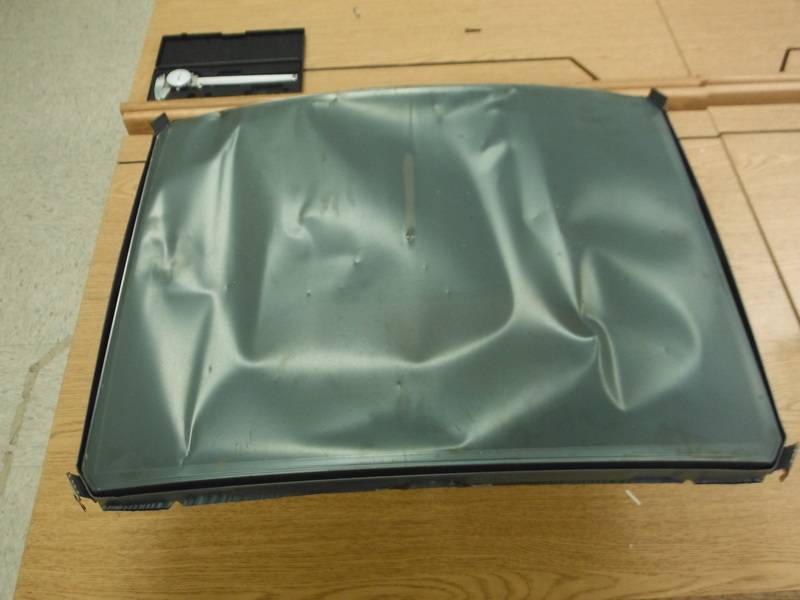
So, for whatever reason, a student brought in a phosphor screen from an old CRT television. I was wondering:

1. if the phosphor posed any risk in a school setting, and
2. if there was a way to utilize it for a physics demonstration of some kind.

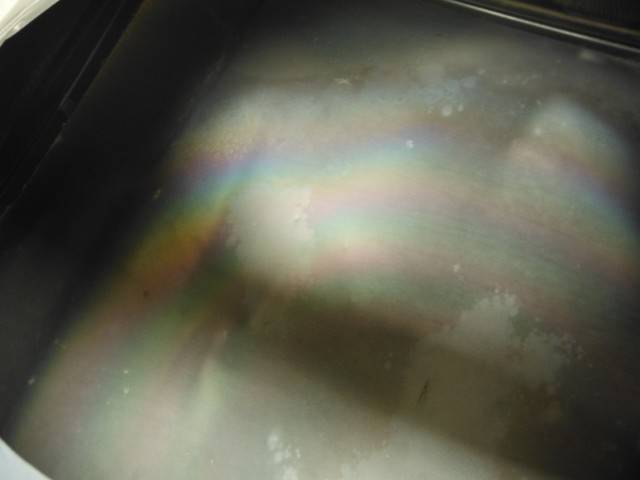
I assume they threw a rock or something at the vacuum tube, so it isn't in pristine condition. Looking from behind you can see the rainbow pattern:
DSCF3767.jpg

DSCF3768.jpg
 

Attachments

  • DSCF3767.jpg
    DSCF3767.jpg
    36.7 KB · Views: 693
  • DSCF3768.jpg
    DSCF3768.jpg
    14 KB · Views: 697
Engineering news on Phys.org
Here is a link for the composition of some common phosphors used in color TVs (the P22 CRT phosphor):
https://www.fh-muenster.de/ciw/downloads/personal/juestel/juestel/CRT-Phosphors.pdf
The Green and Blue are based on ZnS (Zinc Selenide); with Cu (Copper), Au(Gold) and Al(aluminium) for the Green; and with Ag(Silver) for the Blue.
Red is based on Y(Yttrium) and O(Oxygen) with either Vanadium(V), or Sulfur(S), all with Europium(Eu) added.
This was found via: https://www.google.com/search?&q=phosphors+on+color+crt+monitor
(Google reports 1 600 000 hits)

When I was doing TV servicing over 50 years ago, the supposed 'wisdom of experience' or 'common knowledge' was "Don't get the phosphors in an open cut." I never did hear why, but I avoided doing so. The above referenced article also lists the particle sizes used. With a particle size of 2.1μm to 12μm, they are in the size range of being an inhalation danger. I haven't found any toxicity data but haven't done much of a search.

You could also ask a Chemistry instructor for his ideas. I don't think I would introduce this to a grade school class. By college level, much of the stupidity has dissipated. If you will be removing the shadow mask, to avoid particle inhalation, you might consider doing it under a fume hood or outdoors with the wind to your back. If there is a concern in the classroom, you could seal the screen itself with the phosphors in a plastic bag.

Please let us know the outcome and student response.

Cheers,
Tom
 
Some old radar tubes (such as the 7BP7) have a long persistence phosphor, type P7, which will glow for a long time after you shine a lamp on the screen. Ordinary fluorescent tubes, of course, also have a phosphor power coating, which has been used for home made cathode ray tubes,
http://sparkbangbuzz.com/
 
I've tried a few things with no luck, I assume because the vacuum is broken and these things simply aren't the correct magnitude of energy...

1. Shining a super bright shop lamp on it.
2. Arcing a tesla coil into it
3. Arcing a wimshurst machine discharge into it
4. Blacklight (UVA&UVB)
5. UV Laser

I was considering torching a small section I cut from it, but the unknown phosphor compounds bother me. I do have a fume hood.
 
This is now getting out of my field, so I asked others here for their take on the energy needed to make thosse phosphors glow.

"It's not my field so I'm sort of at a loss about how to point out the falacy. It seems to me that the energy required to light up the phosphors is orders of magnitude higher than what is being attempted. The usual electric field in a CRT for beam acceleration is around 1kV per inch for 12 to 20 inches. (somewhere around 12 to 16kV on the second anode.)

Just one result so far:

mfb said:
The excitations of the chemicals happen at a few eV, a low energy electron beam and maybe even UV should be able to excite it - just not as nicely focused as the original beam.
 

Similar threads

  • · Replies 2 ·
Replies
2
Views
2K
  • · Replies 3 ·
Replies
3
Views
5K
  • · Replies 21 ·
Replies
21
Views
6K
  • · Replies 1 ·
Replies
1
Views
3K
  • · Replies 25 ·
Replies
25
Views
8K
  • · Replies 6 ·
Replies
6
Views
6K
Replies
6
Views
4K
  • · Replies 14 ·
Replies
14
Views
5K
Replies
82
Views
10K
  • · Replies 8 ·
Replies
8
Views
5K