Physics History (Maxwell) Rotary Vectors?

Click For Summary
SUMMARY

The discussion centers on the interpretation of Ampere's circuital law as presented in 'Innovations in Maxwell's Electromagnetic Theory'. The key point is the distinction between polar and axial vectors, particularly how their transformations differ under space reflections. When a polar vector field, denoted as ##\vec{A}##, undergoes a curl operation, the resulting vector ##\vec{B}## is classified as an axial vector. Conversely, if ##\vec{A}## is an axial vector, then ##\vec{B}## becomes a polar vector field. This relationship is crucial for understanding vector behavior in electromagnetic theory.

PREREQUISITES
  • Understanding of Ampere's circuital law
  • Familiarity with vector calculus, specifically curl operations
  • Knowledge of polar and axial vectors
  • Basic grasp of tensor notation and transformations under SO(3) and O(3)
NEXT STEPS
  • Study the properties of polar and axial vectors in depth
  • Learn about the Levi-Civita symbol and its role in tensor components
  • Explore the mathematical foundations of curl in vector calculus
  • Investigate the implications of space reflections on vector transformations
USEFUL FOR

This discussion is beneficial for physics students, researchers in electromagnetism, and anyone interested in the mathematical foundations of vector analysis in physics.

Storm3371
Messages
1
Reaction score
0
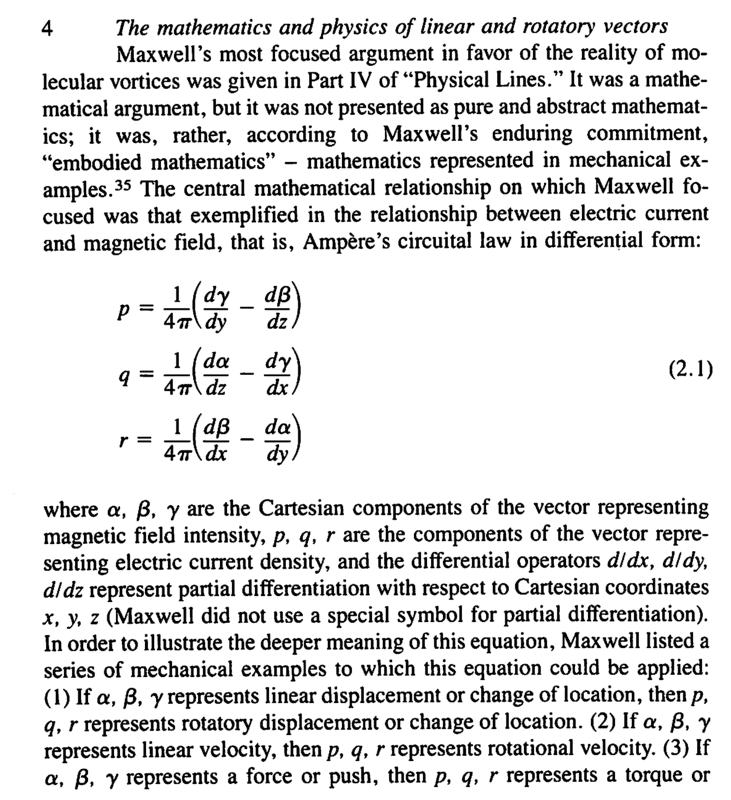
I am reading the text 'Innovations in Maxwell's Electromagnetic Theory'. on page 44 there is a discussion on Ampere's circuital law .
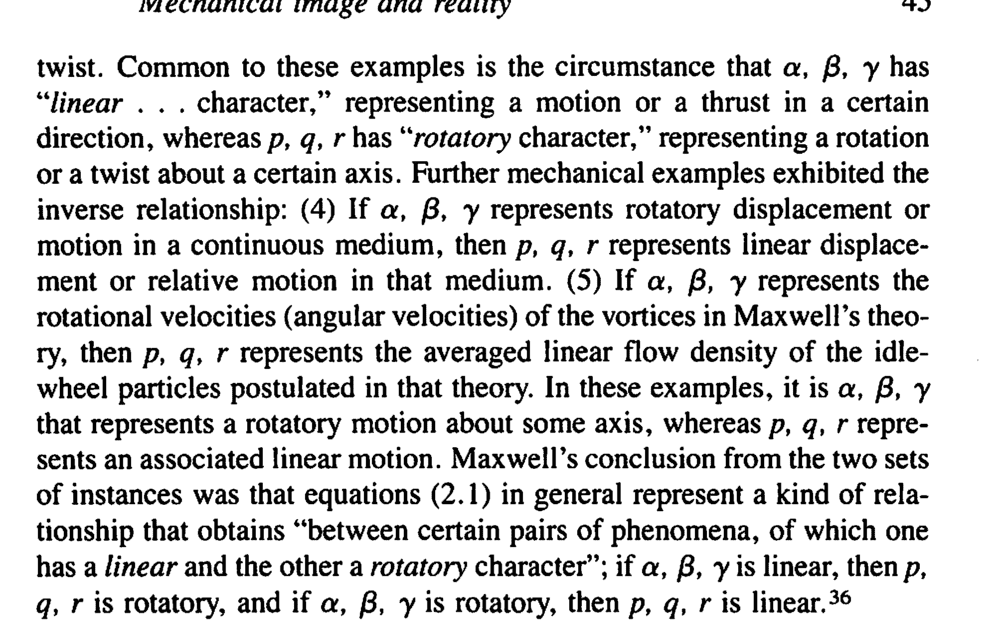
The passage is below. I don't understand the final statement. "In general represent a kind of relationship that obtains between certain pairs of phenomena , of which one has a linear and the other a rotary character. if a,b,y is linear, then p q r is rotary, and if a b y is rotary then p q r is linear."

I sort of understand why p q r would be 'rotary' since these equations are essentially the curl. But I don't really get how you would get a linear vector out if a b y are rotary - or even what it means by them being rotary.

thanks for any clarification that you can offer!
1611857127350.png

1611857201719.png
 
Physics news on Phys.org
I'm not sure. I've always had great difficulties reading old papers not using our modern vector notation. So just take my guess with a grain of salt.

I think what's meant is the difference between a polar and an axial vector, which refers to the behavior of the vectors under space reflections. Both types of vectors transform the same under rotations SO(3) but not under the rotation group including space reflections O(3).

An axial vector can be interpreted as the Hodge dual of an antisymmetric tensor, for which you need the Levi-Civita symbol which forms tensor components under SO(3) but not under O(3).

If I understand the text right, it's stated that for an polar vector field ##\vec{A}## the curl ##\vec{B}=\vec{\nabla} \times \vec{A}## is axial. Indeed under space reflections by assumption ##\vec{A} \rightarrow -\vec{A}## and by definition of a space reflection ##\vec{\nabla} \rightarrow -\vec{\nabla}##. Thus ##\vec{B} \rightarrow (-\vec{\nabla}) \times (-\vec{A}=\vec{\nabla} \times \vec{A}=\vec{B}##, i.e., ##\vec{B}## behaves indeed as an axial vector. In the same way it's clear that when ##\vec{A}## is an axial then ##\vec{B}## is a polar vector field.
 
  • Like
Likes   Reactions: Storm3371

Similar threads

  • · Replies 1 ·
Replies
1
Views
2K
  • · Replies 1 ·
Replies
1
Views
779
  • · Replies 7 ·
Replies
7
Views
2K
  • · Replies 4 ·
Replies
4
Views
5K
  • · Replies 7 ·
Replies
7
Views
3K
  • · Replies 1 ·
Replies
1
Views
50K
  • · Replies 12 ·
Replies
12
Views
4K
  • · Replies 2 ·
Replies
2
Views
2K
  • · Replies 8 ·
Replies
8
Views
2K
  • · Replies 1 ·
Replies
1
Views
2K