Physics Homework -- block pressed against a wall is sliding....

Click For Summary
SUMMARY

The discussion revolves around two physics problems involving forces and motion. The first problem requires determining the magnitude of force F needed to keep a block sliding against a wall, with a coefficient of kinetic friction of 0.260 and a weight of 49.0 N at an angle θ of 37.0°. The user successfully calculated the force for the block sliding up the wall as 76.3 N but struggled with the downward scenario. The second problem involves a penguin sliding down an incline at a constant velocity of 1.61 m/s, with a slope angle of 9.48° and the same friction coefficient. The user seeks to find the time required for the penguin to come to a halt on a horizontal ice patch.

PREREQUISITES
  • Understanding of Newton's Laws of Motion
  • Knowledge of Free-Body Diagrams (FBD)
  • Familiarity with kinetic friction concepts
  • Ability to perform vector resolution of forces
NEXT STEPS
  • Learn how to construct and analyze Free-Body Diagrams (FBD)
  • Study the application of Newton's Laws of Motion in various scenarios
  • Explore the calculations involved in kinetic friction and its effects on motion
  • Investigate the equations of motion for objects on inclined planes
USEFUL FOR

Students studying physics, particularly those focusing on mechanics, as well as educators seeking to understand common student challenges in force and motion problems.

sophia026
Messages
1
Reaction score
0
New poster has been reminded to use the Homework Help Template in the schoolwork forums and show their work
Hey! I've been trying to figure out these two problems but can't seem to get the right answer. Was wondering if someone could help me out?

1.

A block is pressed against a vertical wall by a force F, as the drawing shows.
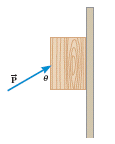
EAT_1323079535063_0_8205558975783672.gif

This force can either push the block upward at a constant velocity or allow it to slide downward at a constant velocity. The magnitude of the force is different in the two cases, while the directional angle θ is the same. Kinetic friction exists between the block and the wall, and the coefficient of kinetic friction is 0.260. The weight of the block is 49.0 N, and the directional angle for the force F is θ = 37.0°. Determine the magnitude of Fwhen the block slides (a) up the wall and (b) down the wall.

I got a) and the answer is 76.3N. Can't seem to get b) right though!

2. A penguin slides at a constant velocity of 1.61 m/s down an icy incline. The incline slopes above the horizontal at an angle of 9.48°. At the bottom of the incline, the penguin slides onto a horizontal patch of ice. The coefficient of kinetic friction between the penguin and the ice is the same for the incline as for the horizontal patch. How much time is required for the penguin to slide to a halt after entering the horizontal patch of ice?
 

Attachments

  • EAT_1323079535063_0_8205558975783672.gif
    EAT_1323079535063_0_8205558975783672.gif
    2 KB · Views: 1,303
Physics news on Phys.org
Hi @sophia026 and welcome to PF!

Homework posts should use the homework template; in addition to the problem description, this requires you to post any equations that apply to the problem, and your attempt at a solution. We will be much better able to help you if you provide this additional information.
 
sophia026 said:
Hey! I've been trying to figure out these two problems but can't seem to get the right answer. Was wondering if someone could help me out?

1.

A block is pressed against a vertical wall by a force F, as the drawing shows.
View attachment 231566
This force can either push the block upward at a constant velocity or allow it to slide downward at a constant velocity. The magnitude of the force is different in the two cases, while the directional angle θ is the same. Kinetic friction exists between the block and the wall, and the coefficient of kinetic friction is 0.260. The weight of the block is 49.0 N, and the directional angle for the force F is θ = 37.0°. Determine the magnitude of Fwhen the block slides (a) up the wall and (b) down the wall.

I got a) and the answer is 76.3N. Can't seem to get b) right though!

2. A penguin slides at a constant velocity of 1.61 m/s down an icy incline. The incline slopes above the horizontal at an angle of 9.48°. At the bottom of the incline, the penguin slides onto a horizontal patch of ice. The coefficient of kinetic friction between the penguin and the ice is the same for the incline as for the horizontal patch. How much time is required for the penguin to slide to a halt after entering the horizontal patch of ice?
Welcome to the PF. :smile:

Please show your work on the first problem, including your FBD. Also show your work on the second problem -- we cannot help you until you show us your best efforts. Thank you.
 
... and please post each unrelated question as a separate thread, with a title that gives some indication of the subject matter.
 
  • Like
Likes   Reactions: gneill and Chestermiller
For Que. 1b, I suggest you draw Free-Body Diagram for the system by taking kinetic friction in the upward direction and then apply Newton's Laws of Motion as you might have done for solving Que. 1a. It's just the matter of directions and algebra and you'll get the answer.

<< Mentor Note -- post edited to remove solution >>
 
Last edited by a moderator:

Similar threads

Replies
14
Views
3K
  • · Replies 4 ·
Replies
4
Views
3K
  • · Replies 1 ·
Replies
1
Views
3K
  • · Replies 10 ·
Replies
10
Views
2K
Replies
12
Views
2K
  • · Replies 13 ·
Replies
13
Views
6K
Replies
3
Views
3K
  • · Replies 45 ·
2
Replies
45
Views
7K
  • · Replies 16 ·
Replies
16
Views
7K
  • · Replies 5 ·
Replies
5
Views
3K