Why Do Euler-Lagrange Equations Fail for This Piecewise Smooth Function?

  • Thread starter Thread starter baby_1
  • Start date Start date
  • Tags Tags
    Function Smooth
Click For Summary
The discussion centers on the failure of the Euler-Lagrange equations for a specific piecewise smooth function, particularly when boundary conditions lead to the trivial solution y=0. Participants explore why this solution is not acceptable and how to incorporate constants in the Euler approach, especially in the context of multidisciplinary functions. One contributor suggests that the problem relates to the Calculus of Variations and highlights that the Euler-Lagrange equations can yield incorrect solutions under certain conditions. The conversation emphasizes the need to understand the underlying assumptions of the Euler-Lagrange derivation, which may not hold in this case. Ultimately, the discussion reveals the complexities and limitations of applying the Euler-Lagrange framework to certain mathematical problems.
baby_1
Messages
159
Reaction score
16
Member warned about posting without the homework template
Hello
Here is my question

Capture.110PNG.PNG

So I solved Euler DE and find
gif.gif

and when we apply the boundary condition we obtain y=0 . My teacher said that we should write it as two different function as
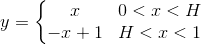
matrix%7D%20x%20%26%200%3Cx%3CH%5C%5C%20-x+1%20%26%20H%3Cx%3C1%20%5Cend%7Bmatrix%7D%5Cright.gif

where H is (1/2).He solved this equation with this way

gif.gif


So Here are my questions:
a) why don't we accept the y=0 as our desire function?
b)how can obtain (a) constant in my equation with Euler approach?because in multidisciplinary function we can't find a ?
 
Physics news on Phys.org
baby_1 said:
Hello
Here is my question
View attachment 94931
So I solved Euler DE and find
gif.gif

and when we apply the boundary condition we obtain y=0 . My teacher said that we should write it as two different function as
matrix%7D%20x%20%26%200%3Cx%3CH%5C%5C%20-x+1%20%26%20H%3Cx%3C1%20%5Cend%7Bmatrix%7D%5Cright.gif

where H is (1/2).He solved this equation with this way
gif.gif


So Here are my questions:
a) why don't we accept the y=0 as our desire function?
b)how can obtain (a) constant in my equation with Euler approach?because in multidisciplinary function we can't find a ?

What is a "multidisciplinary function"? I have never heard that term.

Anyway, is the subject matter one of Calculus of Variations, for ##J = \int_0^1 (1-y'^2)^2 dx##? If so, ##F_{y'} = -4 y'(1-y'^2) = -4 y' + 4 y'^3##, so the Euler equation gives ##F_{y} = 0 = (d/dx) F_{y'}##, or ##(3 y'^2- 1) y'' = 0##, so either ##y'' = 0## or ##y' = \pm 1/ \sqrt{3}##.

On the other hand, we can change variables to ##y'= z##, to get the problem
\min \:K(z) = \int_0^1 (1-z^2)^2 \, dx
with no specified boundary conditions on ##z(0), z(1)##. Without using the Euler-Lagrange equation at all we see that we can make ##K(z) = 0## by taking ##z(t)^2 = 1## for all ##t##, and that gives ##x'(t) = \pm 1##, as your instructor said. Certainly that is an optimal solution, since ##K(z) \geq 0## for all PWS functions ##z(t)##, and ##K(z) = 0## is attained by the solution where ##z(t)^2 = 1 \; \forall \, t##.

The interesting thing about this problem is that the so-called necessary conditions of Euler and Lagrange give the wrong solution. In other words, the Euler-Lagrange equations fail! I suspect that the reason lies in some violation of the hypotheses that underlie the Euler-Lagrange derivation (and which are normally not stated or are ignored when solving problems).
 
Last edited:
  • Like
Likes baby_1
Question: A clock's minute hand has length 4 and its hour hand has length 3. What is the distance between the tips at the moment when it is increasing most rapidly?(Putnam Exam Question) Answer: Making assumption that both the hands moves at constant angular velocities, the answer is ## \sqrt{7} .## But don't you think this assumption is somewhat doubtful and wrong?

Similar threads

  • · Replies 18 ·
Replies
18
Views
3K
  • · Replies 6 ·
Replies
6
Views
2K
  • · Replies 2 ·
Replies
2
Views
2K
Replies
17
Views
2K
Replies
2
Views
1K
  • · Replies 10 ·
Replies
10
Views
2K
  • · Replies 11 ·
Replies
11
Views
2K
Replies
6
Views
2K
  • · Replies 3 ·
Replies
3
Views
2K
  • · Replies 5 ·
Replies
5
Views
2K
