Plane wave angle of incidence calculation

Click For Summary
SUMMARY

The discussion centers on calculating the angle of incidence for a plane wave using Snell's law, represented by the equation n1*sin(theta1)=n2*sin(theta2). The user has identified n1 as 1 and n2 as 1.5, with a propagation vector for the incident wave calculated as ki=4 um. The user attempts to derive the angle of incidence, suggesting it to be 45 degrees based on the propagation vector, leading to a calculated transmitted angle of 28 degrees. However, confusion arises regarding the orientation of the magnetic field and the possibility of a flawed problem statement.

PREREQUISITES
  • Understanding of Snell's law in optics
  • Familiarity with wave propagation vectors
  • Knowledge of transverse electromagnetic waves
  • Basic trigonometry for angle calculations
NEXT STEPS
  • Study the derivation and applications of Snell's law in optics
  • Learn about the properties of transverse electromagnetic waves
  • Explore vector algebra in the context of wave propagation
  • Investigate common pitfalls in optics problem statements
USEFUL FOR

Students and professionals in physics, particularly those focusing on optics and wave mechanics, as well as anyone involved in solving complex wave propagation problems.

quantumguy45
Good afternoon! Please help me figure out the mathematics of this simple plane wave question!

1. Homework Statement
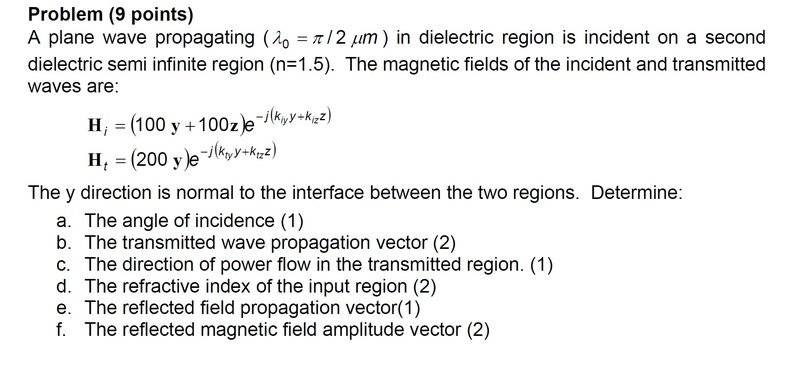
q1.jpg


2. Homework Equations

n1*sin(theta1)=n2*sin(theta2)

The Attempt at a Solution


I need help calculating the angle of incidence.
I found the propagation vector for incidence: ki=2*pi / lambda0 = 4 um
n1= 1 since we are given lambda0
I have n2 = 1.5
I know Snell's law is n1*sin(theta1)=n2*sin(theta2)
What vital information am I missing to solve this? I feel like its staring me in the face yet I'm unable to grasp it.

Thanks so much!
 
Last edited by a moderator:
Physics news on Phys.org
I'm assuming it is a transverse electromagnetic wave with some kind of linear polarization. I'm puzzled as to how the transmitted wave could have its magnetic field pointing only in the y direction perpendicular to the interface. That should mean that the transmitted wave must be propagating parallel to the interface. I'm stuck. Perhaps someone else can give an input. It doesn't look like a simple problem. I question whether the problem may have been misstated, but I could be missing something.
 
Charles Link said:
I'm assuming it is a transverse electromagnetic wave with some kind of linear polarization. I'm puzzled as to how the transmitted wave could have its magnetic field pointing only in the y direction perpendicular to the interface. That should mean that the transmitted wave must be propagating parallel to the interface. I'm stuck. Perhaps someone else can give an input. It doesn't look like a simple problem. I question whether the problem may have been misstated, but I could be missing something.

I have a question, since I found k_i= 4um, can I just say the propagation vector for the incident wave is (4y+4z) therefore the angle of incidence would be arctan(4/4) = 45 degrees? Using this then:
1*sin 45=1.5 sin*(theta_t)
theta_t= 28 degrees?
 
quantumguy45 said:
I have a question, since I found k_i= 4um, can I just say the propagation vector for the incident wave is (4y+4z) therefore the angle of incidence would be arctan(4/4) = 45 degrees? Using this then:
1*sin 45=1.5 sin*(theta_t)
theta_t= 28 degrees?
I don't see a solution. Usually the z direction is taken as perpendicular to the interface in optics problems. Perhaps it is a typo, or perhaps I am missing the obvious, but I don't see a solution. @vanhees71 Could you take a look at this please. Am I missing something? I believe it is a flawed problem, but perhaps you can see a solution.
 
Last edited:
Can I use tanΘi= n2/n1? I'm probably more lost than you are so I'm just looking for a spark to figure this out!
 
quantumguy45 said:
Can I use tanΘi= n2/n1? I'm probably more lost than you are so I'm just looking for a spark to figure this out!
See my edited post above. I've requested another fellow who has considerable expertise to take a look at it. I'm stuck.
 
  • Like
Likes   Reactions: quantumguy45
Just an additional note: Usually problems like this specify the incident and/or transmitted ## \vec{k} ## vector, and they might ask you to solve for the reflected ## \vec{k} ##. They take a little bit of work, but they are interesting problems in vector algebra.
 
  • Like
Likes   Reactions: quantumguy45

Similar threads

  • · Replies 1 ·
Replies
1
Views
2K
  • · Replies 8 ·
Replies
8
Views
2K
  • · Replies 6 ·
Replies
6
Views
5K
  • · Replies 3 ·
Replies
3
Views
11K
  • · Replies 5 ·
Replies
5
Views
2K
  • · Replies 1 ·
Replies
1
Views
2K
Replies
6
Views
2K
Replies
6
Views
2K
Replies
4
Views
2K
  • · Replies 5 ·
Replies
5
Views
9K