jojosg
- 37
- 5
- Homework Statement
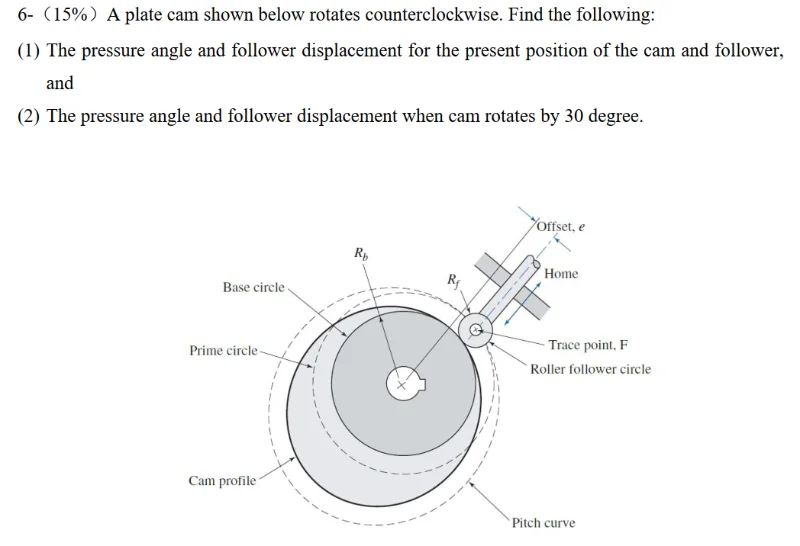
- A plate cam shown below rotates counterclockwise. Find the following. (1) The pressure angle and follower displacement for the present position of the cam and follower, and
(2)The pressure angle and follower displacement when cam rotates by 30 degree.
Am I doing this correctly?
Given variables:
##R_b## = base circle radius
##R_f## = roller radius
##e## = offset (positive as shown in figure)
##\Delta R## = follower displacement from home position
##\frac{\nu}{\omega_{\rm{cam}}} = \frac{ds}{d\theta}## = slope of displacement diagram (length/rad)
(1) Present position (##\theta = 0##, home)
At home: ##\Delta R = 0##, ##\frac{ds}{d\theta} = 0##.
$$
\alpha = \tan^{-1} \left[ \frac{0 \cdot (R_f + R_b + 0)}{e^2 + (R_f + R_b)^2 - e \cdot 0} \right] = \tan^{-1}(0) = 0
$$
$$
\delta = \alpha \;-\; \tan^{-1}\left( \frac{e}{R_f + R_b + \Delta R} \right)
= 0 \;-\; \tan^{-1}\left( \frac{e}{R_f + R_b} \right)
$$
Follower displacement: ##s = 0##
Pressure angle: ##\displaystyle \delta = -\tan^{-1}\left( \frac{e}{R_f + R_b} \right)##
---
(2) After ##30^\circ## cam rotation (CCW)
Let ##\Delta R## = follower rise at ##30^\circ## (from displacement diagram)
Let ##m = \frac{ds}{d\theta}## = slope of displacement diagram at ##30^\circ## (length/rad)
$$
\alpha = \tan^{-1} \left[ \frac{m \left( R_f + R_b + \Delta R \right)}{e^2 + \left( R_f + R_b + \Delta R \right)^2 - e \, m} \right]
$$
$$
\delta = \alpha \;-\; \tan^{-1}\left( \frac{e}{R_f + R_b + \Delta R} \right)
$$
Follower displacement: ##s = \Delta R##
Pressure angle:
$$
\delta = \tan^{-1} \left[ \frac{m (R_f + R_b + \Delta R)}{e^2 + (R_f + R_b + \Delta R)^2 - e m} \right] - \tan^{-1}\left( \frac{e}{R_f + R_b + \Delta R} \right)
$$
Given variables:
##R_b## = base circle radius
##R_f## = roller radius
##e## = offset (positive as shown in figure)
##\Delta R## = follower displacement from home position
##\frac{\nu}{\omega_{\rm{cam}}} = \frac{ds}{d\theta}## = slope of displacement diagram (length/rad)
(1) Present position (##\theta = 0##, home)
At home: ##\Delta R = 0##, ##\frac{ds}{d\theta} = 0##.
$$
\alpha = \tan^{-1} \left[ \frac{0 \cdot (R_f + R_b + 0)}{e^2 + (R_f + R_b)^2 - e \cdot 0} \right] = \tan^{-1}(0) = 0
$$
$$
\delta = \alpha \;-\; \tan^{-1}\left( \frac{e}{R_f + R_b + \Delta R} \right)
= 0 \;-\; \tan^{-1}\left( \frac{e}{R_f + R_b} \right)
$$
Follower displacement: ##s = 0##
Pressure angle: ##\displaystyle \delta = -\tan^{-1}\left( \frac{e}{R_f + R_b} \right)##
---
(2) After ##30^\circ## cam rotation (CCW)
Let ##\Delta R## = follower rise at ##30^\circ## (from displacement diagram)
Let ##m = \frac{ds}{d\theta}## = slope of displacement diagram at ##30^\circ## (length/rad)
$$
\alpha = \tan^{-1} \left[ \frac{m \left( R_f + R_b + \Delta R \right)}{e^2 + \left( R_f + R_b + \Delta R \right)^2 - e \, m} \right]
$$
$$
\delta = \alpha \;-\; \tan^{-1}\left( \frac{e}{R_f + R_b + \Delta R} \right)
$$
Follower displacement: ##s = \Delta R##
Pressure angle:
$$
\delta = \tan^{-1} \left[ \frac{m (R_f + R_b + \Delta R)}{e^2 + (R_f + R_b + \Delta R)^2 - e m} \right] - \tan^{-1}\left( \frac{e}{R_f + R_b + \Delta R} \right)
$$
Last edited by a moderator: