Please review a rate of decay problem for me

  • Thread starter Thread starter Permanence
  • Start date Start date
  • Tags Tags
    Decay Rate Review
Click For Summary

Homework Help Overview

The discussion revolves around a rate of decay problem involving Cobalt-60, specifically its half-life of 5.24 years and the time required for a 100 mg sample to decay to 1 mg. Participants are examining the mathematical formulation and assumptions related to the decay constant.

Discussion Character

  • Conceptual clarification, Mathematical reasoning, Problem interpretation

Approaches and Questions Raised

  • The original poster attempts to clarify the decay constant, k, and its sign in the context of the decay equation. Some participants question the TA's corrections regarding the signs in the equations and the implications for the time calculation. Others suggest alternative methods for solving the problem, such as using the definition of half-life directly.

Discussion Status

Participants are actively engaging with the original poster's concerns about the TA's feedback, with some expressing agreement with the poster's reasoning. There is a recognition of different approaches to the problem, and while some errors are noted, there is no explicit consensus on a single correct method.

Contextual Notes

Participants note that calculators were not available during the quiz, which may have influenced the original poster's approach and understanding of the problem.

Permanence
Messages
53
Reaction score
2
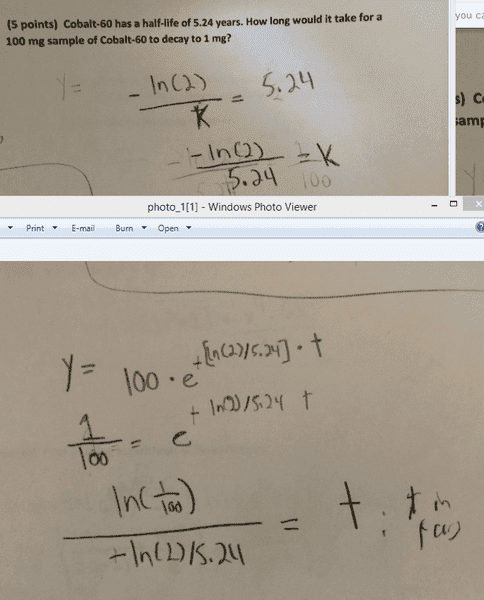
Thank you for taking the time to read my thread. I do not agree with the TA's correction of my quiz and would appreciate if someone could give it a look before I approach him about it.

Homework Statement


Cobalt-60 has a half-life of 5.24 years. How long would it take for a 100 mg sample of Cobalt-60 to decay to 1 mg?

Homework Equations


y = sample*e^(-k*t)
I assumed that k was negative because it was a decay problem. My TA did not agree. I also assumed that the answer must be positive, and it appears that ln(1/100) is indeed negative. We did not have calculators for this quiz.

The Attempt at a Solution


k = -ln(2) / 5.24

y = 100 * e^-[(ln(2)/5.24)*t]
t = ln(1/100) / [ln(2)/5.24) ; where t is expressed in years
3525291ec72b23583c072534123240cb.png
 
Physics news on Phys.org
If the red lines converting minus signs to plus signs are the TA's correction, sack the TA. Since ln(1/100) is negative, a positive denominator will give a negative number of years. (And I agree with your answer.)
 
Yep. Thank you for your feedback. I'll email the TA tonight.
 
Permanence said:
Thank you for taking the time to read my thread. I do not agree with the TA's correction of my quiz and would appreciate if someone could give it a look before I approach him about it.

Homework Statement


Cobalt-60 has a half-life of 5.24 years. How long would it take for a 100 mg sample of Cobalt-60 to decay to 1 mg?


Homework Equations


y = sample*e^(-k*t)
I assumed that k was negative because it was a decay problem. My TA did not agree. I also assumed that the answer must be positive, and it appears that ln(1/100) is indeed negative. We did not have calculators for this quiz.

The Attempt at a Solution


k = -ln(2) / 5.24

y = 100 * e^-[(ln(2)/5.24)*t]
t = ln(1/100) / [ln(2)/5.24) ; where t is expressed in years

3525291ec72b23583c072534123240cb.png

You and the TA both made errors. If you write ##y(t) = c e^{-kt}## then ##k > 0## because you want y(t) to be a decreasing function. If you write ##y(t) = c e^{kt}## then you need ##k < 0## in order to have a decreasing function y(t).

You wrote it correctly in the hand-written work; you just made a mistake in your typed description above. However, the TA made something that is correct into something that is incorrect.
 
I would have just started from 1=100*(1/2)^(t/5.24), using the direct definition of half-life and then let the logs sort themselves out. There's really no need to figure out k. Not to imply there's anything wrong with doing it the other way.
 
Last edited:

Similar threads

  • · Replies 3 ·
Replies
3
Views
2K
  • · Replies 2 ·
Replies
2
Views
4K
  • · Replies 2 ·
Replies
2
Views
2K
Replies
2
Views
2K
  • · Replies 2 ·
Replies
2
Views
1K
  • · Replies 8 ·
Replies
8
Views
2K
  • · Replies 2 ·
Replies
2
Views
2K
Replies
4
Views
2K
  • · Replies 9 ·
Replies
9
Views
4K
  • · Replies 4 ·
Replies
4
Views
1K