Points on a rigid body always have the same angular speed?

Click For Summary

Discussion Overview

The discussion revolves around the concept of angular velocity in the context of rigid body motion, specifically examining whether points on a rigid body have the same angular speed when rotating about different points. The scope includes theoretical considerations and mathematical reasoning related to angular velocity.

Discussion Character

  • Exploratory
  • Technical explanation
  • Debate/contested
  • Mathematical reasoning

Main Points Raised

  • One participant notes that all points on a circle rotating about a point X on its circumference have the same angular velocity of 2 rad/s when considered from the center O of the circle.
  • Another participant suggests that this might seem counterintuitive, as angular velocity does not behave like linear velocity and must consider the distance from the point of rotation.
  • It is stated that angular velocity is a characteristic of the rigid body's motion, implying that it does not make sense to discuss the angular velocity of an individual point of the rigid body.
  • A participant references a definition of angular velocity for points relative to other points, but this is contested by another participant who argues that such a definition does not adequately address the angular velocity of a rigid body.
  • There is a claim that the general definition for a point differs from the definition for a rigid body, indicating a potential misunderstanding or misapplication of concepts.

Areas of Agreement / Disagreement

Participants express disagreement regarding the applicability of angular velocity definitions to individual points versus rigid bodies. The discussion remains unresolved with competing views on the nature of angular velocity in this context.

Contextual Notes

Participants highlight the importance of considering the point of rotation and the implications this has on angular velocity calculations. There are unresolved aspects regarding the definitions and interpretations of angular velocity for points and rigid bodies.

Happiness
Messages
686
Reaction score
30
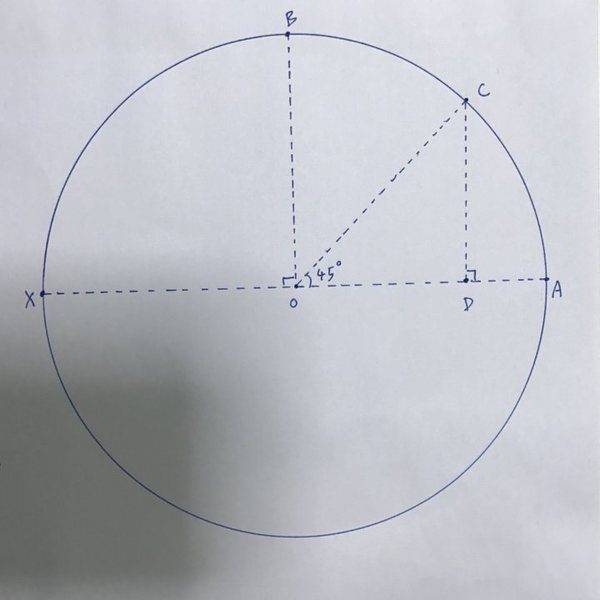
Consider a circle rotating about a point X on its circumference at ##\omega = 2## rad/s. That means all points on and in the circle rotate at the same ##\omega = 2## rad/s.
IMG_5346.JPG


What are the angular velocities of various different points, say points A, B and C, with respect to the centre O of the circle? At first thought, different points with the same ##\omega## with respect to point X should probably have different ##\omega##'s (from one another) with respect to a different point O, because if those points are rotating in sync about point X, they may not necessarily be rotating in sync about point O. But to my surprise, they do have the same ##\omega## and worse, their ##\omega## is still ##2## rad/s!

Why so? Any mathematical proof or intuitive explanations?

Some notes on my calculations:
To calculate the ##\omega## of a point A relative to point O, I take the velocity of A relative to that of O divided by the distance between A and O.
I also calculated the ##\omega##'s of points A, B and C relative to point D. They are equal to ##2## rad/s too!
 
Last edited:
Physics news on Phys.org
Happiness said:
I also calculated the w's of points A, B and C relative to point D. They are equal to 2 rad/s too!
And that isn't a coincidence.

I guess it may seem counterintuitive because anglular velocity doesn't behave the same as linear velocity. Distance from point of rotation must be taken into account in angular, as you noted.
 
Angular velocity is a characteristic of rigid body's motion. It does not make sense to speak about angular velocity of an individual point of the rigid body
 
A.T. said:
ou can define the angular velocity of any point relative to some other point:
No you cannot. Because a trajectory of the point can be essentially spatial curve. By the same reason your definition does almost nothing with angular velocity of the rigid body.

UPD
 
zwierz said:
... your definition does almost nothing with angular velocity of the rigid body.
Yes, this general definition for a point is different from the definition for a rigid body.
 

Similar threads

  • · Replies 30 ·
2
Replies
30
Views
5K
  • · Replies 3 ·
Replies
3
Views
1K
  • · Replies 8 ·
Replies
8
Views
2K
  • · Replies 13 ·
Replies
13
Views
2K
  • · Replies 7 ·
Replies
7
Views
3K
  • · Replies 8 ·
Replies
8
Views
2K
  • · Replies 42 ·
2
Replies
42
Views
7K
Replies
7
Views
3K
  • · Replies 4 ·
Replies
4
Views
2K
  • · Replies 3 ·
Replies
3
Views
2K