Discussion Overview
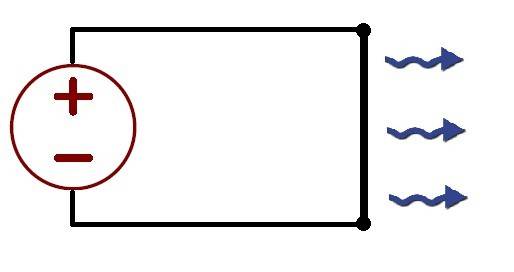
The discussion revolves around the nature of electromagnetic (EM) waves, particularly focusing on the effects of varying voltage sources on radiation emission, the concept of pulses versus continuous waves, and the implications of Fourier analysis in understanding frequency content. Participants explore both classical and quantum perspectives, although the emphasis remains on classical electromagnetism.
Discussion Character
- Exploratory
- Technical explanation
- Conceptual clarification
- Debate/contested
- Mathematical reasoning
Main Points Raised
- Some participants suggest that a voltage source with constant acceleration would emit a singular pulse rather than a continuous EM wave, raising questions about the nature of this pulse and its frequency content.
- Others argue that a pulse consists of a combination of multiple frequencies, leading to confusion about the relationship between pulse duration and frequency emission.
- A participant proposes a specific voltage function and questions whether a half-second pulse would generate a wide band of frequencies, while a full second would yield radiation at a single frequency.
- Some participants clarify that the characteristics of the emitted EM wave depend on the frequency of the generator and the nature of the antenna used.
- There is a discussion about the implications of Fourier analysis, with some noting that real signals are inherently pulses, and the longer the pulse, the closer it resembles a pure sine wave.
- Participants discuss the distinction between electric and magnetic fields in relation to antenna polarity, with some emphasizing the importance of understanding both time and frequency domain descriptions of signals.
- Questions arise regarding the relevance of quantum concepts like photons in the context of classical EM wave discussions, with some asserting that classical explanations suffice.
- There is an exploration of how different signals might interact with materials, particularly regarding low pass filtering and the potential distortion of signals after passing through substances.
Areas of Agreement / Disagreement
Participants express a range of views on the relationship between pulse duration and frequency content, with no clear consensus on how these concepts interact. Some agree on the classical nature of the discussion, while others introduce differing perspectives on the implications of Fourier analysis and signal behavior.
Contextual Notes
Participants note that the discussion is heavily influenced by mathematical principles, particularly Fourier analysis, and that assumptions about signal behavior may vary based on the definitions and contexts used. The distinction between ideal and real signals is also highlighted, indicating potential limitations in the discussion.