Polarization of light using Mueller matrix

4 replies · 2K views · last reply
Nur Ziadah
Messages
34
Reaction score
3
Hi everyone
First of all, I am a computer science student and I have a question regarding the polarization of light as stated in an article entitled "Multi-stage quantum secure communication using polarization hopping" by Rifai et al.,2015.
Given the Mueller matrix:
Equation text: the Mueller matrix of a rotating half wave plate, M_HWP(θ), a 4x4 matrix with rows [1 0 0 0], [0 cos(4θ) sin(4θ) 0], [0 sin(4θ) -cos(4θ) 0], [0 0 0 -1].

The input of light state is:
Equation: S_in equals a column vector with entries 1, 1, 0, 0, representing a 0 degree polarized input state by Stokes parameters.

And lastly, the operation to produce the output of light after it go through a half wave plate:
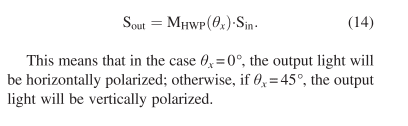
Equation 14: S_out = M_HWP(θx) · S_in, followed by the statement that for θx = 0° the output is horizontally polarized and for θx = 45° it is vertically polarized.

After I do the calculation, the S_out for the θx=0° is [1 1 0 0] meaning that the light is horizontally polarized. However, when the θx=45°, I didn't get the vertical light polarization [1 -1 0 0] as stated in wikipedia:
Two column vectors with four entries each: [1, 1, 0, 0] labelled linearly polarized (horizontal), and [1, -1, 0, 0] labelled linearly polarized (vertical).

This is the result of my calculation using Python programming language:
Python console output listing S_in as a column vector [1, 1, 0, 0], followed by the Stokes vectors for horizontal polarized [1, 1, 0, 0] and vertically polarized [1, -1, -1, 0].

It seems that my vertical polarization of light is wrong. I hope that anyone may help me to clarify this problem.
Thank you so much & regards.
 
Attachments
  • Equation text: the Mueller matrix of a rotating half wave plate, M_HWP(θ), a 4x4 matrix with rows [1 0 0 0], [0 cos(4θ) sin(4θ) 0], [0 sin(4θ) -cos(4θ) 0], [0 0 0 -1].
    upload_2018-7-17_23-6-47.png
    4.3 KB · Views: 952
  • Equation: S_in equals a column vector with entries 1, 1, 0, 0, representing a 0 degree polarized input state by Stokes parameters.
    upload_2018-7-17_23-8-46.png
    3 KB · Views: 618
  • Equation 14: S_out = M_HWP(θx) · S_in, followed by the statement that for θx = 0° the output is horizontally polarized and for θx = 45° it is vertically polarized.
    upload_2018-7-17_23-10-37.png
    4.8 KB · Views: 588
  • Printed program output listing S_in as a column vector [1, 1, 0, 0], then horizontally polarized S_out [1, 1, 0, 0] and vertically polarized S_out [1, -1, -1, 0] as column vectors.
    upload_2018-7-17_23-19-46.png
    1.2 KB · Views: 508
  • Python console output listing S_in as a column vector [1, 1, 0, 0], followed by the Stokes vectors for horizontal polarized [1, 1, 0, 0] and vertically polarized [1, -1, -1, 0].
    upload_2018-7-17_23-24-43.png
    1.2 KB · Views: 621
  • Two column vectors with four entries each: [1, 1, 0, 0] labelled linearly polarized (horizontal), and [1, -1, 0, 0] labelled linearly polarized (vertical).
    upload_2018-7-17_23-27-30.png
    2.3 KB · Views: 651
Nur Ziadah said:
Hi everyone
First of all, I am a computer science student and I have a question regarding the polarization of light as stated in an article entitled "Multi-stage quantum secure communication using polarization hopping" by Rifai et al.,2015.

I did a quick read of the paper, and I'm a little confused by the parameter 'θx'. How does θx relate to θA and/or θB (referring to Figure 3)?
 
Andy Resnick said:
I did a quick read of the paper, and I'm a little confused by the parameter 'θx'. How does θx relate to θA and/or θB (referring to Figure 3)?
θA is the rotational of half wave plate at Alice side while θB is rotational at Bob and they are unitary transformation.
 
Nur Ziadah said:
θA is the rotational of half wave plate at Alice side while θB is rotational at Bob and they are unitary transformation.

Ok, I read through the paper more carefully and was able to reproduce most of their equations. I did indeed get vertical polarization for θx=45°. I'm not sure why your Python script returned a different result. Try it by hand, leaving θx as a free parameter, then after you calculate Sout, put in different values for θx.
 
Andy Resnick said:
Ok, I read through the paper more carefully and was able to reproduce most of their equations. I did indeed get vertical polarization for θx=45°. I'm not sure why your Python script returned a different result. Try it by hand, leaving θx as a free parameter, then after you calculate Sout, put in different values for θx.

Finally I got the true result. Something mistakes happened in my Python codes. Anyway, thank you for your explanation.