Poloidal current in toroidal solenoid

Click For Summary
SUMMARY

The discussion focuses on defining the current density for a poloidal current in a toroidal solenoid using Mathematica. The participant outlines the geometric definition of a torus through conical and spherical rings and presents the mathematical expression for the poloidal current density. The inquiry also addresses the smoothness of the torus and its homeomorphism to the standard torus, alongside a request for expressing current density in spherical coordinates for a standard toroidal solenoid.

PREREQUISITES
  • Understanding of toroidal geometry and its mathematical representation.
  • Familiarity with current density equations in electromagnetism.
  • Knowledge of Mathematica for visualizing geometric shapes.
  • Basic concepts of topology, particularly homeomorphism.
NEXT STEPS
  • Research the mathematical properties of toroidal shapes in electromagnetism.
  • Learn how to express current density in spherical coordinates for toroidal solenoids.
  • Explore the multipole expansion of electromagnetic fields in toroidal geometries.
  • Study the implications of smoothness and homeomorphism in physical models.
USEFUL FOR

Physicists, electrical engineers, and students studying electromagnetism, particularly those interested in toroidal solenoids and current density calculations.

Mr. Rho
Messages
14
Reaction score
1
Hi, I'm trying to figure out how the current density for a poloidal current in toroidal solenoid is written. I found you may define a torus by an upper conical ring ##(a<r<b,\theta=\theta_1,\phi)##, a lower conical ring ##(a<r<b,\theta=\theta_2,\phi)##, an inner spherical ring ##(r=a,\theta_{1}<\theta<\theta_{2},\phi)## and an outter spherical ring ##(r=b,\theta_{1}<\theta<\theta_{2},\phi)##. I used Mathematica to illustrate the torus generated with this definition:
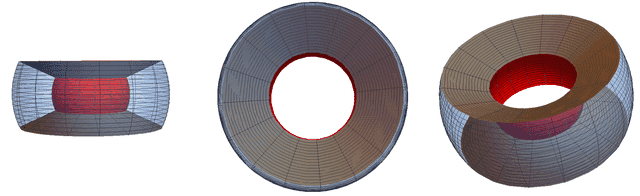
Untitled.png

So, the poloidal current density may be weitten:
\mathbf{J}(\mathbf{r})=\frac{NI}{2\pi r\sin\theta}\lbrace\frac{\hat{r}}{r}[\delta(\theta-\theta_{1})-\delta(\theta-\theta_{2})][\Theta(r-a)-\Theta(r-b)]+\hat{\theta}[\delta(r-b)-\delta(r-a)][\Theta(\theta-\theta_{1})-\Theta(\theta-\theta_{2})]\rbrace
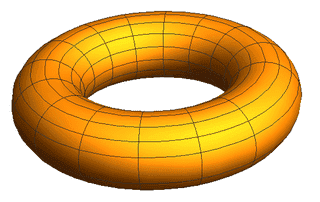
My question is: is that definition of a torus correct? my problem here is that this torus is not smooth, so I don't know if it is homeomorphic to the standard torus (I don't know much about Topology). Also I would like to know if there is a possible way to write a current density in spherical coordinates for a poloidal current in a standard toroidal solenoid:

Untitled.png

Thank you for your answers (:
 
Last edited:
Physics news on Phys.org
Mr. Rho said:
my problem here is that this torus is not smooth, so I don't know if it is homeomorphic to the standard torus (I don't know much about Topology).
It is, but I don't see how this could be relevant in a physics problem.
Mr. Rho said:
Also I would like to know if there is a possible way to write a current density in spherical coordinates for a poloidal current in a standard toroidal solenoid:
Sure, but the equations could get messy.
 
mfb said:
It is, but I don't see how this could be relevant in a physics problem.
Sure, but the equations could get messy.

Thank you, I'm studying the multipole expansion of EM fields for such toroidal solenoid but I want to feel confortable with the current density before start to calculate things...
 

Similar threads

  • · Replies 5 ·
Replies
5
Views
825
  • · Replies 2 ·
Replies
2
Views
2K
  • · Replies 5 ·
Replies
5
Views
2K
  • · Replies 32 ·
2
Replies
32
Views
2K
  • · Replies 5 ·
Replies
5
Views
2K
  • · Replies 7 ·
Replies
7
Views
4K
Replies
8
Views
1K
  • · Replies 4 ·
Replies
4
Views
4K
  • · Replies 1 ·
Replies
1
Views
1K
  • · Replies 2 ·
Replies
2
Views
2K