Discussion Overview
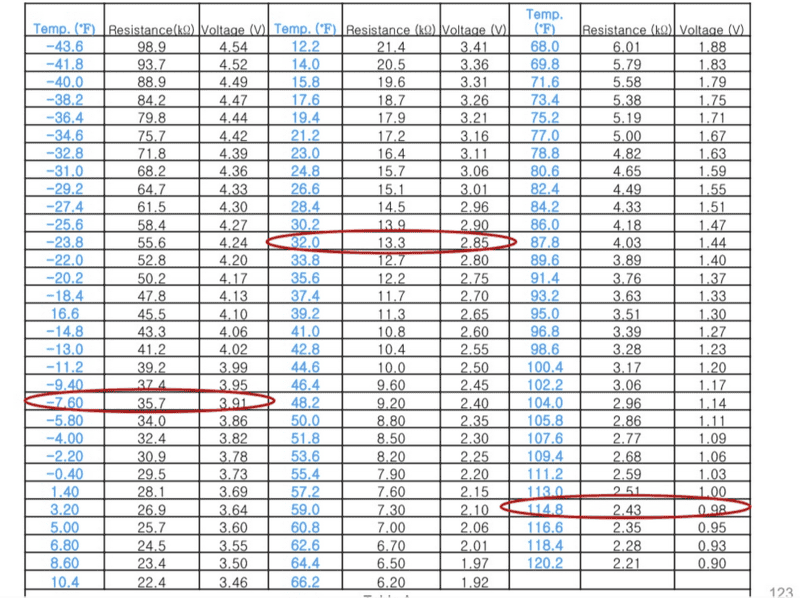
The discussion revolves around the possibility of modifying the resistance curve of a thermistor in a refrigerator to achieve more accurate temperature readings. Participants explore various methods to adjust the thermistor's response, including the use of resistors in series or parallel, and discuss the implications of these adjustments on the system's performance.
Discussion Character
- Exploratory
- Technical explanation
- Debate/contested
- Mathematical reasoning
Main Points Raised
- One participant describes the current issue with a Samsung fridge maintaining a temperature higher than set, suggesting that the main board might be functioning correctly but may require adjustments to the thermistor resistance.
- Another participant proposes creating a correction chart to offset the temperature readings, mentioning the importance of knowing whether the thermistor is NTC or PTC and the configuration of the circuit.
- Some participants discuss the use of a series resistor to improve linearity of the thermistor response, while others express skepticism about how a series resistor could achieve this, suggesting that a parallel resistor might be more effective.
- A participant shares specific details about a Tewa thermistor, including its resistance at a given temperature and the calculations for achieving linearity through a series resistor, noting the maximum deviation from linearity and sensitivity.
- There are discussions about the Steinhart-Hart equation as a model for NTC thermistors, with some participants suggesting that simpler polynomial expansions could also be effective for certain applications.
- Concerns are raised about the potential downsides of modifying the thermistor resistance, including the need to check for issues like cracked solder joints that could affect circuit resistance.
- One participant reflects on the variability of temperature within their own refrigerator, questioning the necessity of precise temperature readings and the practical implications of such adjustments.
Areas of Agreement / Disagreement
Participants express a variety of viewpoints on the best approach to modifying the thermistor resistance, with no clear consensus on the effectiveness of series versus parallel resistors or the overall necessity of achieving precise temperature readings.
Contextual Notes
Participants mention various assumptions regarding the configuration of the thermistor circuit and the characteristics of the thermistor itself, which may influence the effectiveness of proposed solutions. There are also unresolved questions about the impact of modifications on the overall system performance.