Possible to prove difference between Scissor Lift vs. Straight Lift?

  • Thread starter Thread starter Grant_
  • Start date Start date
  • Tags Tags
    Difference Lift
Click For Summary

Discussion Overview

The discussion revolves around the mechanical analysis of scissor lifts compared to straight lifts, focusing on the forces involved in their operation and the implications of their design. Participants explore mathematical modeling, force distribution, and practical applications of each lift type.

Discussion Character

  • Technical explanation
  • Mathematical reasoning
  • Debate/contested

Main Points Raised

  • One participant proposes a model for scissor lifts, suggesting that the force applied to the center by the screw is calculated as (payload + top arms)/tanθ, with a specific payload value leading to an average force of 1013 N.
  • Another participant questions the representation of the screw in the model, seeking clarification on its geometric role within the quadrilateral structure of the scissor lift.
  • A participant suggests that the load is shared between two arms, proposing an alternative calculation of load distribution as load ÷ (2tanθ).
  • There is a discussion on the advantages of scissor lifts, particularly their ability to apply loads sideways and to lift from near floor level, contrasting this with the design constraints of straight lifts.

Areas of Agreement / Disagreement

Participants express differing views on the mechanics of scissor lifts versus straight lifts, particularly regarding force calculations and design advantages. No consensus is reached on the optimal approach or definitive conclusions about the efficiency of each lift type.

Contextual Notes

The discussion includes assumptions about load distribution and the geometry of the lifts, which may not be universally applicable. The mathematical steps and definitions used in the models are not fully resolved.

Grant_
Messages
12
Reaction score
0
I've tried to come up with a simple model for scissor lifts
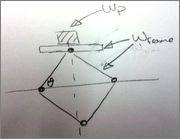
IMG_20120203_182339.jpg


and came to the conclusion that the force applied to the centre, by the screw must be the (payload + top arms)/tanθ

I set payload + top arms = 981 N

I then found the average value of the function by integrating from 15 to 90° and then dividing by pi/2-pi/12, and received an answer of 1013 N.

A regular lift would have an average value of 981 N - top arms. It seems like using a scissor lift requires more effort, is the only advance that you can apply a load sideways?

I'd appreciate any help.
Thanks
 
Last edited:
Physics news on Phys.org
Grant_ said:
and came to the conclusion that the force applied to the centre, by the screw must be the (payload + top arms)/tanθ
The screw being represented by the horiz diagonal of your quadrilateral here?
 
NascentOxygen said:
The screw being represented by the horiz diagonal of your quadrilateral here?

Yes sorry, the screw is the diagonal line that intersect the quadrilateral (scissor part).
 
Grant_ said:
and came to the conclusion that the force applied to the centre, by the screw must be the (payload + top arms)/tanθ
There are two arms sharing the weight, so I think this will be load ÷ (2tanθ)

It seems like using a scissor lift requires more effort, is the only advance that you can apply a load sideways?
Good question! :smile:

If you use a basic screw, then with the scissor lift the ends of the screw can be allowed to extend out through the corners of the frame, allowing you to lift something from near floor level. Whereas, if you upend the screw and make it be the lift, then it will have to be able to extend through the middle of the load, or be able to retract into a hole in the ground, or comprise multiple telescoping sections, or something, to allow you to lift a load from near floor level. That's how it seems to me.
 

Similar threads

  • · Replies 10 ·
Replies
10
Views
5K
  • · Replies 48 ·
2
Replies
48
Views
12K
  • · Replies 1 ·
Replies
1
Views
5K