Power dissipation of 2 diodes (1 is a Zener diode)

  • Context: Engineering 
  • Thread starter Thread starter Edy56
  • Start date Start date
  • Tags Tags
    Diode equations Power
Click For Summary

Discussion Overview

The discussion revolves around the power dissipation in two diodes, one being a Zener diode, focusing on the correctness of equations and the process for solving the problem. Participants explore the conditions under which the Zener diode conducts and the implications for current and voltage calculations in the circuit.

Discussion Character

  • Technical explanation
  • Debate/contested
  • Mathematical reasoning
  • Homework-related

Main Points Raised

  • Some participants question whether the Zener diode is conducting, suggesting that its breakdown voltage of 5.6 volts may not be reached.
  • One participant notes that the Zener diode's operating voltage could be less than 5.6 volts, impacting its conduction state.
  • Another participant suggests calculating the currents and node voltages based on the circuit configuration.
  • There is a discussion about the voltage drop across the second diode (D2) and how it affects the calculations for current (I2).
  • Concerns are raised about the clarity of the original poster's equations and handwriting, leading to confusion regarding the values assigned to voltages.
  • Some participants emphasize the importance of explaining the thought process behind the equations rather than just presenting them for validation.

Areas of Agreement / Disagreement

Participants express differing views on the operational state of the Zener diode and the correctness of the equations presented. There is no consensus on the validity of the original poster's approach or the values used in their calculations.

Contextual Notes

Participants note potential issues with the clarity of the original equations due to handwriting, which may lead to misinterpretations of the circuit values. The discussion highlights the need for careful consideration of the Zener diode's conduction conditions and the implications for the overall circuit analysis.
Edy56
Messages
38
Reaction score
5
Homework Statement
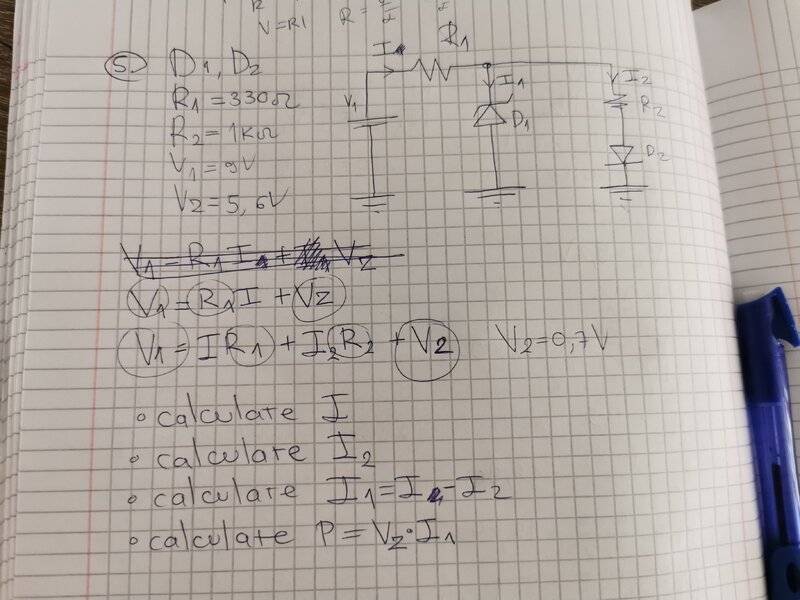
The circuit in Figure 4 uses two diodes, D1 and D2. Write which diodes are in question. Determine the value of the power dissipated on diode D1. It is known: R1= 330 Ω, R2= 1 kΩ, V1= 9 V, VZ= 5, 6 V
Relevant Equations
None
Are my equations correct? And my process of how I should solved this problem?
IMG_20230606_110811.jpg
 
Physics news on Phys.org
Have you checked whether the zener diode is conducting?
 
Gordianus said:
Have you checked whether the zener diode is conducting?
Zener Is because it requires 5.6 volts and sicillium one always does.
 
Thus, if you feel confident, compute the currents and node voltages.
 
Edy56 said:
Zener Is because it requires 5.6 volts and sicillium one always does.
5v6 is the Zener breakdown voltage only for that 5v6 Zener diode, which is not always the operating voltage. It could be less.
The resistors R1 and R2, with D2, form a potential divider. It is possible that the Zener diode, D1, has a voltage below 5.6 volts, and so does not conduct. Check that first.

Once you have determined the actual voltage on D1, you can solve for the current and power in D2.

Solve for the current through R1, subtract the current that flows through R2 and D2. What current remains flows through D1.
 
  • Like
Likes   Reactions: scottdave
It's hard to read your handwriting. Is ##V_1 = 5V## or is ##V_1 = gV##?
 
From the sketch above it looks to me like the Zener is reverse biased so the voltage after the R1 is constant 5.6V. And so you may calculate I.
Subtract 0.7 volts - the voltage drop constant across D2 - from 5.6 V and then calculate I2
 
berkeman said:
It's hard to read your handwriting. Is ##V_1 = 5V## or is ##V_1 = gV##?
I'd guess it's ##V_1 = 9~\rm V##.

Edy56 said:
Are my equations correct? And my process of how I should solved this problem?
I'd say no. You've written things like ##V_1 = R_1## and ##V_2=5.6~\rm V## and ##V_2=0.7~\rm V## (hence implying 5.6=0.7!). Plus you don't appear to indicate exactly what you mean by ##V_2## as far as I can see.

ETA: Oh, I see! Some of those 2s are actually Zs. There's a reason we ask you to type up your work. Your handwriting isn't as easy to read as you might think. :smile:

It would be more helpful if you explain your thought process behind your work instead of spewing a bunch of equations and asking "are they right?" That way the helpers can see where you're getting stuck and possibly help you identify what you're unsure about.
 
  • Like
Likes   Reactions: berkeman

Similar threads

  • · Replies 1 ·
Replies
1
Views
1K
  • · Replies 45 ·
2
Replies
45
Views
9K
  • · Replies 5 ·
Replies
5
Views
4K
  • · Replies 4 ·
Replies
4
Views
3K
  • · Replies 8 ·
Replies
8
Views
2K
  • · Replies 12 ·
Replies
12
Views
2K
Replies
6
Views
2K
  • · Replies 15 ·
Replies
15
Views
7K
  • · Replies 2 ·
Replies
2
Views
2K
  • · Replies 33 ·
2
Replies
33
Views
4K