Power Loss in Transmission Lines: AC vs DC Comparison Explained with a Model

Click For Summary
SUMMARY

The forum discussion centers on the comparison of power loss in AC and DC transmission lines, emphasizing that AC experiences greater losses due to inductive effects and the skin effect. The discussion utilizes a marble analogy to illustrate the differences in power transmission, but participants note its limitations. Key insights include that AC is preferred for its voltage transformation capabilities, while DC is more efficient for long-distance transmission exceeding 1000 km. The conversation also highlights the importance of understanding instantaneous power calculations, where P=VI applies equally to both AC and DC.

PREREQUISITES
  • Understanding of AC and DC power transmission principles
  • Familiarity with inductive losses and skin effect in electrical conductors
  • Knowledge of voltage transformation and its significance in power distribution
  • Basic grasp of instantaneous power calculations (P=VI)
NEXT STEPS
  • Research the impact of inductive losses in AC transmission systems
  • Explore the skin effect and its implications for AC power loss
  • Learn about high-voltage direct current (HVDC) systems and their advantages
  • Investigate the role of power electronics in modern DC transmission lines
USEFUL FOR

Electrical engineers, power system analysts, and anyone involved in the design and optimization of electrical transmission systems will benefit from this discussion.

John3509
Messages
61
Reaction score
6
Intuitively I fell like AC would lose more power long a long power line than DC. I will use a model to explain my perspective.

Let me model a wire as a long straight, non-frictionless tube, about the diameter of a marble, filled with a row of marbles that are each connected to the one next to it by springs. This models the electrons and their repulsive nature.
Voltage in this model is pressure or force applied to the marbles from one end.

To simulate AC, i take a marble from one and and vibrate it back and forth. Because of the friction in the tube and all the springs a lot of that motion would not reach the marble on the other end, it would vibrate at a lower amplitude, and would also transmit less force to anything placed at its end. If you ever played with a slinky on a table you know how much and can pull and push one end before the other budges, think of something like that.

To simulate DC, just push and one marble at one end and keep on pushing. Since you are not drawing back the motion but continuing to push you will eventually compress all the springs, up until this point the force you were applying to a marble at one end is higher than the force the marble at the other end fells and transmits. But after this point, it will equalize, the marbles will move wit the same forward motion, like a rigid rod. Imagine the stretched out slinky is being compressed and then pushed across the table.

In other words, Id imagine that with DC, after the initial phase where you do not transmit much power, eventually you would reach the point where the voltage at receiving end of the transmission line is the same as provided at the source. But with AC, the "slinky" effect over long distances, would absorb a lot more voltage that would reach the end of the transmission line.

Or a more simpler model, if you have a block of wood with a spring on the table and you push on the spring eventually the compression will overcome the static friction of the block and it will move but if you pull back on the spring before this point it will not move. I am imagining this type of principle at play in a long wire.
 
  • Like
Likes   Reactions: Delta2
Physics news on Phys.org
John3509 said:
Intuitively I fell like AC would lose more power long a long power line than DC.
Correct.
I'm not sure if the marble analogy helps, however. AC has inductive losses which don't have an equivalent for marbles, and it has the skin effect which also doesn't have an analogy. There is also the difference between peak and effective voltage for AC, that doesn't transfer well to marbles either. Synchronizing AC over a long distance is an issue, too, there I could see how this is modeled with marbles.
We have a series of Insights articles about AC power grids.

AC is used because it is easier to transform between different voltages, something necessary to transmit electricity over relevant distances. DC is used when electricity is transmitted over very long distances - above ~1000 km the lower losses per length are more important than the slightly higher losses from transformation. As power electronics get cheaper and better there are more and more DC transmission lines.
 
  • Like
  • Informative
Likes   Reactions: Dale, John3509, sophiecentaur and 1 other person
John3509 said:
To simulate AC, i take a marble
That was a worthy try, but the reality of conduction in a wire is too complicated for such a simple model.

For one thing, the moving electrons have many collisions with atoms in the solid.
See https://en.wikipedia.org/wiki/Drude_model To make an analogy with marbles, the wire is not a hollow tube, it is like a Japanese pachinko game or a pinball machine.
1564062278892.png


Also electrons repel other electrons. That means all the electrons in the wire have forces that are like springs that connects every electron to every other electron. Marbles don't have that.

There are even more complexities that I won't explain. Bottom line, there is no simple analogy of electrons behaving like marbles or water that comes close to the reality of current in a wire. It is one those annoying cases where simplifications don't work.

But there's an easier way to think about your AC versus DC question, that does not mention electrons. The key relationship, P=VI, power equals voltage times current. it works for AC and DC, and it works instantaneously. So think of an instant that is so brief, that even a sine wave varying AC current is approximately constant for that instant. Constant current for an instant is the same for AC and DC. Therefore, in an instantaneous view there is not difference between AC and DC. That is the simple answer to your question about AC versus DC power losses.

This picture helps illustrate this point. A series of steps approximates a sine. The more steps, the better the approximation. During the flat part of each step, it is like DC.
1564063812987.png

It is only when we consider averages over long times, that the AC/DC differences arise. Actually averages of a number of complete AC cycle, that the complications come it. Complications like peak versus RMS measurements, imaginary power. But when you return to the instantaneous view where V and I are approximately constant for the instant, all the differences between AC and DC power losses vanish.

There is also a middle view, where V and I may vary with time but not necessarily as a sin wave. We can write differential equations including terms like IR, LdI/dt, and CdV/dt and solve those for voltages and currents versus time including inductance and capacitance. In that approach, there is also no such thing as AC, but only time varying quantities.

Let me repeat for clarity. The whole topic of AC electricity applies only when we use averages over one or more complete cycles. When we model electricity instantaneously, we do not use averages and there is no such thing as AC.
 
Last edited:
  • Like
Likes   Reactions: John3509 and sophiecentaur
John3509 said:
Or a more simpler model, if you have a block of wood with a spring on the table and you push on the spring eventually the compression will overcome the static friction of the block and it will move but if you pull back on the spring before this point it will not move. I am imagining this type of principle at play in a long wire.
This model of yours goes quite a long way to describing the propagation of Sound ( pressure) waves through a solid but is really doesn't remotely describe the process of electrical conduction. The only mechanical analogy for electricity that takes us very far is the flow of a fluid through a pipe (the Water Model) but even that is extremely limited and doesn't begin to deal with the electromagnetic fields associated with electricity.
 
  • Like
Likes   Reactions: John3509
John3509 said:
Intuitively I fell like AC would lose more power long a long power line than DC.

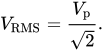
You can divide the peak voltage of the AC by the square root of 2 to get the root mean square voltage, which is the equivalent DC voltage that dissipates the same power.

05970bf00d52692bc643ce11c31acc925f71b40f


https://en.m.wikipedia.org/wiki/Root_mean_square#Definition
 
  • Like
Likes   Reactions: John3509
metastable said:
You can divide the peak voltage of the AC by the square root of 2 to get the root mean square voltage, which is the equivalent DC voltage that dissipates the same power.

05970bf00d52692bc643ce11c31acc925f71b40f


https://en.m.wikipedia.org/wiki/Root_mean_square#Definition
Note - this only works for a true sine wave AC. If the wave shape is a square wave (or even just an approximation) the RMS value is the same for AC and DC.
The (better) DMMs that you can buy these days, actually calculate the true RMS value of low frequency AC waveforms.
 
  • Like
Likes   Reactions: John3509 and anorlunda
In a permanent magnet motor, one can choose between FOC control mode (sine wave) or BLDC control mode (6-step).

In the latter case BLDC 6-step, which during any given step the current through the motor resembles DC, only 2/3rds of the copper and 2 out of 3 of the phases are used at the same time (assuming a WYE winding).

In the former case FOC sine wave, a 3 phase AC sine wave is generated in the motor, which uses all 3 phases and 3/3rds of the copper simultaneously. Using more of the copper results in lower losses for a given amount of electrical power at a given rpm, resulting in greater torque for the same electrical power with FOC and sine wave AC. FOC stands for Field Oriented Control and is a highly complex topic on its own.
 
  • Like
Likes   Reactions: John3509
anorlunda said:
Bottom line, there is no simple analogy of electrons behaving like marbles or water that comes close to the reality of current in a wire. It is one those annoying cases where simplifications don't work.
Yes. This.
Many of the losses in AC power distribution are due to field effects away from the actual transmission wire, like induced currents in lossy materials (like the ground). Marbles and water don't do that.
 
  • Like
Likes   Reactions: John3509
The main advantage of AC for power distribution is the ability to step up to high voltages which does reduce power losses (I=P/V) (P= I^2 R).
 
Last edited:
  • Like
Likes   Reactions: davenn and John3509
  • #10
rcgldr said:
The main advantage of AC for power distribution is the ability to step up to high voltages which does reduce power losses (P= I^2 R).
Great for intermediate distances and where you can synchronise power sources. For very long distances, DC losses are less than AC losses and nowadays, there are DC equivalent devices to the Transformer which are pretty low loss. You can transfer power between areas with different frequency standards by using a DC link.
 
  • Like
Likes   Reactions: John3509
  • #11
sophiecentaur said:
Great for intermediate distances and where you can synchronize power sources. For very long distances, DC losses are less than AC losses and nowadays, there are DC equivalent devices to the Transformer which are pretty low loss. You can transfer power between areas with different frequency standards by using a DC link.
How long is long enough? USA has two major power grids (and yes they are synchronized). There are generators at Hoover Dam powering parts of southern California. The high voltage lines run from 500,000 to 700,000+ volts with what I thought was relatively low power losses. There's also the issue of USA infrastructure based on 3 phase AC power generation, but that's a separate issue from power losses.

https://en.wikipedia.org/wiki/North_American_power_transmission_grid
However parts of Europe are using high power dc distribution:

https://en.wikipedia.org/wiki/High-voltage_direct_current
 
  • Like
Likes   Reactions: John3509
  • #12
mfb said:
Correct.
I'm not sure if the marble analogy helps, however. AC has inductive losses which don't have an equivalent for marbles, and it has the skin effect which also doesn't have an analogy. There is also the difference between peak and effective voltage for AC, that doesn't transfer well to marbles either. Synchronizing AC over a long distance is an issue, too, there I could see how this is modeled with marbles.
We have a series of Insights articles about AC power grids.

AC is used because it is easier to transform between different voltages, something necessary to transmit electricity over relevant distances. DC is used when electricity is transmitted over very long distances - above ~1000 km the lower losses per length are more important than the slightly higher losses from transformation. As power electronics get cheaper and better there are more and more DC transmission lines.

Well, this looks to be much more complex then I imagined and that there are other things at play here. Until you mentioned it I totally forgot the skin effect even existed.

But regardless of the other effects that may or may not be more influential, am I correct in assuming that specifically the mechanical properties I described would be amongst these effects that would more negatively effect AC in voltage drop over DC ? I want to look at each effects, effect individually. Is what I described even an actual effect? You mentioned Synchronizing, is that it? Can you elaborate on that please.

Also, a follow up question, why is the ability to step up or down voltages so important?
 
Last edited:
  • #13
sophiecentaur said:
This model of yours goes quite a long way to describing the propagation of Sound ( pressure) waves through a solid but is really doesn't remotely describe the process of electrical conduction. The only mechanical analogy for electricity that takes us very far is the flow of a fluid through a pipe (the Water Model) but even that is extremely limited and doesn't begin to deal with the electromagnetic fields associated with electricity.

I now realize its much more complicated than I originally pictured and that I ignored other effects. But given that let me reformulate my question. In addition to the electro magnetic interactions, there has to at least some mechanical component to them as well right?
What I want to know is if the effect I described, which I think would arise from their mechanical interactions, would actually cause more voltage drop, and as a result power loss, in AC than DC? I want to look at how each different effect individually effects the voltage. I now know there are others like skin effect, and field effect.
 
  • #14
rcgldr said:
The main advantage of AC for power distribution is the ability to step up to high voltages which does reduce power losses (I=P/V) (P= I^2 R).

Im glad you brought this up here because this is something someone else told me before and I did not understand it and its been in my head ever since.
How does increasing voltage decrease power loss?
 
  • #15
John3509 said:
Im glad you brought this up here because this is something someone else told me before and I did not understand it and its been in my head ever since.
How does increasing voltage decrease power loss?
All else being the same, there is more power loss with higher current. Increasing the voltage allows the same amount of power to be carried with less current, which decreases the loss.
 
  • Like
Likes   Reactions: John3509 and DaveE
  • #16
rcgldr said:
How long is long enough?
I can't find too much about HISTORY in this thread but History is always responsible for the direction of new projects or expansion in Engineering. Compatibility Rules unless there are very good reasons to change direction. The present AC Power technology does pretty well and there are many established companies that will supply AC equipment for incremental expansion of networks.
One day, I expect nearly all electrical power distribution to use DC. One good reason for using AC at present is that Induction Motors are driven with AC and an AC distribution system has allowed big static equipment to be driven straight off the mains. Big AC motors are Everywhere! But Power Electronics is advancing all the time and it won't be long before all induction motors can be fed from AC. Even better - speed control on Induction Motors is achieved by varying the supply frequency so local DC-AC conversion has this facility built in.
Poor old Tesla must be turning in his grave (at 60Hz, I imagine).
 
  • Like
Likes   Reactions: John3509
  • #17
rcgldr said:
How long is long enough?
~700 km on land, ~50 km under the sea, as the HVDC article you linked describes.
Sometimes it is used even for "zero distance" if it connects unsynchronized networks. North America has five unsynchronized regions according to the article and a while ago I saw a news article about a connection station using HVDC to transfer power between two or three of them.
John3509 said:
But regardless of the other effects that may or may not be more influential, am I correct in assuming that specifically the mechanical properties I described would be amongst these effects that would more negatively effect AC in voltage drop over DC ? I want to look at each effects, effect individually. Is what I described even an actual effect? You mentioned Synchronizing, is that it? Can you elaborate on that please.
I don't even understand where you see some effect in the marble analogy. It is just too far away from electricity to be useful here.
 
  • Like
Likes   Reactions: John3509
  • #18
John3509 said:
am I correct in assuming that specifically the mechanical properties I described would be amongst these effects that would more negatively effect AC in voltage drop over DC ?
mfb said:
I don't even understand where you see some effect in the marble analogy. It is just too far away from electricity to be useful here.
I can never understand why people insist that there is merit in the models they just thought up in their heads, with no evidence or with no serious provenance. Advances in Science thinking are few and far between and they always come from those who are very well informed. Remember Newton's statement about 'standing on the shoulders of others"? He was never the most humble of men but even he acknowledged that ok.
 
  • Like
Likes   Reactions: John3509
  • #19
John3509 said:
there has to at least some mechanical component to them as well right?
Sorry but very wrong. Your attempt to understand electricity mechanically is so seriously wrong that you should forget it completely. Pretend that you never heard of the word electron.
 
  • Like
Likes   Reactions: John3509
  • #20
I do not want to distract the main topic of this thread. However, the Drude's model is completely wrong and has nothing to do with reality. It is worse than the Bohr's model of an atom, and can reach some quantities correctly, most quantities completely wrong and some quantities correctly only because gross errors cancel each other out.

I personally find its teaching in solid state physics to be a disgrace, as it can lead to build a faulty intuition of the electron's behaviors in a conductor. Don't do that. Don't rely on that model, not even for intuition.
This is not equivalent to Newtonian mechanics vs GR, where Newtonian mechanics can be reached in some limits. Here we're talking of a known-to-be-wrong model that has absolutely nothing to do with reality vs, say, the free (and/or nearly free) electron model, which would be the equivalent of a good model where we have taken some limits to make the description much simpler, losing many details of course in the process (and predictive power).
 
  • Like
Likes   Reactions: John3509
  • #21
I don't like the Drude model much either. But is it still taught for students unable to cope with the free electron model. But I think you are overstating the case for deprecation. The free electron model you mentioned is still called the Drude-Sommerfield model.

https://en.wikipedia.org/wiki/Drude_model said:
The model was extended in 1905 by Hendrik Antoon Lorentz (and hence is also known as the Drude–Lorentz model) and is a classical model. Later it was supplemented with the results of quantum theory in 1933 by Arnold Sommerfeld and Hans Bethe, leading to the Drude–Sommerfeld model.

My personal preference for teaching electric conduction is to restrict it to three levels with solid foundations.
  1. Circuit analysis (no fields, no charges, no propagation)
  2. Maxwell's equations.
  3. Q.E.D.
Intermediate levels (we could call the free electron model level 2.6) are most often only of interest to specialized researchers.

But B level students yearn for a level 1.5. They learn Ohm's law, then they want to jump directly into atomic physics. (See the lament #18) This is fostered by many (perhaps most) teaching in basic electricity that begins with the atomic structure. If I ruled the world, it would be a crime for a teacher to mention the word electron to B level students.
 
  • Like
Likes   Reactions: John3509 and fluidistic
  • #22
rcgldr said:
How long is long enough? USA has two major power grids (and yes they are synchronized). There are generators at Hoover Dam powering parts of southern California. The high voltage lines run from 500,000 to 700,000+ volts with what I thought was relatively low power losses. There's also the issue of USA infrastructure based on 3 phase AC power generation, but that's a separate issue from power losses.

https://en.wikipedia.org/wiki/North_American_power_transmission_grid
However parts of Europe are using high power dc distribution:

https://en.wikipedia.org/wiki/High-voltage_direct_current
The US has 3 major grids (East, West, Texas), and they aren't synchronized with each other. DC is used to tie the grids together, and also for very long distance, such as the line that takes power from the pacific northwest to the LA area (https://en.wikipedia.org/wiki/Pacific_DC_Intertie).
 
  • Like
  • Informative
Likes   Reactions: John3509, mfb and anorlunda
  • #23
Nugatory said:
All else being the same, there is more power loss with higher current. Increasing the voltage allows the same amount of power to be carried with less current, which decreases the loss.

How though? I know power drained by a resistor is P = I*I *R so lower I means lower power drained but how can you deliver higher voltage with less current when voltage and current are proportional? How do you wind up with the same amount of power being carried?
And, isn't the load at the end of the cable, like a vacuum cleaner for instance, just another resistance in the circuit, so aren't you just lowering the power the vacuum clearer gets?
 
  • #24
mfb said:
.I don't even understand where you see some effect in the marble analogy. It is just too far away from electricity to be useful here.
sophiecentaur said:
I can never understand why people insist that there is merit in the models they just thought up in their heads, with no evidence or with no serious provenance.
anorlunda said:
Sorry but very wrong. Your attempt to understand electricity mechanically is so seriously wrong that you should forget it completely. Pretend that you never heard of the word electron.

I understand my model is bad but I am not insisting on using it despite all reason. I'm not trying to use it as an alternative to the water in pipe analogy given to new students or a general model for electricy flow but address in particular how voltage travels. Like if you had a wire from here to the moon and osilated the voltage, how it would reach the other end. What I am trying is to understand a specific aspect of current, how voltage propogates trough a wire differently with AC and DC and how this effects voltage drop. I guess how I should have started this tread is to just ask "does something similar to how sound propogates trough air or waves trough water ever happen in wires" mfb mentioned synchronizing AC over long distances, i feel like the answer I am looking for will have something to do with this. For context.

I know that
  1. Electrons repel and can be compressed to be more densely packed or less, like in compactor plates, so there is springiness to their motion
  2. electrons can behave both as particle and wave,
  3. In thermodynamics you model matter as a grid of points connected by springs in 3D
  4. Current is not instantaneous throughout the wire so it must travel along the wire
This is why I assumed that in addition to the electromagnetic and quantum stuff going on there would at least in some aspect be mechanical motion.

But something i read from someone very recently tells me that current is actually pushed by the electric field that goes along the whole wire and that electrons don't actually push on each other at all like megnetic freight carts on a track. Is this true?
 
  • #25
John3509 said:
how I should have started this tread is to just ask "does something similar to how sound propogates trough air or waves trough water ever happen in wires"
No. Sound and water waves are not very similar at all to electric current flow in a wire.
 
  • Like
Likes   Reactions: John3509
  • #26
John3509 said:
But something i read from someone very recently tells me that current is actually pushed by the electric field that goes along the whole wire and that electrons don't actually push on each other at all like megnetic freight carts on a track. Is this true?
Really, if you want to try to understand electricity, you need to give up on analogies like water, marbles and magnetic freight carts.
 
  • Like
Likes   Reactions: John3509
  • #27
John3509 said:
How though? I know power drained by a resistor is P = I*I *R so lower I means lower power drained but how can you deliver higher voltage with less current when voltage and current are proportional? How do you wind up with the same amount of power being carried?
And, isn't the load at the end of the cable, like a vacuum cleaner for instance, just another resistance in the circuit, so aren't you just lowering the power the vacuum clearer gets?
You want to deliver a specific power P to the consumer. Pconsumer=Ugrid I. A higher voltage means you need a lower current to deliver the same power.

Losses in the cable are Pcable = I2 Rcable. A lower current means lower losses in the cable.

We can also plug the first equation into the second: Pcable = Rcable P2consumer/(U2grid). We can't change the power the consumer wants. We can lower the cable resistance, and we can increase the cable voltage to reduce the power lost in the cable.
 
  • Like
Likes   Reactions: John3509
  • #28
John3509 said:
How though? I know power drained by a resistor is P = I*I *R so lower I means lower power drained but how can you deliver higher voltage with less current when voltage and current are proportional? How do you wind up with the same amount of power being carried?
And, isn't the load at the end of the cable, like a vacuum cleaner for instance, just another resistance in the circuit, so aren't you just lowering the power the vacuum clearer gets?
You can think of the load as another resistance but you must remember that the load is not the vacuum cleaner itself, but rather the step-down transformer at the end of the transmission line. Its resistance will vary with the power demand so the voltage and the current in the transmission line are not proportional. Instead, we have V=IR with R varying and V held constant by the generator so that I and R are inversely proportional to one another.
 
  • Like
Likes   Reactions: John3509
  • #29
Maxwell's Equations tell us that electromagnetic effects propagate at a finite speed. That speed is c in a vacuum. In other media, such as a wire the propagation speed is in the range 0.6-0.8 c.

At those speeds, AC versus DC is irrelevant. Ordinary circuit analysis breaks down and you must treat wires as waveguides, and antennas.

If you are trying to teach students about that, then using circuits is the wrong approach. You need to consider Maxwell's Equations. Unfortunately, the math is difficult so it is not usually taught at the high school level, but rather in field theory courses to college seniors or post graduate students.
 
  • Like
Likes   Reactions: John3509
  • #30
This math will also tell you that for dispersive media it is very important to clearly define which "speed of propagation" you are talking about... (phase velocity, group velocity, front velocity,...).
 
  • Like
Likes   Reactions: John3509

Similar threads

  • · Replies 7 ·
Replies
7
Views
7K
  • · Replies 12 ·
Replies
12
Views
1K
  • · Replies 14 ·
Replies
14
Views
2K
  • · Replies 2 ·
Replies
2
Views
2K
  • · Replies 10 ·
Replies
10
Views
4K
  • · Replies 46 ·
2
Replies
46
Views
18K
  • · Replies 7 ·
Replies
7
Views
2K
  • · Replies 25 ·
Replies
25
Views
4K
  • · Replies 7 ·
Replies
7
Views
3K
  • · Replies 3 ·
Replies
3
Views
2K