Powering an LED Array On and Off at 1kHz

Click For Summary

Discussion Overview

The discussion revolves around the challenges of powering an LED array using a circuit designed to switch on and off at a frequency of 1kHz. Participants explore various aspects of circuit design, including the role of transistors, current draw, and the configuration of the power supply and signal generator.

Discussion Character

  • Technical explanation
  • Debate/contested
  • Mathematical reasoning

Main Points Raised

  • One participant notes that the current drawn by the LED array is significantly lower when switched at 1kHz compared to when connected directly to the power supply, prompting questions about the cause.
  • Another participant suggests that the frequency generator may not be amplifying the signal properly and emphasizes the importance of the duty cycle of the square wave in determining current draw.
  • A suggestion is made to use the BJT as a common emitter amplifier and to modify the circuit to allow the BJT to sink current instead of sourcing it.
  • Current limiting resistors are recommended to be added to the circuit to ensure proper functioning of the LED array.
  • Concerns are raised about the gain of the 2N2222 transistor at high currents, with calculations provided regarding the necessary base current to achieve the desired LED current.
  • Participants propose various modifications, such as increasing the offset voltage, raising the power supply voltage, and using multiple transistors in parallel to improve performance.
  • Clarifications are provided regarding the circuit configuration, emphasizing that the order of components can be flexible as long as the transistor can be controlled by the oscillator.

Areas of Agreement / Disagreement

Participants express differing views on the optimal circuit configuration and the specific modifications needed to achieve the desired current draw. There is no consensus on a single solution, and multiple approaches are suggested.

Contextual Notes

Participants highlight the importance of the duty cycle and the configuration of the circuit components, indicating that assumptions about the power supply and signal generator may affect performance. The discussion does not resolve these technical uncertainties.

Who May Find This Useful

This discussion may be useful for students and hobbyists working on electronics projects involving LED arrays, particularly those interested in switching circuits and transistor applications.

bluurple
Messages
2
Reaction score
0
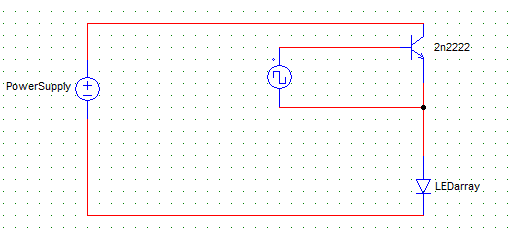
So I have a question about a circuit I'm making for class. I'm using this PowerSupply is a power supply I'm using in the lab. The 1kHz square wave is 700mV pk to pk with a 350mV offset. LEDarray is a red LED light array (http://www.ledtronics.com/Products/ProductsDetails.aspx?WP=2003).

When I connect the light to the power supply directly, it draws 230mA at 12V. But when I connect the light as shown in the schematic with the intent to switch it on and off at 1kHz, not enough current is drawn to fully power the LED array (only a fourth of the light turns on, and not very bright). Only 10mA is drawn.

I'm not sure how to make the light draw 230mA while switching on and offat 1kHz. Is the issue with the power supply not being able to switch that fast at that amperage, the switch not being able to put 230mA through at that frequency, or something else entirely? Help please?

Thank you
Capture.png
 
Last edited:
Engineering news on Phys.org
Welcome to PhysicsForums!

The problem is that your frequency generator is connected across the base and emitter of the BJT, and isn't amplifying your signal. You also don't mention the duty cycle of the square wave (percentage of each period which is high), which will impact the amount of current drawn, assuming that you're able to supply the 12 V across the LED.

I would look into using the BJT as a common emitter amplifier, and modifying your circuit such that the BJT sinks current, rather than trying to source it (at 12 V).
 
Clarifying what MATLABdude said, connect the emitter directly to battery -. Connect your signal source between battery - and the base and connect the cathode of the LED to the collector and the anode to battery +.
 
Thanks for the replies! Not sure why I never tried this. :P
 
You will also need to add current limiting resistors like this:

http://dl.dropbox.com/u/4222062/LED%20driver%202.PNG

The transistor shown as NPN will need to be a high gain, power transistor, but not a Darlington, as there is not enough voltage drive for a Darlington.
 
Last edited by a moderator:
If you check the data sheet for the 2N2222, notice that the gain drops a lot for high current and also for a saturated transistor.

If this transistor had about 1 volt across it and it was supplying 230 mA, the current gain could be about 30. So, this means the base current would have to be about 7.6 mA.

In this case, the position of the LED doesn't matter since you have the signal source isolated from the power supply.

Some things you could try:

Increase the offset voltage. At present, only the very peak of the input signal is causing any LED current to flow.

Increase the power supply voltage to about 15 volts so that the voltage across the transistors is greater.
Gradually increase the square wave amplitude from zero while monitoring the LED current.

Put 4 2N2222's in parallel. This will give more gain because each transistor would not have to draw so much current.
 
skeptic2 said:
Clarifying what MATLABdude said, connect the emitter directly to battery -. Connect your signal source between battery - and the base and connect the cathode of the LED to the collector and the anode to battery +.

To be fair to bluurple, his original diagram is fine - but only as long as either his power supply or his oscillator is 'floating'. The elements in the circuit that includes battery, LED and transistor need not actually be in the order we'd normally expect as long as the transistor can be turned on and off by the oscillator.
In real life, of course, we would try to stick with just one 'ground' and to use the same power supply for everything so the suggested circuit would be better. But, in principle . . . . . ..
 

Similar threads

  • · Replies 15 ·
Replies
15
Views
2K
  • · Replies 2 ·
Replies
2
Views
2K
  • · Replies 9 ·
Replies
9
Views
3K
  • · Replies 6 ·
Replies
6
Views
4K
  • · Replies 8 ·
Replies
8
Views
3K
  • · Replies 23 ·
Replies
23
Views
4K
  • · Replies 7 ·
Replies
7
Views
19K
  • · Replies 8 ·
Replies
8
Views
2K
Replies
4
Views
3K
  • · Replies 19 ·
Replies
19
Views
3K