notapro
- 2
- 0
Hello there,
I am having a discussion with a co-worker about a pressure drop test. I have two different 'boxes' for which I don't know the pressure drop. What I want to know is the difference in pressure drop between the two 'boxes'.
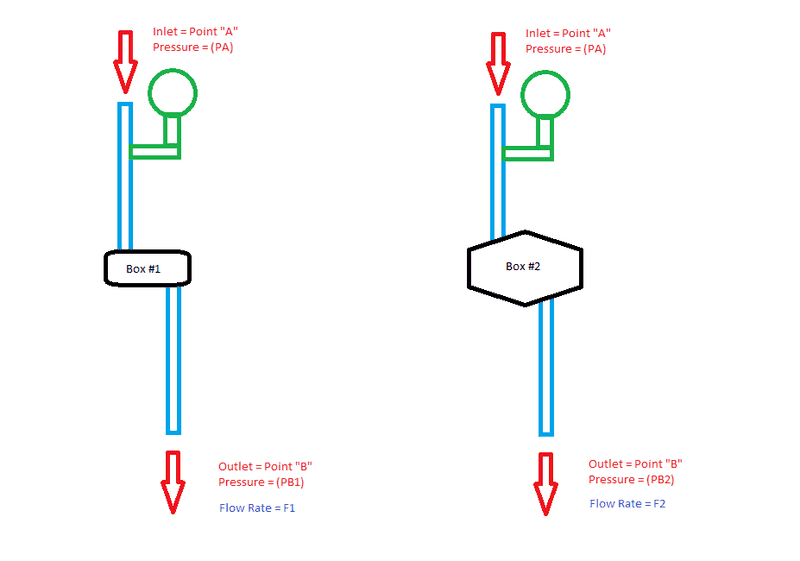
Knowns
1) PA1 = PA2 = PA = Inlet Pressure for Setup 1 and 2 = Measured (Same for both setups)
2) FA1 = FB1 = F1 = Flow Rate for Setup 1 = Measured (Same throughout setup 1)
3) FA2 = FB2 = F2 = Flow Rate for Setup 2 = Measured (Same throughout setup 2)
Unknowns
1) PB1 = Pressure at Outlet in Setup 1
2) PB2 = Pressure at Outlet in Setup 2
What I want to find out
1) PB1 - PB2 = ΔPB = ?
----------------------------------------------------
The first step I took is to use the equation:
[itex]\frac{F_1}{F_2}[/itex] = [itex]\sqrt{\frac{P_{B1}}{P_{B2}}}[/itex] (Eq. 1)
And simplified it to:
[itex]∆P_B=P_{B1}-P_{B2}=P_{B1}-P_{B1}(\frac{F_2}{F_1})^2[/itex] (Eq. 2)
So, at this point, I have two unknowns (ΔP and PB1) and only one equation. I am claiming that we have to measure and/or solve for either PB1 (or PB2) in order to find an answer. My co-worker is claiming that we do NOT have to find either of these values. He wants to use another Equation 1, or something along those lines.
However, I feel you can’t use Equation 1 to compare different points in a system. For instance, Equation 3 below is NOT a usable equation.
[itex]\frac{F_{A1}}{F_{B1}}[/itex] = [itex]\sqrt{\frac{P_{A1}}{P_{B1}}}[/itex] (Eq. 3)
Since FA1 = FB1; this is meaningless, right? Or am I missing something?
Thanks in advance!
Alan
I am having a discussion with a co-worker about a pressure drop test. I have two different 'boxes' for which I don't know the pressure drop. What I want to know is the difference in pressure drop between the two 'boxes'.
Knowns
1) PA1 = PA2 = PA = Inlet Pressure for Setup 1 and 2 = Measured (Same for both setups)
2) FA1 = FB1 = F1 = Flow Rate for Setup 1 = Measured (Same throughout setup 1)
3) FA2 = FB2 = F2 = Flow Rate for Setup 2 = Measured (Same throughout setup 2)
Unknowns
1) PB1 = Pressure at Outlet in Setup 1
2) PB2 = Pressure at Outlet in Setup 2
What I want to find out
1) PB1 - PB2 = ΔPB = ?
----------------------------------------------------
The first step I took is to use the equation:
[itex]\frac{F_1}{F_2}[/itex] = [itex]\sqrt{\frac{P_{B1}}{P_{B2}}}[/itex] (Eq. 1)
And simplified it to:
[itex]∆P_B=P_{B1}-P_{B2}=P_{B1}-P_{B1}(\frac{F_2}{F_1})^2[/itex] (Eq. 2)
So, at this point, I have two unknowns (ΔP and PB1) and only one equation. I am claiming that we have to measure and/or solve for either PB1 (or PB2) in order to find an answer. My co-worker is claiming that we do NOT have to find either of these values. He wants to use another Equation 1, or something along those lines.
However, I feel you can’t use Equation 1 to compare different points in a system. For instance, Equation 3 below is NOT a usable equation.
[itex]\frac{F_{A1}}{F_{B1}}[/itex] = [itex]\sqrt{\frac{P_{A1}}{P_{B1}}}[/itex] (Eq. 3)
Since FA1 = FB1; this is meaningless, right? Or am I missing something?
Thanks in advance!
Alan