Probability Distribution of Geometric Random Variables

Join the discussion
Ask a follow-up here, or get your own question answered by working scientists, mathematicians and engineers — people, not an autocomplete.
Real named experts · corrections over time · the nuance an AI answer skips
4 replies · 4K views
bincy
Messages
38
Reaction score
0
Dear friends,

I have divided the time into slots of fixed size. And i toss a coin of probability of heads 1/2 in the first slot. In the next slot, i toss a coin of probability of head 1/4, and in the i^th slot i toss a coin of prob of head 1/2^i. I do this until i get a head. What is the probability distribution of the no. of slots until a success?If it was fixed Prob of heads in each slot, the prob was as easy as a pie. (Geometric)

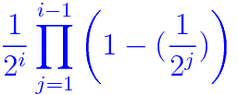
Initially i thought that, the distribution is View attachment 141for i>=2, and for i=1, prob(i=1)=1/2But this prob distribution do not sum up to one( Mathematica says that it is approximately 0.72). Can anyone explain me why it is not true? What is the real ans?I am perplexed. Thanks in advance.
 

Attachments
  • Tex2Img_1335717981.gif
    Tex2Img_1335717981.gif
    1.7 KB · Views: 152
Physics news on Phys.org
Re: To find out the probability distribution of" something like geometric random variables"

Hai,

Thanks for the immediate reply.

But i don't think that your ans is correct.

I considered that, in the previous n-1 slots, none are heads, but in your case it is none are 'all heads' in the previous n-1 slots.
 
Re: To find out the probability distribution of" something like geometric random variables"

bincybn said:
Hai,

Thanks for the immediate reply.

But i don't think that your ans is correct.

I considered that, in the previous n-1 slots, none are heads, but in your case it is none are 'all heads' in the previous n-1 slots.

Of course You are right and I deleted my post... very sorry!...

The probability to have a head in the n-th slot and 'all tails' in the previously n-1 slots is, as You wrote,...

$\displaystyle P_{n}=2^{-n}\ \prod_{k=1}^{n} (1-2^{-k})$ (1)

The fact that $\displaystyle \sum_{n=1}^{\infty} P_{n}<1$ is not surprising because the event 'an head sooner or later' is not 'sure' ,i.e. it has not probability 1...

Kind regards

$\chi$ $\sigma$
 
Last edited:
Re: To find out the probability distribution of" something like geometric random variables"

bincybn said:
Dear friends,

I have divided the time into slots of fixed size. And i toss a coin of probability of heads 1/2 in the first slot. In the next slot, i toss a coin of probability of head 1/4, and in the i^th slot i toss a coin of prob of head 1/2^i. I do this until i get a head. What is the probability distribution of the no. of slots until a success?If it was fixed Prob of heads in each slot, the prob was as easy as a pie. (Geometric)

Initially i thought that, the distribution is View attachment 141for i>=2, and for i=1, prob(i=1)=1/2But this prob distribution do not sum up to one( Mathematica says that it is approximately 0.72). Can anyone explain me why it is not true? What is the real ans?I am perplexed. Thanks in advance.
That the probabilities do not sum to one is not necessarily a deficiency in this case. It is possible with these decreasing probabilities of success that the probability of never getting a head is non-zero.

I think what you have is correct, you just have to add the extra case that the probability of never getting a head is 1 minus the sum of the probabilities that you have.

By the way the formula works for i=1 as well, since the empty product is 1.

CB
 
Re: To find out the probability distribution of" something like geometric random variables"

Thanks all of you. I am convinced with your answers.

I have to add one more thing that the avg no. of slots to get a head is infinity.:p