MHB Probability Distribution of Geometric Random Variables

AI Thread Summary
The discussion revolves around the probability distribution of obtaining heads when tossing coins with decreasing probabilities in successive slots. The initial assumption about the distribution was incorrect, as it was found that the probabilities do not sum to one, indicating a non-zero chance of never getting a head. The correct probability for getting a head in the n-th slot, given all previous slots resulted in tails, was established. Participants clarified that the sum being less than one is acceptable in this context, as it reflects the possibility of never achieving a head. Ultimately, it was concluded that the average number of slots needed to get a head is infinite.
bincy
Messages
38
Reaction score
0
Dear friends,

I have divided the time into slots of fixed size. And i toss a coin of probability of heads 1/2 in the first slot. In the next slot, i toss a coin of probability of head 1/4, and in the i^th slot i toss a coin of prob of head 1/2^i. I do this until i get a head. What is the probability distribution of the no. of slots until a success?If it was fixed Prob of heads in each slot, the prob was as easy as a pie. (Geometric)

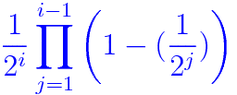
Initially i thought that, the distribution is View attachment 141for i>=2, and for i=1, prob(i=1)=1/2But this prob distribution do not sum up to one( Mathematica says that it is approximately 0.72). Can anyone explain me why it is not true? What is the real ans?I am perplexed. Thanks in advance.
 

Attachments
  • Tex2Img_1335717981.gif
    Tex2Img_1335717981.gif
    1.7 KB · Views: 113
Mathematics news on Phys.org
Re: To find out the probability distribution of" something like geometric random variables"

Hai,

Thanks for the immediate reply.

But i don't think that your ans is correct.

I considered that, in the previous n-1 slots, none are heads, but in your case it is none are 'all heads' in the previous n-1 slots.
 
Re: To find out the probability distribution of" something like geometric random variables"

bincybn said:
Hai,

Thanks for the immediate reply.

But i don't think that your ans is correct.

I considered that, in the previous n-1 slots, none are heads, but in your case it is none are 'all heads' in the previous n-1 slots.

Of course You are right and I deleted my post... very sorry!...

The probability to have a head in the n-th slot and 'all tails' in the previously n-1 slots is, as You wrote,...

$\displaystyle P_{n}=2^{-n}\ \prod_{k=1}^{n} (1-2^{-k})$ (1)

The fact that $\displaystyle \sum_{n=1}^{\infty} P_{n}<1$ is not surprising because the event 'an head sooner or later' is not 'sure' ,i.e. it has not probability 1...

Kind regards

$\chi$ $\sigma$
 
Last edited:
Re: To find out the probability distribution of" something like geometric random variables"

bincybn said:
Dear friends,

I have divided the time into slots of fixed size. And i toss a coin of probability of heads 1/2 in the first slot. In the next slot, i toss a coin of probability of head 1/4, and in the i^th slot i toss a coin of prob of head 1/2^i. I do this until i get a head. What is the probability distribution of the no. of slots until a success?If it was fixed Prob of heads in each slot, the prob was as easy as a pie. (Geometric)

Initially i thought that, the distribution is View attachment 141for i>=2, and for i=1, prob(i=1)=1/2But this prob distribution do not sum up to one( Mathematica says that it is approximately 0.72). Can anyone explain me why it is not true? What is the real ans?I am perplexed. Thanks in advance.
That the probabilities do not sum to one is not necessarily a deficiency in this case. It is possible with these decreasing probabilities of success that the probability of never getting a head is non-zero.

I think what you have is correct, you just have to add the extra case that the probability of never getting a head is 1 minus the sum of the probabilities that you have.

By the way the formula works for i=1 as well, since the empty product is 1.

CB
 
Re: To find out the probability distribution of" something like geometric random variables"

Thanks all of you. I am convinced with your answers.

I have to add one more thing that the avg no. of slots to get a head is infinity.:p
 
Seemingly by some mathematical coincidence, a hexagon of sides 2,2,7,7, 11, and 11 can be inscribed in a circle of radius 7. The other day I saw a math problem on line, which they said came from a Polish Olympiad, where you compute the length x of the 3rd side which is the same as the radius, so that the sides of length 2,x, and 11 are inscribed on the arc of a semi-circle. The law of cosines applied twice gives the answer for x of exactly 7, but the arithmetic is so complex that the...
Thread 'Unit Circle Double Angle Derivations'
Here I made a terrible mistake of assuming this to be an equilateral triangle and set 2sinx=1 => x=pi/6. Although this did derive the double angle formulas it also led into a terrible mess trying to find all the combinations of sides. I must have been tired and just assumed 6x=180 and 2sinx=1. By that time, I was so mindset that I nearly scolded a person for even saying 90-x. I wonder if this is a case of biased observation that seeks to dis credit me like Jesus of Nazareth since in reality...
Fermat's Last Theorem has long been one of the most famous mathematical problems, and is now one of the most famous theorems. It simply states that the equation $$ a^n+b^n=c^n $$ has no solutions with positive integers if ##n>2.## It was named after Pierre de Fermat (1607-1665). The problem itself stems from the book Arithmetica by Diophantus of Alexandria. It gained popularity because Fermat noted in his copy "Cubum autem in duos cubos, aut quadratoquadratum in duos quadratoquadratos, et...
Back
Top