Problem generating spark under water for cavitation bubbles

  • Context: Misc. 
  • Thread starter Thread starter Beekeeper
  • Start date Start date
  • Tags Tags
    Bubbles Spark Water
Join the discussion
Ask a follow-up here, or get your own question answered by working scientists, mathematicians and engineers — people, not an autocomplete.
Real named experts · corrections over time · the nuance an AI answer skips
35 replies · 6K views
Beekeeper said:
But I am still not sure how to safely measure the volts across the spark gap.
Measuring very high volts is often done using a Potential Divider with a very high series resistor in series. But suitable resistors need to be made appropriate for many. 100's kV operation. They can be expensive and don't even look like the little chaps with two wires coming out of the ends. Google "very high voltage dvm adaptors" to get an idea about what they look like and cost. The adaptors are pretty safe.
 
on Phys.org
I had an idea, I could add an additional spark gap but in air in series with the spark gap in the water. This way the Arc Pulse Generator would have some time to charge up as there would be an open circuit in the air and then it would arc in both the air and in water.

I experimented with this and it worked! Not as well as I would have liked as the spark does not sustain for long but I can generate the spark underwater. To do this however, I did have to take extra precautions to ensure that the air gap was in a sealed container and again all my wiring was properly insulated. This took a bit of time to setup. I also need to tune the distance of the air gap for optimal performance but for me this is a good step forward.

Thanks again @Rive and @sophiecentaur for your advice.

sophiecentaur said:
Did you make your choice because you saw yours advertised 'cheap'?
That was one factor. I could have come up with my own circuit but I thought it would be easier to buy an off the shelf product that has been tried and tested first. Plus it might be "safer" than me making my own. I wanted to use this rather than a piezo because I thought it would be eaiser to trigger multiple simultaneously. Incidently now that I know why it failed, I think a piezo would probablly would work because it is a different technology. I also hope to get around to taking some of the measurements and make some of the calculations you mentioned.

Thanks
 
Beekeeper said:
Arc Pulse Generator would have some time to charge up
It seems to me that your HV generator generates a burst of AC (hence the transformer in the circuit) it will not 'charge' a capacitor because the sign of the PD changes each cycle. The system they are using in that video makes it clear that a capacitor is charged; not the same system as yours, I'm afraid.
Beekeeper said:
I thought it would be easier to buy an off the shelf product that has been tried and tested first.
There\s so much to take onboard at first - easy mistake to make and you have to 'know' what your purchase actually does. I suggest you do more Googling for "cavitation with sparks" sort of search terms.
 
Reply
  • Like
Likes   Reactions: Beekeeper
Yeah true. The Arc Pulse Generator is a bit of black box which makes it hard. I were to learn more or tinker with one it would be the 15kV one which clearly you can see what is going on.
 
sophiecentaur said:
It seems to me that your HV generator generates a burst of AC (hence the transformer in the circuit) it will not 'charge' a capacitor because the sign of the PD changes each cycle.
It'll be likely some variation (maybe some (more) voltage doubler stages added) of this one:
51zZxDt7VqL._AC_SL1500_.jpg
 
Reply
  • Like
Likes   Reactions: Beekeeper
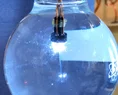
Hi, I have managed to produce some electrical sparks underwater. I would attache a video if I could however I can only attache a photo.

You can see this is vaporising the water which should cause the cavitation bubbles to form. I was hoping here that some shockwaves would be produced enough to damage or even destroy the solid in the middle (fishing line) however that was not the case. I could see no traces of damage at all and I suspect it is because the target is simply too small.

I'll try again but this this time replace the line with a small piece of foil. I plan to also capture it in slow motion on my phone. I would like to record some evidence I am actually cavitation bubbles.

I have read some of the book Cavitation and Bubble Dynamics by Christopher Ears Brennen. It is quite comprehensive but also quite heavy. If anyone could recommend some other lighter reading I would appreciate that.

Thanks.
 

Attachments

  • WwoElectrodeFrame.webp
    WwoElectrodeFrame.webp
    32.5 KB · Views: 35