Problem studying the convergence of a series

Click For Summary

Homework Help Overview

The discussion revolves around the convergence of a series, specifically examining the Taylor expansion of the sine function applied to a rational expression involving \( n \). Participants are exploring the implications of approximations and the conditions under which certain mathematical properties hold.

Discussion Character

  • Exploratory, Conceptual clarification, Mathematical reasoning, Assumption checking

Approaches and Questions Raised

  • Participants discuss the validity of using the Taylor expansion for \( \sin((n^2+n+1)/(n+1)\cdot\pi) \) and question the implications of truncating the series. There is a focus on the conditions under which \( \sin(x) \approx x \) is applicable, particularly when \( x \) approaches zero.

Discussion Status

Some participants have offered guidance on the necessity of maintaining accuracy in calculations before applying approximations. There is recognition of the need to consider absolute convergence and the triangle inequality, as well as the behavior of the sine function at specific limits.

Contextual Notes

Participants note that the original poster's approach may have overlooked the requirement for \( n \) to be sufficiently small for the Taylor expansion to be valid. There is an acknowledgment of the importance of understanding how close to zero the terms in the series are, which influences convergence.

Amaelle
Messages
309
Reaction score
54
Homework Statement
Convergence of a serie (look at the image)
Relevant Equations
absolute convergence, taylor expnasion, asymptotic behaviour!
Good day
here is the exercice
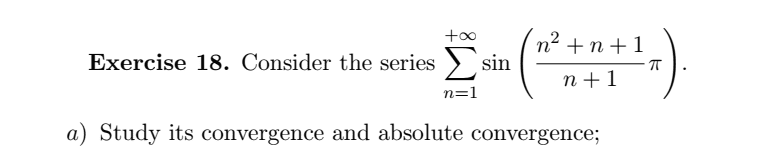
1612086383866.png

and here is the solution that I understand very well
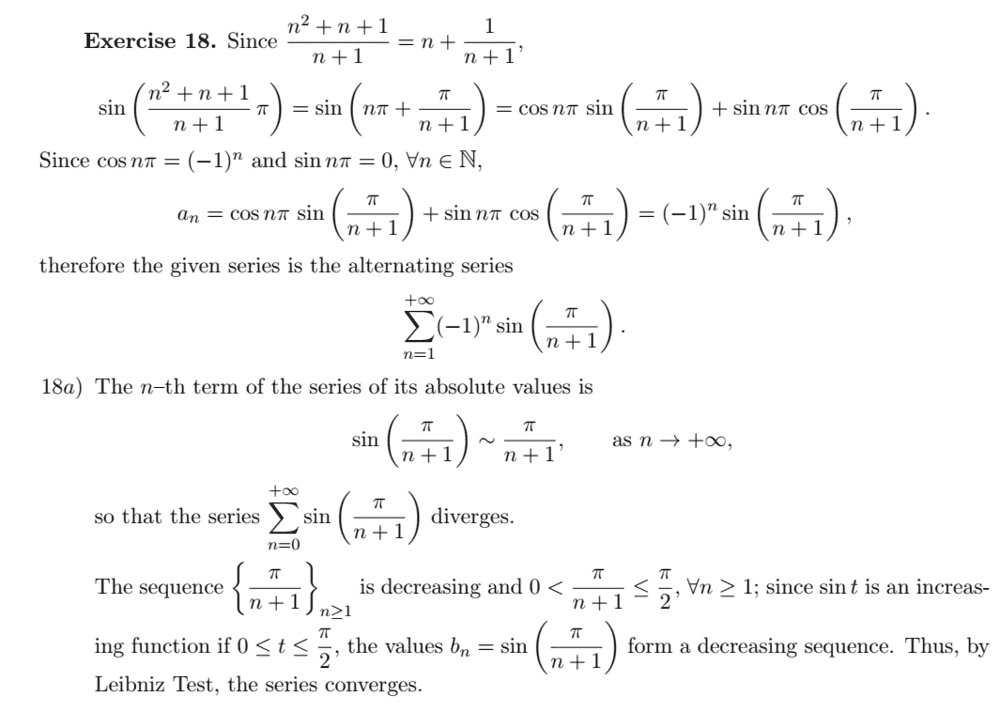
1612086450657.png


but I have a confusion I hope someone can explain me
if I take the taylor expansion of sin ((n^2+n+1/(n+1))*pi)≈n^2+n+1/(n+1))*pi≈n*pi which diverge!
I know something is wrong in my logic please help me

many thanks in advance!
best regards!
 
Physics news on Phys.org
Amaelle said:
Homework Statement:: Convergence of a serie (look at the image)
Relevant Equations:: absolute convergence, taylor expnasion, asymptotic behaviour!

if I take the taylor expansion of sin ((n^2+n+1/(n+1))*pi)≈n^2+n+1/(n+1))*pi≈n*pi which diverge!
This is what you get by a quick, but wrong look at it. To cut off all the rest of the Taylor series gives you a false impression. With this method you either have to use the complete series or investigate merely absolute convergence, in which case you need the triangle inequality.

Anyway, the point is, that a) ##\sin(x)\approx x## only holds for ##x\ll 1## and b) that we actually have ##\sin(f(n)\cdot \pi )## with ##f(n)=\dfrac{n^2+n+1}{n+1}## which itself converges to ##n\pi## and ##\sin(n\pi)=0##.

Hence we add numbers which are close to zero. We know from ##\sum \dfrac{1}{n} \to \infty ##, ##\sum \dfrac{1}{n^2} \to \pi^2/6 ##, and ##\sum (-1)^n\dfrac{1}{n} \to -\log(2)## that in such cases we have to have a close look on "how close to zero". This means that we must keep equality as long as possible before we can start to simplify by Taylor or other means. That is where the addition theorem comes into play.

It is generally a good advice for any calculation: Stay accurate as long as possible and turn to estimations and approximations at the very last.
 
  • Love
Likes   Reactions: Amaelle
Amaelle said:
Homework Statement:: Convergence of a serie (look at the image)
Relevant Equations:: absolute convergence, taylor expnasion, asymptotic behaviour!

if I take the taylor expansion of sin ((n^2+n+1/(n+1))*pi)≈n^2+n+1/(n+1))*pi≈n*pi which diverge!

You seem to take only first order of Taylor expansion. It is no good because
\frac{n^2+n+1}{n+1}=n+\frac{1}{n+1}>1
We should remove ##n## to apply Taylor series properly as the text does.
 
  • Love
Likes   Reactions: Amaelle
fresh_42 said:
This is what you get by a quick, but wrong look at it. To cut off all the rest of the Taylor series gives you a false impression. With this method you either have to use the complete series or investigate merely absolute convergence, in which case you need the triangle inequality.

Anyway, the point is, that a) ##\sin(x)\approx x## only holds for ##x\ll 1## and b) that we actually have ##\sin(f(n)\cdot \pi )## with ##f(n)=\dfrac{n^2+n+1}{n+1}## which itself converges to ##n\pi## and ##\sin(n\pi)=0##.

Hence we add numbers which are close to zero. We know from ##\sum \dfrac{1}{n} \to \infty ##, ##\sum \dfrac{1}{n^2} \to \pi^2/6 ##, and ##\sum (-1)^n\dfrac{1}{n} \to -\log(2)## that in such cases we have to have a close look on "how close to zero". This means that we must keep equality as long as possible before we can start to simplify by Taylor or other means. That is where the addition theorem comes into play.

It is generally a good advice for any calculation: Stay accurate as long as possible and turn to estimations and approximations at the very last.
thanks a million it's clear now!
 
anuttarasammyak said:
You seem to take only first order of Taylor expansion. It is no good because
\frac{n^2+n+1}{n+1}=n+\frac{1}{n+1}>1
We should remove ##n## to apply Taylor series properly as the text does.
thanks a million for this nice shot!
 

Similar threads

  • · Replies 5 ·
Replies
5
Views
2K
  • · Replies 7 ·
Replies
7
Views
2K
  • · Replies 3 ·
Replies
3
Views
2K
Replies
7
Views
2K
  • · Replies 3 ·
Replies
3
Views
2K
  • · Replies 2 ·
Replies
2
Views
2K
Replies
8
Views
2K
  • · Replies 5 ·
Replies
5
Views
2K
  • · Replies 1 ·
Replies
1
Views
1K
  • · Replies 5 ·
Replies
5
Views
2K