Product Rule with Partial Derivatives

Click For Summary

Homework Help Overview

The discussion revolves around the application of the product rule in the context of solving Laplace's equation using separation of variables. Participants are exploring the differentiation of functions involved in the equation and the implications of applying the product rule to partial derivatives.

Discussion Character

  • Conceptual clarification, Mathematical reasoning, Assumption checking

Approaches and Questions Raised

  • Participants are attempting to clarify the definitions and roles of functions f and g in the context of the product rule. Questions arise regarding the multiplication of partial derivatives and the correct application of the product rule to the given equation.

Discussion Status

There is an ongoing exploration of the product rule's application, with some participants suggesting that separating the derivative may complicate the problem. Others are providing guidance on how to approach the differentiation and encouraging calculations of the derivatives of f and g.

Contextual Notes

Some participants express confusion about the notation and the steps involved in the differentiation process, indicating a need for clarification on the relationship between the terms in the equation.

Vapor88
Messages
24
Reaction score
0
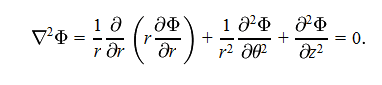
Hi, so I'm trying to solve Laplace's equation by separation of variables, and there's a basic step I'm not understanding with regards to the product rule.

Given
laplace1.png


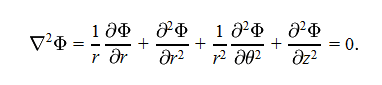
A product rule (i think) is taken to make the first term easier to deal with and we get
laplace2.png


I'm just having trouble understanding what the derivatives of f and g are. And am I correct in saying that f = 1/r*partial wrt r
g = r * partial phi wrt r

Thank you
 
Physics news on Phys.org
Vapor88 said:
I'm just having trouble understanding what the derivatives of f and g are. And am I correct in saying that f = 1/r*partial wrt r
g = r * partial phi wrt r

No, to apply the product rule to [itex]\frac{\partial}{\partial r}\left(r\frac{\partial \Phi}{\partial r}\right)[/itex], you let [itex]f(r)=r[/itex] and [itex]g(r)=\frac{\partial \Phi}{\partial r}[/itex].
 
If that's the case, then I have a problem. How do you multiply partial derivatives together? I don't see at all how you go from equation one to equation two.
 
Hey Vapor,

If you are trying to use separation of variables then your first step should be:
[tex]\phi = f(r)g(\theta)h(z)[/tex].

Coto
 
Coto,

I'm okay on that end of things, and understand every step when I plug those equations in, but I just can't get a grasp of this first one.
 
Hmm :). Generally speaking, it doesn't make sense to separate that derivative. It makes more sense to keep it as is since you can then easily solve the differential equation that results for r.

In other words, applying the product rule actually moves you back a step!

Anyway, the product rule is:
[tex]\frac{d}{dr}(f(r) \cdot g(r)) = g(r)\frac{df}{dr} + f(r)\frac{dg}{dr}[/tex].

Use this in combination with gabbas advice, where,
[tex]\frac{d}{dr}\frac{d\phi}{dr} = \frac{d^2\phi}{dr^2}[/tex].
 
As coto says, the product rule tells you that

[tex]\frac{\partial}{\partial r}\left(r\frac{\partial \Phi}{\partial r}\right)=\frac{\partial}{\partial r}\left(f(r)g(r)\right)=\frac{\partial f}{\partial r}g(r)+f\frac{\partial g}{\partial r}[/tex]

So, calculate [tex]\frac{\partial f}{\partial r}[/itex] and [tex]\frac{\partial g}{\partial r}[/itex] and see what that gives you.[/tex][/tex]
 
Coto said:
Hmm :). Generally speaking, it doesn't make sense to separate that derivative. It makes more sense to keep it as is since you can then easily solve the differential equation that results for r.

That depends on what form you are used to seeing Bessel's differential equation in.
 
gabbagabbahey said:
That depends on what form you are used to seeing Bessel's differential equation in.

I suppose. I strongly encourage the "Sturm-Liouville" form.
 
  • #10
Excellent. I now understand. I guess I was just having a problem with the notation of it. I didn't understand that the partial wrt r was for what was in the parentheses after it, and that the 1/r term is simply multiplied through afterwards. Thanks!
 

Similar threads

Replies
2
Views
2K
Replies
10
Views
3K
Replies
9
Views
2K
  • · Replies 2 ·
Replies
2
Views
2K
Replies
5
Views
4K
  • · Replies 1 ·
Replies
1
Views
3K
Replies
12
Views
2K
  • · Replies 2 ·
Replies
2
Views
2K
  • · Replies 36 ·
2
Replies
36
Views
6K
  • · Replies 4 ·
Replies
4
Views
3K