LCSphysicist
- 644
- 163
- Homework Statement
- All below
- Relevant Equations
- N/A
I was just thinking, if is said to me demonstrate any geometry statement, can i open the vector in its vector's coordinates? I will say more about:
For example, if is said to me: Proof the square's diagonals are orthogonal, how plausible is a proof like?:
d1 = Diagonal one = (a,b,c)
d2 = Diagonal two =(-a,-b,c)
but a² + b² = l² = c²
d1*d2 = (-a² -b² + c²) = (-(a² + b²) + c²) = > This is the dot product
The problems i see is:
#1 = I adopt a R3 space.
#2 = I assumed the basis orthogonal, so the distance between the vertex lying in the same side is (a²+b²)^(1/2)
The dot product holds for any basis anyway.
Can someone say: "(This is not a general proof, you adopt the orthogonal basis and R3)"?
We could try to proof by plane geometry, this is the general proof?
OBS: There is too
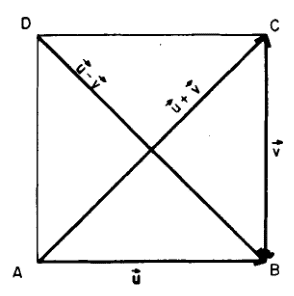
 (the rest is easy)
What seems to me more general proof.
For example, if is said to me: Proof the square's diagonals are orthogonal, how plausible is a proof like?:
d1 = Diagonal one = (a,b,c)
d2 = Diagonal two =(-a,-b,c)
but a² + b² = l² = c²
d1*d2 = (-a² -b² + c²) = (-(a² + b²) + c²) = > This is the dot product
The problems i see is:
#1 = I adopt a R3 space.
#2 = I assumed the basis orthogonal, so the distance between the vertex lying in the same side is (a²+b²)^(1/2)
The dot product holds for any basis anyway.
Can someone say: "(This is not a general proof, you adopt the orthogonal basis and R3)"?
We could try to proof by plane geometry, this is the general proof?
OBS: There is too
What seems to me more general proof.