Protein structure drawing method

Click For Summary
SUMMARY

The discussion centers on the terminology used for drawing protein and RNA structures, specifically the method of flattening these structures to visualize amino acid sequences. Participants identify this method as a "secondary structure diagram," with variations including "flattened secondary structure" and "2D secondary structure." For RNA, the term "stem-loop diagrams" is also mentioned. The conversation highlights the aesthetic appeal of these diagrams, comparing them to street maps.

PREREQUISITES
  • Understanding of protein and RNA structures
  • Familiarity with secondary and tertiary structures in biochemistry
  • Knowledge of diagrammatic representation in molecular biology
  • Basic concepts of amino acid sequences and their visualization
NEXT STEPS
  • Research "secondary structure diagrams" in molecular biology
  • Explore "stem-loop diagrams" for RNA visualization
  • Learn about the differences between secondary and tertiary structures in proteins
  • Investigate software tools for creating protein structure diagrams
USEFUL FOR

Biochemists, molecular biologists, educators, and students interested in the visualization of protein and RNA structures.

John37309
Messages
102
Reaction score
0
Protein structure drawing method

I want to know the proper name given to this particular method of drawing proteins, RNA and Genes. I have two examples;

If you look at the Wikipedia page for tRNA, they show the Tertiary structure of tRNA like this;
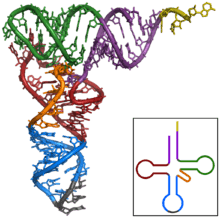
220px-TRNA-Phe_yeast_1ehz.png


http://en.wikipedia.org/wiki/Transfer_RNA

But they also show this particular type of secondary tRNA structure;
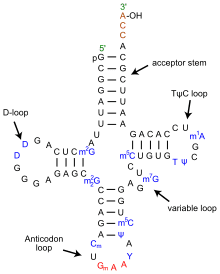
220px-TRNA-Phe_yeast_en.svg.png


I personally describe this method as flattening out the structure so we can see the exact amino acid sequence more clearly. Wikipedia describes this structure for tRNA as the "Secondary cloverleaf structure". But they only say that because tRNA looks like a three leaf clover when you flatten it out like that. Other proteins and stuff take on very different patterns when you flatten them out!

The same flattening method is used here for the Gene HAR1F;
http://en.wikipedia.org/wiki/HAR1F

I want to know what is the proper name given to this flattening method of drawing proteins, amino acids and genes?

John.
 
Last edited:
Biology news on Phys.org
I don't know if there's a specific name, but it'd call it a secondary structure diagram. These types of images are meant to represent the secondary structure (e.g. the base pairing for RNAs or the alpha-helices/beta-sheets for proteins), but do not accurately represent the tertiary structure (the overall 3D folding) of the molecules.
 
Thanks Ygggdrasil,
So your not aware of any specific name given to this particular drawing method other than just "secondary structure" or maybe "flattened secondary structure" or maybe "2D secondary structure".

OK, Thank you,
John.
 
For nucleic acids (especially RNA), I've heard them referred to as stem-loop diagrams.

For proteins, it's usually just "secondary structure diagram" in my experience.
 
Thanks Mike,
Yes, that seems to be the case here. People just seem to be referring to these drawings as secondary structure.

These drawings are beautiful, they have an hypnotic effect on my mind. Some of them become very large and very complex. But the more complex they get, the more beautiful they look. The look like street maps for living things! stunning! Shockingly beautiful! It reminds me of the London underground maps :)

16S rRNA Secondary Structure

rrna.gif


John.
 
Last edited:

Similar threads

Replies
4
Views
3K
  • · Replies 4 ·
Replies
4
Views
3K
  • · Replies 8 ·
Replies
8
Views
2K
  • · Replies 4 ·
Replies
4
Views
4K
Replies
10
Views
8K
  • · Replies 11 ·
Replies
11
Views
7K
  • · Replies 1 ·
Replies
1
Views
3K
  • · Replies 1 ·
Replies
1
Views
14K
  • · Replies 1 ·
Replies
1
Views
3K
  • · Replies 4 ·
Replies
4
Views
2K