Prove that dim(V⊗W)=(dim V)(dim W)

Click For Summary
SUMMARY

The discussion centers on the proof that the dimension of the tensor product of two vector spaces, denoted as dim(V⊗W), equals the product of their dimensions, dim V * dim W. The tensor product is defined as V⊗W = {f: V^* × W^* → k | f is bilinear}, where V^* and W^* are the dual spaces of V and W. The equality (e_i⊗f_j)(φ,ψ) = φ(e_i)ψ(f_j) is established through the definition of the bilinear map, confirming that the set {e_i⊗f_j} forms a basis for V⊗W, leading to the conclusion that dim(V⊗W) = dim V * dim W.

PREREQUISITES
  • Understanding of tensor products in linear algebra
  • Familiarity with dual spaces, specifically V^* and W^*
  • Knowledge of bilinear maps and their properties
  • Basic concepts of vector space dimension
NEXT STEPS
  • Study the properties of bilinear maps in linear algebra
  • Explore the concept of dual spaces and their applications
  • Learn about the uniqueness of tensor products in category theory
  • Investigate the role of bases in vector spaces and their implications for dimension
USEFUL FOR

Mathematicians, students of linear algebra, and anyone interested in advanced vector space theory and tensor products.

Karl Karlsson
Messages
104
Reaction score
12
TL;DR
This proof was in my book.
(see image below)
Tensor product definition according to my book: $$V⊗W=\{f: V^*\times W^*\rightarrow k | \textrm {f is bilinear}\}$$ wher ##V^*## and ##W^*## are the dual spaces for V and W respectively.

I don't understand the step where they say ##(e_i⊗f_j)(φ,ψ) = φ(e_i)ψ(f_j)##. Why is this equality true? What definition has been used? My understanding for all of this is still quite basic.
This proof was in my book.
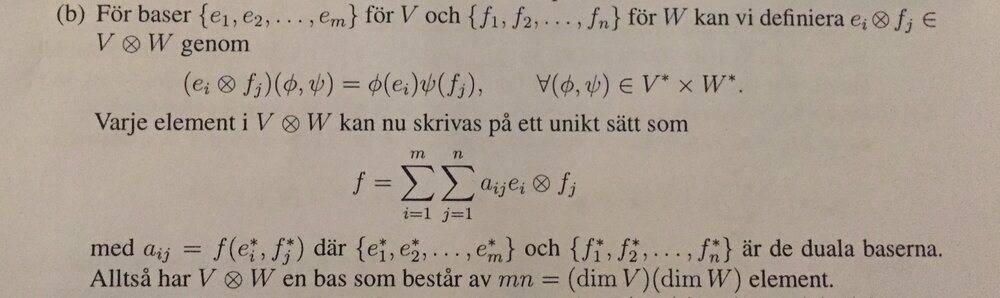
IMG_0775.jpg

Tensor product definition according to my book: $$V⊗W=\{f: V^*\times W^*\rightarrow k | \textrm {f is bilinear}\}$$ wher ##V^*## and ##W^*## are the dual spaces for V and W respectively.

I don't understand the step where they say ##(e_i⊗f_j)(φ,ψ) = φ(e_i)ψ(f_j)##. Why is this equality true? What definition has been used? My understanding for all of this is still quite basic.

Thanks in advance!
 
Physics news on Phys.org
This is true because they define it that way. By definition, ##e_i \otimes f_j## is the bilinear map defined by $$e_i \otimes f_j: V^* \times W^* \to k: (\phi, \psi) \mapsto \psi(e_i) \psi(f_j)$$
It is just a definition. The only thing you should check is that this map is indeed ##k##-bilinear. We then obtain that ##e_i \otimes f_j \in V \otimes W## and it is then checked that ##\{e_i \otimes f_j\}_{(i,j)}## is a basis for ##V \otimes W## and since this basis has ##\dim V \dim W## amount of elements, you can conclude ##\dim(V \otimes W) = \dim V \dim W##.
 
It should have been part of the definition. As it is written, it suggests that it cannot be done otherwise, which would require a proof. However, uniqueness of the tensor product is easier to prove in the language of categories, rather than using coordinates. The way it was done in the book is a mixture of both - neither done rigorously. The shortest way out of the dilemma is to incorporate it in the definition:
$$
T\in V\otimes W \Longleftrightarrow T=\sum_{\rho=1}^R v_{\rho} \otimes w_{\rho} \, : \,(X,Y)\longmapsto \sum_{\rho=1}^R v_{\rho}(X) \cdot w_{\rho}(Y) \in k
$$
for some ##v_{\rho}\in V^*,w_{\rho}\in W^*## and all ##X\in V, Y\in W.##
 
  • Skeptical
  • Like
Likes   Reactions: Karl Karlsson and member 587159

Similar threads

  • · Replies 7 ·
Replies
7
Views
3K
  • · Replies 32 ·
2
Replies
32
Views
4K
  • · Replies 4 ·
Replies
4
Views
2K
  • · Replies 2 ·
Replies
2
Views
2K
  • · Replies 2 ·
Replies
2
Views
2K
Replies
15
Views
2K
  • · Replies 1 ·
Replies
1
Views
3K
  • · Replies 1 ·
Replies
1
Views
2K
  • · Replies 2 ·
Replies
2
Views
2K
Replies
6
Views
4K