Proving Curvature at Point (a,f(a))

  • Context: Graduate 
  • Thread starter Thread starter typhoonss821
  • Start date Start date
  • Tags Tags
    Curvature Point
Click For Summary
SUMMARY

The discussion focuses on proving the curvature at the point (a, f(a)) for a smooth function f(x). The curvature formula is established as f''(a) / (1 + f'(a)^2)^(3/2). A participant suggests using the concept of an osculating circle to understand curvature, emphasizing the need for a clear definition of curvature to validate the formula. The conversation also references the Wikipedia page on curvature for further clarification.

PREREQUISITES
  • Understanding of calculus, specifically derivatives and second derivatives.
  • Familiarity with the concept of curvature in differential geometry.
  • Knowledge of osculating circles and their role in approximating curves.
  • Basic comprehension of limits and their application in calculus.
NEXT STEPS
  • Study the derivation of curvature formulas in differential geometry.
  • Learn about osculating circles and their significance in curvature analysis.
  • Explore the application of limits in defining curvature more rigorously.
  • Review the Wikipedia article on curvature for additional insights and examples.
USEFUL FOR

Students studying calculus and differential geometry, educators teaching these concepts, and anyone interested in the mathematical foundations of curvature and its applications.

typhoonss821
Messages
13
Reaction score
1
hallow everyone
i am a tenth-grade student in Taiwan.What i want to know is that how to proove the curvature at point (a,(f(a))(assume f(x) is smooth at this point) is
f"(a)/(1+f'(a)^2)^(3/2))
i've thought this way:consider a circle first
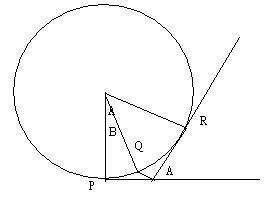
未命名.JPG

in this circle the curvature at point P is lim arcPR/A as R approaches P ,curvature at point Q supposesd to be lim arcQR/(A-B) as R approaches Q
it might be d(arcQR)/d(A-B),equaling to d(arcQR)/d(A-(A-B)),because (A-B) is constant,it also equals to arcPR/A
So if we draw an ossculating cirsle at (a,(f(a)) ,we can reply the conclusion to deal with the problem,is this saying right??
 
Last edited:
Physics news on Phys.org

Similar threads

  • · Replies 3 ·
Replies
3
Views
2K
  • · Replies 9 ·
Replies
9
Views
3K
  • · Replies 1 ·
Replies
1
Views
2K
  • · Replies 16 ·
Replies
16
Views
4K
  • · Replies 5 ·
Replies
5
Views
2K
  • · Replies 1 ·
Replies
1
Views
2K
  • · Replies 3 ·
Replies
3
Views
4K
  • · Replies 30 ·
2
Replies
30
Views
4K
  • · Replies 5 ·
Replies
5
Views
2K
  • · Replies 8 ·
Replies
8
Views
2K