Proving the Chord One Rule in Circle Theorems | Isosceles Triangle Proof

  • Thread starter Thread starter adjacent
  • Start date Start date
  • Tags Tags
    Circle
Click For Summary

Homework Help Overview

The discussion revolves around proving a specific rule in circle theorems related to isosceles triangles, particularly focusing on the relationship between a chord and the radius drawn to its midpoint.

Discussion Character

  • Conceptual clarification, Mathematical reasoning, Problem interpretation

Approaches and Questions Raised

  • Participants explore the properties of isosceles triangles and the angles formed by lines drawn from the vertex to the midpoint of the base. There are attempts to establish relationships between angles and sides, as well as discussions on congruence and the implications of angle sums.

Discussion Status

The conversation includes various attempts to clarify the proof's requirements and the relationships between angles. Some participants provide insights into congruence and angle relationships, while others express uncertainty about the assumptions being made.

Contextual Notes

Participants are navigating through the proof without assuming prior knowledge of certain properties, leading to questions about angle measures and the nature of right triangles. The discussion reflects a mix of established geometric principles and ongoing exploration of the proof's validity.

adjacent
Gold Member
Messages
1,552
Reaction score
62
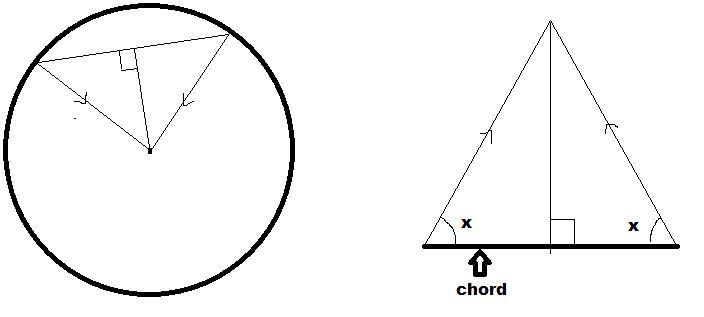
One rule of circle theorems is,a line drawn from center to the mid-point of a chord cuts the cord at 90°.
What's the proof?
It's true that two radius and a chord creates an isosceles triangle.
So,
attachment.php?attachmentid=64135&stc=1&d=1384969206.gif


How can I prove that in an isosceles triangle,a line drawn from the vertex angle to the mid-point of the base side cuts the side at 90°?
 

Attachments

  • Chord.gif
    Chord.gif
    4.2 KB · Views: 699
Last edited:
Physics news on Phys.org
You don't (yet) know that those two angles are 90 degrees... But what do you know about them?
 
Nugatory said:
You don't (yet) know that those two angles are 90 degrees... But what do you know about them?
I'm not talking about the base anlgles.I am talking about the 90° angle you see in the image.
let vertex angle be y
##180-(\frac{y}{2}+x)=90##
##2x+y=180##

I can't seem to solve y and x.I don't know whether this is a proof or not. :confused:
 
adjacent said:
I'm not talking about the base anlgles.
I am talking about the 90° angle you see in the image.
I'm sorry, I wasn't clear. Those two 90-degree angles are the two angles that I mean, and my question still stands: What do you know about them?
 
Nugatory said:
I'm sorry, I wasn't clear. Those two 90-degree angles are the two angles that I mean, and my question still stands: What do you know about them?
hahahah.

I don't know what do you mean.
In a right angle triangle, ##c^2=a^2+b^2##

c and b of both triangles is same.
so if it is two right angle triangles,a should be same
As the line was drawn to the midpoint,a is same in both triangles.So it is a right angle triangle.
Is this enough for a proof?
 
Last edited:
adjacent said:
hahahah.

I don't know what do you mean.
In a right angle triangle, ##c^2=a^2+b^2##

c and b of both triangles is same.
so if it is two right angle triangles,a should be same
As the line was drawn to the midpoint,a is same in both triangles.So it is a right angle triangle.
Is this enough for a proof?

No, because you've worked in the assumption both are right triangles, which is what you're trying to prove. The ##c^2=a^2+b^2## relationship isn't helping any because you don't know the values for all three to prove that you do have a right triangle...

But there's a reason I keep asking what you know about the two angles, not just one of them... What is their sum?
 
Nugatory said:
No, because you've worked in the assumption both are right triangles, which is what you're trying to prove. The ##c^2=a^2+b^2## relationship isn't helping any because you don't know the values for all three to prove that you do have a right triangle...

But there's a reason I keep asking what you know about the two angles, not just one of them... What is their sum?
180°.Where any straight two lines intercept,any one side of the line has 180°.
but why should this help?If we have a 40° and a 50° angle,we would still get 180 as a sum.
 
Your midpoint line divides the large triangle into two smaller congruent triangles. They are congruent by "SSS": the two radii of the circle, the two bases, and the single ray in both triangles. From that follows that other "corresponding parts" are congruent.
 
HallsofIvy said:
Your midpoint line divides the large triangle into two smaller congruent triangles. They are congruent by "SSS": the two radii of the circle, the two bases, and the single ray in both triangles. From that follows that other "corresponding parts" are congruent.
I know it's congruent.but how do I know that the angle is 90°?
I know that if vertex angle is y,the upper angle of both triangles have to be y/2
 
  • #10
Look at the attached figure.

Since ΔABD is congruent to ΔACD ,

∠ADB = ∠ADC

Now ∠ADB + ∠ADC =180° (Linear pair )

So, 2∠ADB = 180° or ∠ADB = 90°
 

Attachments

  • Chord.gif
    Chord.gif
    4.4 KB · Views: 565
  • Like
Likes   Reactions: 1 person
  • #11
Tanya Sharma said:
Look at the attached figure.

Since ΔABD is congruent to ΔACD ,

∠ADB = ∠ADC

Now ∠ADB + ∠ADC =180° (Linear pair )

So, 2∠ADB = 180° or ∠ADB = 90°
Thank you.Now that makes sense.
You all must be very skilled in proofs.I haven't even started.
 

Similar threads

  • · Replies 14 ·
Replies
14
Views
2K
  • · Replies 5 ·
Replies
5
Views
3K
  • · Replies 16 ·
Replies
16
Views
3K
  • · Replies 6 ·
Replies
6
Views
3K
Replies
8
Views
3K
  • · Replies 8 ·
Replies
8
Views
4K
  • · Replies 12 ·
Replies
12
Views
3K
  • · Replies 1 ·
Replies
1
Views
2K
  • · Replies 2 ·
Replies
2
Views
2K
Replies
3
Views
2K