Pulley Problem With Tension Direction

Click For Summary
SUMMARY

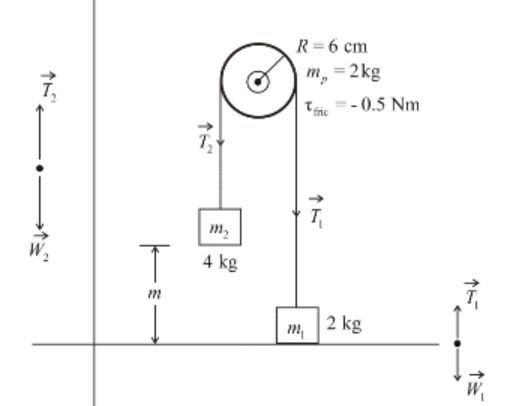
The discussion centers on the mechanics of a pulley system involving two weights and a massless rope. The pulley has a diameter of 12 cm and a mass of 2 kg, with a friction-induced torque of 0.5 Nm at the axle. The key question raised is about the direction of tension in the rope, which is downward for the weights but switches when considering the pulley. The principles of action and reaction forces are emphasized, confirming that tension is a force that acts equally and oppositely at both ends of the rope.

PREREQUISITES
  • Understanding of Newton's laws of motion
  • Basic knowledge of torque and rotational dynamics
  • Familiarity with pulley systems and tension forces
  • Concept of massless ropes in physics
NEXT STEPS
  • Study the principles of Newton's third law of motion
  • Explore calculations involving torque in pulley systems
  • Learn about the effects of friction on rotational motion
  • Investigate the dynamics of massless ropes in mechanical systems
USEFUL FOR

Physics students, mechanical engineers, and anyone interested in understanding the dynamics of pulley systems and tension forces in mechanics.
cjavier
Messages
17
Reaction score
0
In the attached picture, one sees a pulley with a mass which is holding two different weights. In chegg, the tension due to a weight is represented as a downward direction. Then, when the tension is seen in relation to the pulley, the direction switches for both weights. WHY IS THIS?!

pulley2.jpg


Thanks,
Cameron
 
Physics news on Phys.org
What problem is it? Can you tell me what it is or what problem from chegg you are trying to understand?
 
LoadedAnvils said:
What problem is it? Can you tell me what it is or what problem from chegg you are trying to understand?

The two blocks in the figure are connected by a massless rope that passes over a pulley. The pulley is 12cm in diameter and has a mass of 2kg. As the pulley turns, friction at the axle exerts a torque of magnitude 0.5Nm. If the blocks are released from rest, how long does it take the 4 kg block to reach the floor?
 
It's standard action and reaction. A weight pulls down on a string with an equal and opposite force to that with which the string pulls up on the weight. Similarly between string and pulley, and between each little section of string and its neighbours.
 
Hi Cameron! :smile:
cjavier said:
… the tension due to a weight is represented as a downward direction. Then, when the tension is seen in relation to the pulley, the direction switches for both weights. WHY IS THIS?!

Tension is a force.

The tensions at the two ends of a rope are opposite (and equal in magnitude if the rope is massless). :wink:
 

Similar threads

  • · Replies 10 ·
Replies
10
Views
5K
  • · Replies 2 ·
Replies
2
Views
2K
  • · Replies 12 ·
Replies
12
Views
1K
  • · Replies 3 ·
Replies
3
Views
2K
  • · Replies 15 ·
Replies
15
Views
6K
  • · Replies 1 ·
Replies
1
Views
2K
  • · Replies 22 ·
Replies
22
Views
3K
  • · Replies 3 ·
Replies
3
Views
2K
  • · Replies 17 ·
Replies
17
Views
3K
  • · Replies 22 ·
Replies
22
Views
1K