Est120
- 54
- 3
- Homework Statement
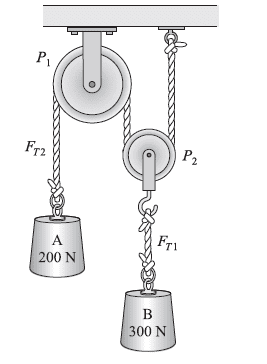
- In Figure 3-25, the weights of the objects are 200 N and 300 N. It is considered
that the pulleys have no friction and that their masses are negligible. Pulley
P1 has a stationary axis, the P2 pulley can raise or lower freely.
Calculate the tensions FT1 and FT2, as well as the acceleration of each body
- Relevant Equations
- F=m a
Homework Statement: In Figure 3-25, the weights of the objects are 200 N and 300 N. It is considered
that the pulleys have no friction and that their masses are negligible. Pulley
P1 has a stationary axis, the P2 pulley can raise or lower freely.
Calculate the tensions FT1 and FT2, as well as the acceleration of each body
Homework Equations: F=m a
this problem is in the schaum physics book 10 ed 3.37 and says something like this:
Mass B rises and mass A falls. This can be seen if it is observed that the forces acting on the P2 pulley are 2FT2 up and FT1 down
WHY does the forces acting on P2 pulley are 2FT2?
that the pulleys have no friction and that their masses are negligible. Pulley
P1 has a stationary axis, the P2 pulley can raise or lower freely.
Calculate the tensions FT1 and FT2, as well as the acceleration of each body
Homework Equations: F=m a
this problem is in the schaum physics book 10 ed 3.37 and says something like this:
Mass B rises and mass A falls. This can be seen if it is observed that the forces acting on the P2 pulley are 2FT2 up and FT1 down
WHY does the forces acting on P2 pulley are 2FT2?
Last edited by a moderator: