Pulley system to balance the weight of a person

Click For Summary
SUMMARY

The discussion centers on analyzing the forces in an ideal pulley system used to balance the weight of a person. Participants confirm that the tensions T1, T2, and T3 are equal, denoting them as F, and derive that F equals (m + m_p)g/2. The tension T4 is debated, with the conclusion that it equals 3F plus the weight of the upper pulley (M_p g). The importance of free body diagrams in clarifying the relationships between forces in the system is emphasized.

PREREQUISITES
  • Understanding of Newton's laws of motion
  • Familiarity with free body diagrams
  • Basic knowledge of tension in ideal pulley systems
  • Concept of equilibrium in mechanical systems
NEXT STEPS
  • Study the principles of static equilibrium in mechanical systems
  • Learn how to draw and analyze free body diagrams
  • Explore the effects of friction in real-world pulley systems
  • Investigate advanced topics in mechanics, such as torque and angular momentum
USEFUL FOR

Students of physics, mechanical engineers, and anyone interested in understanding the mechanics of pulley systems and equilibrium forces.

lorenz0
Messages
151
Reaction score
28
Homework Statement
If the mass of the man to be saved is ##m##, the mass of the smaller pulley ##m_p## and the mass of the bigger pulley ##M_p##, find: ##T_1, T_2, T_3, T_4, T_5, F.##
Relevant Equations
##\vec{F}=m\vec{a}##
Since we are dealing with an ideal rope, we have that ##T_1=T_2=T_3=F and T_2+T_3=2F=(m+m_p)g\Leftrightarrow F=\frac{m+m_p}{2}g.##
##T_4=3F+(m+m_p+M_p)g=\frac{3}{2}(m+m_p)g+(m+m_p+M_p)g=(\frac{5}{2}m+\frac{5}{2}m_p+M_p)g## and ##T_5=mg-2F.##

Is this correct? If not, I woould appreciate a brief explanation on how to deal with these ideal-pulley ideal-rope systems since they seem quite counterintuitive to me.
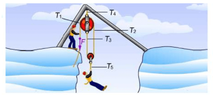
 

Attachments

  • pulley.png
    pulley.png
    75.3 KB · Views: 178
Physics news on Phys.org
I agree that ##T_1 = T_2 = T_3## and that we can call this ##F##. As you say, the pulleys are ideal so all three tensions will match.

I agree that ##T_2 + T_3 = 2F##. Since those two tensions support the man plus the smaller pulley, it follows that ##2F = (m+m_p)g##. So yes, we can conclude that ##F=\frac{m+m_p}{2}g##

You will have to persuade me that ##T_4 = 3F + (m + m_p + M_p)g##. How did you arrive at that? I think you are double dipping there.
 
  • Like
Likes   Reactions: lorenz0, Steve4Physics and Lnewqban
@lorenz0, in addition to what @jbriggs444 has said, can I add this...

Presumably the system is in equilibrium (acceleration = 0).

Your equations/logic could be clearer if not joined together into a single line/paragraph.

The facts that ##T_1 = T_2 = T_3## and ##T_2+T_3=2F## lead to ##T_1 = F##. Can you see a simpler way to get this relationship directly?

All parts of the system are in equilibrium. You can draw a free body diagram for any part of the system. If you draw (or just imagine) a free body diagram for the upper pulley alone, it should help you.
 
  • Like
Likes   Reactions: Lnewqban and lorenz0
Steve4Physics said:
@lorenz0, in addition to what @jbriggs444 has said, can I add this...

Presumably the system is in equilibrium (acceleration = 0).

Your equations/logic could be clearer if not joined together into a single line/paragraph.

The facts that ##T_1 = T_2 = T_3## and ##T_2+T_3=2F## lead to ##T_1 = F##. Can you see a simpler way to get this relationship directly?

All parts of the system are in equilibrium. You can draw a free body diagram for any part of the system. If you draw (or just imagine) a free body diagram for the upper pulley alone, it should help you.
Drawing the free body diagram for the upper pulley alone, it seems that ##T_4=3F+M_Pg.## Is this correct?
 
Last edited:
lorenz0 said:
Drawing the free body diagram for the upper pulley alone, it seems that ##T_4=3F.## Is this correct?
No. You missed something this time.
 
jbriggs444 said:
No. You missed something this time.
The mass of the upper pulley, I guess.
 
  • Like
Likes   Reactions: jbriggs444
lorenz0 said:
Drawing the free body diagram for the upper pulley alone, it seems that ##T_4=3F.## Is this correct?
Pulley.jpg
 
lorenz0 said:
The mass of the upper pulley, I guess.
You mean the weight of the upper pulley. (Hopefully it's not a 'guess', as a free body diagram must include the body's weight.) Your Post #4 edited equation is now correct.

BTW, it's best to not significantly edit a post once someone has replied to it. Better to write a new Post making clear any changes you want. That can avoid confusion and messages at cross-purposes.
 
  • Like
Likes   Reactions: lorenz0 and Lnewqban

Similar threads

  • · Replies 40 ·
2
Replies
40
Views
5K
  • · Replies 22 ·
Replies
22
Views
6K
  • · Replies 8 ·
Replies
8
Views
3K
  • · Replies 18 ·
Replies
18
Views
938
  • · Replies 22 ·
Replies
22
Views
1K
  • · Replies 18 ·
Replies
18
Views
5K
Replies
4
Views
849
  • · Replies 2 ·
Replies
2
Views
1K
  • · Replies 11 ·
Replies
11
Views
2K
  • · Replies 30 ·
2
Replies
30
Views
4K