Pulley-to-Shaft-to-Pulley Calculation?

  • Context: Undergrad 
  • Thread starter Thread starter playludesc
  • Start date Start date
  • Tags Tags
    Calculation
Click For Summary

Discussion Overview

The discussion revolves around calculating the RPM of a blue pulley based on the RPM of a black pulley and their respective diameters. Participants explore the relationship between pulley diameters and rotational speeds, considering mechanical advantage and the implications of different pulley configurations. The context includes practical applications related to a supercharger setup.

Discussion Character

  • Exploratory
  • Technical explanation
  • Debate/contested
  • Mathematical reasoning

Main Points Raised

  • One participant seeks to calculate the RPM of the blue pulley using the diameters and RPM of the black pulley, suggesting a mechanical advantage approach.
  • Another participant argues that if the pulleys are on the same shaft, they would rotate at the same rate, implying that the speeds of the belts would be proportional to the diameters.
  • There is a discussion about whether the RPMs would differ if the pulleys are connected by a belt, with some suggesting that the peripheral speeds would be the same.
  • A participant clarifies that if two wheels are connected via a normal axle, they will have the same RPM, regardless of their diameters, and distinguishes between rotational speed and tangential speed.
  • One participant simplifies the velocity equations, proposing a relationship between the tangential speeds and diameters of the pulleys.
  • Another participant inquires about the nature of the blue pulley, asking if it is a variable diameter sheave, and shares details about their supercharger project.

Areas of Agreement / Disagreement

Participants express differing views on whether the RPMs of the pulleys would be the same or different based on their configuration. Some agree on the method of calculating the "out" speed for the blue pulley, while others emphasize the need to distinguish between RPM and tangential speed. The discussion remains unresolved regarding the best approach to calculate the RPM of the blue pulley.

Contextual Notes

Participants mention the importance of understanding the setup of the pulleys, including whether they are on the same shaft or connected by a belt. There are also references to potential confusion between rotational speed and tangential speed, which may affect the calculations.

Who May Find This Useful

Individuals interested in mechanical engineering, automotive design, or pulley systems may find this discussion relevant, particularly those working on projects involving superchargers or similar mechanical configurations.
playludesc
Messages
8
Reaction score
0
Hello all! I'm working with a particular pulley configuration and I realized after a few calculations that I don't have an accurate way to calculate one part of the set up.

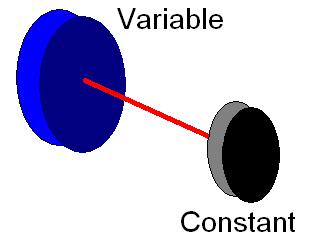
Here's a quick MSPaint sketch showing what I need to solve for. If I know the outer diameter of both pulleys, and the RPM of the black pulley, how can I solve for the RPM at the outer diameter of the blue pulley? (If you care, this is regarding the jackshaft for my supercharger!)

PulleyQ.jpg


Thanks very much for your help!
 
Physics news on Phys.org
So I figured that this is probably a simple mechanical advantage equation, as the two pulleys simply work like levers on each other. Here's what I ended up with:

Blue pulley diameter = 1.835"
Black pulley diameter = 2.000"
Black pulley RPM = 22,023.5

1.835/2.000 = 0.9175

22,023.5*0.9175 = RPM for Blue pulley of 20,206.5

Can anyone confirm if I've done that correctly; or, more importantly, if mechanical advantage is the right way to calculate this?
 
If they're on the same shaft (as in the picture) then they would both rotate at the same rate so the speeds of the two belts (?) will be proportional to the diameters. If they are coupled by a belt then the peripheral speeds will be the same.
Take your pick.
 
sophiecentaur said:
If they're on the same shaft (as in the picture) then they would both rotate at the same rate so the speeds of the two belts (?) will be proportional to the diameters. If they are coupled by a belt then the peripheral speeds will be the same.
Take your pick.

Right, would the belts' speed be directly proportional, like in my calculation above? Or should I be using a different formula?
 
playludesc said:
Right, would the belts' speed be directly proportional, like in my calculation above? Or should I be using a different formula?

Which bit are you asking is right? In one bit you seem to imply that the RPMs would be different. How could that be if they are on the same shaft?
The belt speed 'out' will be belt speed 'in' times the ratio of diameters - it's that simple.
 
Hi playludesc! I'm not sure I understand your sketch (what does variable and constant mean in the sketch?). If two wheels are connected via a normal axle, they will have the same RPM (revolutions/minute), regardless of the diameter of the wheels (unless you mean some entirely different setup). You may be confusing rotational speed (revolutions/minute) with tangential speed (e.g. centimeters/second).

The circumferences c of the wheels are (d are diameters):

cblack = pi*dblack

cblue = pi*dblue

so the tangential velocities v at the circumference of the wheels will be

vblack = cblack/t = pi*dblack * RPM

vblue = cblue/t = pi*dblue * RPM

If you measure the diameters in cm, the velocities above will be cm/minute (and t is time in minutes).
If you measure the diameters in inches, the velocities above will be inches/minute.
Edit: I saw sophiecentaur had already answered about the RPM, while I was writing my reply...
 
Last edited:
sophiecentaur said:
Which bit are you asking is right? In one bit you seem to imply that the RPMs would be different. How could that be if they are on the same shaft?
The belt speed 'out' will be belt speed 'in' times the ratio of diameters - it's that simple.

That's what I thought. Sorry if my phrasing was confusing.

I'm just asking if my method of calculating the "out" speed for the blue pulley is correct in my second post. Your posts seem to agree with my method, so we're good!
 
DennisN said:
Hi playludesc! I'm not sure I understand your sketch (what does variable and constant mean in the sketch?). If two wheels are connected via a normal axle, they will have the same RPM (revolutions/minute), regardless of the diameter of the wheels (unless you mean some entirely different setup). You may be confusing rotational speed (revolutions/minute) with tangential speed (e.g. centimeters/second).

The circumferences c of the wheels are (d are diameters):

cblack = pi*dblack

cblue = pi*dblue

so the tangential velocities v at the circumference of the wheels will be

vblack = cblack/t = pi*dblack * RPM

vblue = cblue/t = pi*dblue * RPM

If you measure the diameters in cm, the velocities above will be cm/minute (and t is time in minutes).
If you measure the diameters in inches, the velocities above will be inches/minute.
Edit: I saw sophiecentaur had already answered about the RPM, while I was writing my reply...

Thanks very much for taking the time to answer so thoroughly. I think sophie confirmed that I'm on track for my application. Even so, I'll wrap my English degree head around your post and get back to you in a bit!
 
A jackshaft, also called a countershaft, is a common mechanical design component used to transfer or synchronize rotational force in a machine. A jackshaft is often just a short stub with supporting bearings on the ends and two pulleys, gears, or cranks attached to it.
http://en.wikipedia.org/wiki/Jackshaft

Aha that solves the mystery. Sophie and dennis both picked up on it.

Is your blue pulley a variable diameter sheave?
What are you supercharging, just out of curiosity?
 
  • #10
Nah, blue pulley will be a timing belt pulley, I'm just trying to figure out exactly what size to make it, which in the calculation/selection phase makes it the variable.

I've got a ported M62 going on the H22a4 in my fifth generation Prelude.
 
  • #11
Hi again! I might as well also simplify my two velocity equations further. If the pullies have the same RPM (as I suppose), then the velocity relations can be divided to yield the following relation;

vblue/vblack = dblue/dblack

which means e.g.

dblue = (dblack*vblue)/vblack

(d=diameters, v=tangential speeds)
I don't know if it helps you, I'm not sure about the other stuff in your project :smile:. (Btw, the t I used before was the period, i.e. the time for one revolution.)
 
Last edited:

Similar threads

  • · Replies 1 ·
Replies
1
Views
2K
  • · Replies 4 ·
Replies
4
Views
2K
  • · Replies 8 ·
Replies
8
Views
4K
  • · Replies 30 ·
2
Replies
30
Views
3K
Replies
1
Views
4K
  • · Replies 5 ·
Replies
5
Views
5K
Replies
3
Views
6K
  • · Replies 1 ·
Replies
1
Views
4K
  • · Replies 5 ·
Replies
5
Views
5K
Replies
17
Views
2K