Discovering the Keq of a System: Understanding Pulleys and Springs

Click For Summary
SUMMARY

The discussion centers on calculating the equivalent spring constant (Keq) of a system involving pulleys and springs. The key equation derived is x = 2(x1 + x2), where x represents the displacement of the mass, and x1 and x2 are the displacements of Pulley 1 and Pulley 2, respectively. The relationship between the movements of the pulleys and the mass is clarified, demonstrating that when Pulley 1 moves through x1, the mass moves through a distance of y1 = 2x1, and similarly for Pulley 2. This understanding is crucial for accurately determining the system's behavior under applied forces.

PREREQUISITES
  • Understanding of basic mechanics, specifically the principles of pulleys and springs.
  • Familiarity with the concept of displacement in mechanical systems.
  • Knowledge of spring constants and their role in system dynamics.
  • Ability to manipulate algebraic equations to solve for unknowns.
NEXT STEPS
  • Study the principles of mechanical advantage in pulley systems.
  • Learn about the derivation and application of Hooke's Law in spring systems.
  • Explore the concept of equivalent spring constants in series and parallel configurations.
  • Investigate the dynamics of combined pulley and spring systems in real-world applications.
USEFUL FOR

This discussion is beneficial for physics students, mechanical engineers, and anyone interested in understanding the dynamics of pulley systems and their interactions with springs.

Saladsamurai
Messages
3,009
Reaction score
7
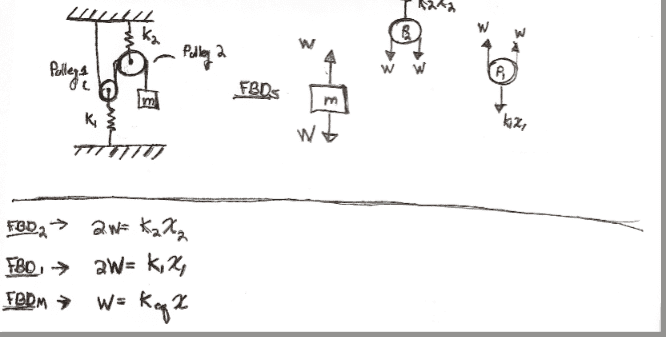
So I am trying to follow along this example in the text to find keq of the system.

I can follow everything up until the point that they say: "It follows that x=2(x1+x2)

where:

x = displacement of mass
x1 =displacement of Pulley1cm
x2 =displacement of Pulley2cm

I am not seeing it. I am also very tired. So please help me and then slap me :smile:
Picture6-3.png
 
Physics news on Phys.org
For the time being, suppose k2 is not operating. When the pulley1 moves up through x1, what is the distance moved by the mass ?
 
Yeah. I don't see it. How ca I relate anything to x?

Like rl.bhat says: If k2 was not operating, I know that 2W=k1*x1 ... but I
don't see how that helps?
 
Anyone?
 
Just compare the movement of the pulley and release of the rope at mass end.
When the pulley1 moves through x1, mass moves through y1 distance ,then y1 = 2x1. Similarly for pulley 2, y2 = 2x2. So the distance moved by the mass y1 + y2 = x = 2(x1 + x2)
 
Okay. I mean, I believe you. I just don't see it.
 
Saladsamurai said:
Okay. I mean, I believe you. I just don't see it.
When p1 moves up through x1, on both side of the pulley x1 rope is released. That adds up to 2x1.
 
rl.bhat said:
When p1 moves up through x1, on both side of the pulley x1 rope is released. That adds up to 2x1.

Ahh. I think I see it now. Thanks for your patience!
 

Similar threads

  • · Replies 18 ·
Replies
18
Views
2K
  • · Replies 4 ·
Replies
4
Views
1K
  • · Replies 10 ·
Replies
10
Views
1K
Replies
17
Views
2K
  • · Replies 40 ·
2
Replies
40
Views
5K
Replies
8
Views
7K
Replies
6
Views
986
  • · Replies 5 ·
Replies
5
Views
7K
Replies
24
Views
4K
  • · Replies 2 ·
Replies
2
Views
829