Pulse Through Cable: Solving Part A and B

  • Thread starter Thread starter mmmboh
  • Start date Start date
  • Tags Tags
    Cable Pulse
Click For Summary

Discussion Overview

The discussion revolves around solving parts A and B of a problem related to pulse propagation through a transmission line (TL). Participants explore the calculations for wave speed, time, and voltage reflections in the context of an open circuit and characteristic impedance.

Discussion Character

  • Technical explanation
  • Mathematical reasoning
  • Debate/contested

Main Points Raised

  • One participant calculates the wave speed as V=(L/C)^-1/2=2.5x10^8 m/s and the time T=x/v for a distance of 10m, resulting in T=4x10^-8s.
  • Another participant questions the reflection of the wave, suggesting that since it is the first wave, there would be no reflecting wave yet, leading to V-=0.
  • There is a discussion about the equation for voltage amplitude V+=[VL/2](1+R0/RL) and its application in an open circuit scenario where RL is considered infinite.
  • Some participants express confusion about the amplitude calculations, with one suggesting that the pulse height should be 24V due to a combination of waves.
  • Another participant mentions the reflection coefficient equation V-/V+=(RL-R0)/(RL+R0) and explores different scenarios for voltage at the oscilloscope based on varying resistance values.
  • One participant believes that the second answer regarding voltage division is correct, indicating a potential for double the incident amplitude at the open end until multiple reflections occur.

Areas of Agreement / Disagreement

Participants express uncertainty and confusion regarding the calculations for part B, particularly about the voltage amplitudes and the effects of reflections. Multiple competing views on the correct approach and outcomes remain unresolved.

Contextual Notes

Participants reference different equations and concepts related to characteristic impedance and wave propagation, indicating a need for clarity on the application of these principles in the context of the problem.

mmmboh
Messages
401
Reaction score
0
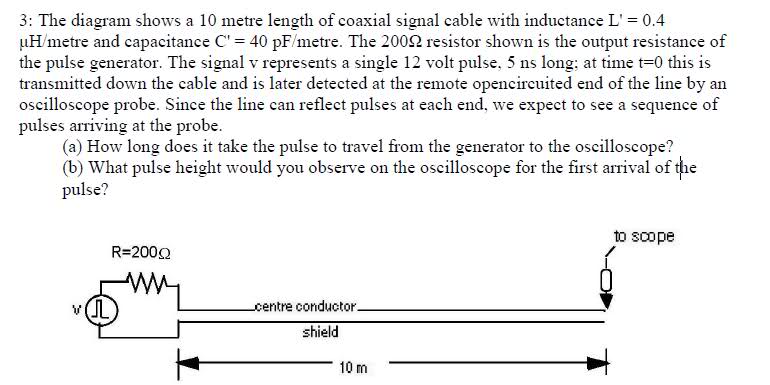
Hi, this is the question:

66ltgp.jpg


For part a) I did V=(L/C)-1/2=2.5x108 m/s. And then I said T=x/v where x=10m, so T=4x10⁻⁸s.

For part b) V++V-=VL...since it's the first wave I suppose there wouldn't be a reflecting wave yet, so V-=0.
I have an equation that says V+=[VL/2](1+R0/RL)...since it is an open circuit, RL=infinity, so R0/RL=0, and the equation becomes V+=VL/2 and VL=12V, so V+=pulse height = 6V...but if [tex]V_-=0[/tex] then according to my first equation [tex]V_+=V_L=12V[/tex]..I'm confused.

I have a feeling b) is wrong and that it should actually be 24V because of a combination of waves, I'm not sure about part a), any help please?
 
Physics news on Phys.org
mmmboh said:
Hi, this is the question:

66ltgp.jpg


For part a) I did V=(L/C)-1/2=2.5x108 m/s. And then I said T=x/v where x=10m, so T=4x10⁻⁸s.

For part b) V++V-=VL...since it's the first wave I suppose there wouldn't be a reflecting wave yet, so V-=0.
I have an equation that says V+=[VL/2](1+R0/RL)...since it is an open circuit, RL=infinity, so R0/RL=0, and the equation becomes V+=VL/2 and VL=12V, so V+=pulse height = 6V...but if [tex]V_-=0[/tex] then according to my first equation [tex]V_+=V_L=12V[/tex]..I'm confused.

I have a feeling b) is wrong and that it should actually be 24V because of a combination of waves, I'm not sure about part a), any help please?

It looks like you used the equation for characteristic impedance:

http://en.wikipedia.org/wiki/Characteristic_impedance

instead of for the propagation velocity (of a lossless TL):

http://en.wikipedia.org/wiki/Wave_propagation_speed

And to your question about the amplitude at the first reflection, remember that you are driving the TL through the 200 Ohm resistor. That will play off against the Zo of the TL. And I believe they want you to include the reflection effects in calculating the initial open circuit voltage at the open end...
 
For the propagation velocity thing, is that for part a)? I used the same equation except without the c in the denominator because I don't need what fraction of the speed of light it is.

For part b), I'm not sure I understand what to do in that case, is the equation I used wrong?
 
mmmboh said:
For the propagation velocity thing, is that for part a)? I used the same equation except without the c in the denominator because I don't need what fraction of the speed of light it is.

You posted for part a:

For part a) I did V=(L/C)-1/2

That's Zo.
 
Ooh right, I meant to put v=(LC)^-1/2 actually, that's the calculation I did, so the answer remains the same for part a).
 
Ok so from my equation for reflection coefficient, V-/V+(=RL-R0)/(RL+R0)...since there is an open circuit at the oscilloscope RL=infinity, and so V-/V+=1...so V- and V+ add together to make the pulse height at the oscilloscope 24 V...the answer is either that, or since Z0=100 ohm and the resistance in the generator is 200 ohm then V+=12V(100/300)=4V, unless it's 12V(200/300)=8V and then the V+ and V- still add and make 8V (or 16V depending on which equation is right) at the oscilloscope...

I think one of these two is the answer, maybe not, can you clear things up please?
 
mmmboh said:
Ok so from my equation for reflection coefficient, V-/V+(=RL-R0)/(RL+R0)...since there is an open circuit at the oscilloscope RL=infinity, and so V-/V+=1...so V- and V+ add together to make the pulse height at the oscilloscope 24 V...the answer is either that, or since Z0=100 ohm and the resistance in the generator is 200 ohm then V+=12V(100/300)=4V, unless it's 12V(200/300)=8V and then the V+ and V- still add and make 8V (or 16V depending on which equation is right) at the oscilloscope...

I think one of these two is the answer, maybe not, can you clear things up please?

I believe your 2nd answer is correct. As long as the TL is electrically long enough so that you can't treat it as just a lumped capacitance, then you will get the 3:1 voltage division, and the full positive reflection at the open end should give you double the incident amplitude. At least until things start ringing all over the place from the multiple reflections.
 
Ok thanks a lot!
 

Similar threads

  • · Replies 9 ·
Replies
9
Views
3K
  • · Replies 14 ·
Replies
14
Views
4K
Replies
0
Views
2K
  • · Replies 18 ·
Replies
18
Views
3K
Replies
13
Views
2K
  • · Replies 19 ·
Replies
19
Views
2K
  • · Replies 5 ·
Replies
5
Views
4K
  • · Replies 4 ·
Replies
4
Views
2K
  • · Replies 6 ·
Replies
6
Views
2K
  • · Replies 3 ·
Replies
3
Views
2K