Pumping water upwards into a large water tank

Click For Summary
SUMMARY

The discussion centers on the feasibility of pumping water from a 1000-litre tank to a 40-litre tank located below it in a campervan setup. Participants confirm that pressure is not an issue, provided the pump is appropriately selected and installed. Recommendations include using internal baffles in the larger tank to prevent sloshing and considering a pyramidal or cylindrical design for structural integrity. Venting the system is crucial to avoid airlocks and ensure proper flow.

PREREQUISITES
  • Understanding of fluid dynamics and pressure principles
  • Knowledge of pump specifications and horsepower requirements
  • Familiarity with tank design considerations, including baffles and venting
  • Experience with plumbing systems in campervans or similar vehicles
NEXT STEPS
  • Research pump selection criteria for water systems in campervans
  • Learn about the design and implementation of internal baffles in water tanks
  • Investigate the benefits of pyramidal versus cylindrical tank designs
  • Study air venting techniques for fluid systems to prevent airlocks
USEFUL FOR

Campervan enthusiasts, plumbing engineers, and anyone involved in designing water systems for mobile applications will benefit from this discussion.

domv95
Messages
1
Reaction score
0
TL;DR
Pumping water upwards against water in a tank of 1000-litres. Will the pressure be too high to push against it?
Hi everyone! Not sure if this is the right place, but here we go:

I am layman when it comes to physics, so I might be overthinking this completely, but I need to make sure that the physics stack up before I do the actual pipes etc.

I have a 1000-litre water tank and below it I have a smaller 40-litre water tank. My plan is to fill in 1000-litre water via the smaller 40-litre tank. The smaller tank sits right below the large tank. Based on this information and the information on the picture below, is this physically possible or will the pressure be too high as the 1000 litres of water will be pushing so much downwards due to gravity that I will not be able to push the water upwards against it with a regular pressure that you get from a sink faucet, let's say?

P.S. the reason I made four holes in the large water tank (one in each corner) is because this tank is located under the floor of a campervan, so if I only had one hole, let's say in the middle, then because of a low height of this water tank (only 10cm) if I was parked at a slight angle, many hundreds litres of water could be pushed to one corner and I wouldn't be able to access this water through that one hole in the middle. By having those four holes, even if I'm parked at an angle (whichever way) the water will always flow down to the smaller water tank and I will pump the water to my plumbing in the campervan from that smaller tank, which will always be full due to gravity sending the water from the large water tank.

Any information would be appreciated. Thank you in advance!
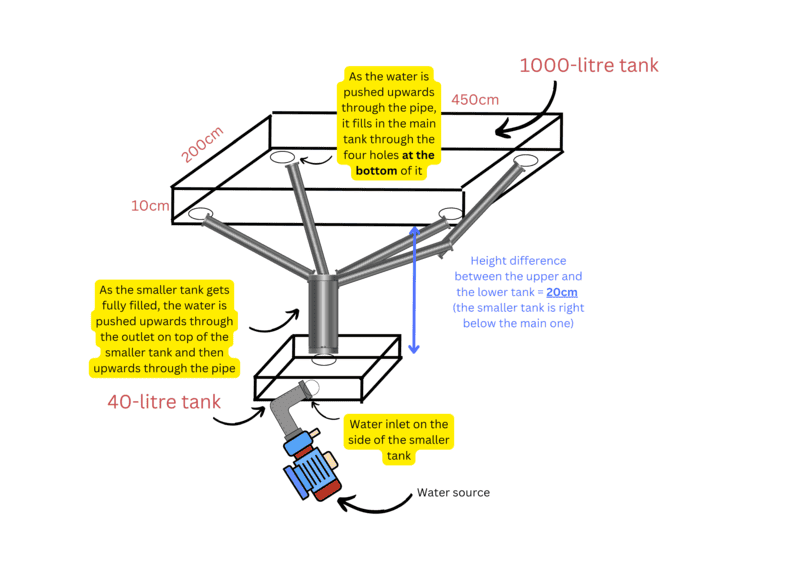
20231025_024357_0000.png
 
Physics news on Phys.org
It's all about vertical height : in your case when parked level, 30'ish centimeters : a bit over 1 ounce of force. How are you venting the system ?
 
The thing(s) limiting this are the output of the pump and the integrity of your plumbing.
You don't specify the pump horsepower so assuming you plumb it appropriately, there is technically nothing preventing this from working.

As a former campervanner myself, I am dying to know what purpose this serves.

What do you need a 1000 litres of (presumably) water for?
What is the function of the 40 litre tank? A bilge/sump?

When I park my campervan, I ensure I park it level, using a few short lengths of lumber and couple of small bubble levels on the dash.

Now, I had a propane fridge, so for me it was important to have it level when is use, or it will burn unevenly and cause all sort s of problems, but you may not have the same issues. Also, you;re gonn have real heartbreak when you try to paoch your eggs in a shallow pan.
 
Welcome to PF.
Pressure is certainly not a problem.

The top tank will need several internal baffles. Those will support the floor of the tank from above, and prevent sloshing while driving with a part filled tank.

I would eliminate the four pipes and holes, by building the top tank with a pyramidal base. That will be more rigid, and may also eliminate the bottom tank, as that becomes the low part of the top tank. The added height of a pyramidal tank will reduce the plan dimensions required for the same mass or volume of water. The weight of the empty tank will also be less. A pyramidal tank can be rinsed out more easily than one with pipes to the corners.

To prevent collapse when you drain it, or an airlock when you fill the tank, there must also be an air vent or breather from each end of the top tank. The top surface could also be pyramidal. Put an inspection and access hole in the top of the tank.

The problem with pyramidal faces is that each still has four flats. To prevent bistable flip-flopping of flat surfaces as you drive, replace the pyramids with cylindrical or conical surfaces. That will eliminate fatigue at the edge and corner joints. Curve the side walls slightly to make a more rigid and reliable tank.

What material will you use to make the tank?
 
  • Informative
Likes   Reactions: DaveC426913
domv95 said:
TL;DR: Pumping water upwards against water in a tank of 1000-litres. Will the pressure be too high to push against it?

My plan is to fill in 1000-litre water via the smaller 40-litre tank.
What would be your reason for the smaller lower tank? If your pump can get water to the upper tank then why not pump straight to the top? As @Baluncore comments, the lower tank could be below - or even inside the upper tank. Could you rephrase your reasoning as You have built in a complication with the four pipes etc.

1000l of water weighs a fair bit. How about your cornering at speed?
 
The only pressure required is the head of water from the water level in the top tank to the ground. Not very much. However, if a leak occurs, then a tonne of water will pour out. Why not fill the top tank from the top, with an air gap, so nothing can escape?
 

Similar threads

  • · Replies 17 ·
Replies
17
Views
2K
Replies
50
Views
7K
  • · Replies 32 ·
2
Replies
32
Views
10K
  • · Replies 9 ·
Replies
9
Views
2K
  • · Replies 3 ·
Replies
3
Views
2K
  • · Replies 14 ·
Replies
14
Views
2K
  • · Replies 21 ·
Replies
21
Views
3K
  • · Replies 3 ·
Replies
3
Views
4K
  • · Replies 6 ·
Replies
6
Views
3K
  • · Replies 4 ·
Replies
4
Views
655