(QM) Number of states with Energy less than E

Click For Summary
SUMMARY

The discussion focuses on calculating the number of quantum states with energy less than a specified value E, derived from the equation E = (ħ²/2m)(π²/a²)(n_x² + n_y² + n_z²). Participants identified that for large N, the integers n_x, n_y, and n_z can be treated as continuous variables x, y, and z, leading to the interpretation of the problem as counting points within a sphere of radius √(2Em/a²ħ²π²). This approach allows for estimating the density of states in three-dimensional space.

PREREQUISITES
  • Quantum mechanics fundamentals, including energy quantization
  • Understanding of the Schrödinger equation and wave functions
  • Familiarity with spherical coordinates and volume calculations
  • Basic knowledge of statistical mechanics and density of states
NEXT STEPS
  • Study the concept of density of states in quantum mechanics
  • Learn about the derivation of energy levels in a three-dimensional infinite potential well
  • Explore the implications of the limit N >> 1 in quantum systems
  • Investigate the geometric interpretation of quantum states in phase space
USEFUL FOR

Students and researchers in quantum mechanics, particularly those studying energy states and density of states in three-dimensional systems.

iakmngle
Messages
3
Reaction score
0
Homework Statement
Give an expression for the number of states, N , having energy less than some given E .
Assume N >> 1.
Relevant Equations
$$
\psi (x,y,z) \equiv A
\sin{\left(\frac{n_x \pi x}{a} \right)}
\sin{\left(\frac{n_y \pi y}{a} \right)}
\sin{\left(\frac{n_z \pi z}{a} \right)}
$$
Hi, so I'm having trouble with a homework problem where it asks me to find the number of states with an energy less than some given E.
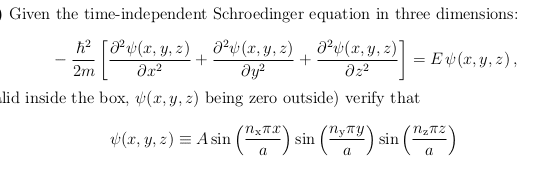
Screenshot at 2020-04-14 01-50-22.png


From this, I was able to work out the energy E to be
$$
E = \frac{\hbar^2}{2m} \frac{\pi^2}{a^2} \left(
n_x^2 + n_y^2 + n_z^2
\right)
$$
and also find the energy of the ground and first excited states respectively by replacing (nx,ny,nz) with (1,1,1) and (1,1,2).

I've attempted to rearrange the equation as below, but am not really sure about where to go next.
$$
n_x^2 + n_y^2 + n_z^2 = \frac{2m E a^2}{\hbar^2 \pi^2}
$$

Any guidance would be appreciated. Thanks in advance!
 
Last edited:
Physics news on Phys.org
I'm not sure I see any obvious way you could count up the states in this case. I have a vague recollection of looking at this once, but I can't help I'm afraid.

Is that the whole question?
 
PeroK said:
I'm not sure I see any obvious way you could count up the states in this case. I have a vague recollection of looking at this once, but I can't help I'm afraid.

Is that the whole question?

There were a few questions leading up to this such as find the ground and first state. But the question is pretty much this.
 
iakmngle said:
There were a few questions leading up to this such as find the ground and first state. But the question is pretty much this.
They say to consider the case ##N \gg 1##. In that limit, the integer ##n_x,n_y,n_z## can be thought as forming a dense set, so think of them as ##x,y,z##. Now, does the expression ##x^2 + y^2 +z^2## remind you of something?
 
  • Like
Likes   Reactions: iakmngle and etotheipi
nrqed said:
They say to consider the case ##N \gg 1##. In that limit, the integer ##n_x,n_y,n_z## can be thought as forming a dense set, so think of them as ##x,y,z##. Now, does the expression ##x^2 + y^2 +z^2## remind you of something?
I guess we are looking for a rough estimate rather than an expression? An expression suggests to me that we can count them precisely.
 
  • Informative
Likes   Reactions: etotheipi
nrqed said:
They say to consider the case ##N \gg 1##. In that limit, the integer ##n_x,n_y,n_z## can be thought as forming a dense set, so think of them as ##x,y,z##. Now, does the expression ##x^2 + y^2 +z^2## remind you of something?

That would be a sphere at the origin with a radius of $$\sqrt{\frac{2 E m a^2}{h^2 \pi^2}}$$. I'm not too sure what to do with this, could it be something with the density?
 
iakmngle said:
That would be a sphere at the origin with a radius of $$\sqrt{\frac{2 E m a^2}{h^2 \pi^2}}$$. I'm not too sure what to do with this, could it be something with the density?
The idea is that if you have a state ##n_x, n_y, n_z##, then you could look at that as a point in 3D space. Then it's a question of how many points lie within a given volume.
 
Last edited:
  • Like
Likes   Reactions: nrqed and etotheipi

Similar threads

  • · Replies 8 ·
Replies
8
Views
2K
  • · Replies 17 ·
Replies
17
Views
3K
  • · Replies 5 ·
Replies
5
Views
2K
  • · Replies 3 ·
Replies
3
Views
1K
Replies
8
Views
1K
  • · Replies 7 ·
Replies
7
Views
2K
  • · Replies 6 ·
Replies
6
Views
2K
  • · Replies 16 ·
Replies
16
Views
2K
  • · Replies 4 ·
Replies
4
Views
3K
  • · Replies 2 ·
Replies
2
Views
2K