Quadrature Booster or Phase shifting TX

  • Thread starter Thread starter tim9000
  • Start date Start date
  • Tags Tags
    phase transformer
Click For Summary
SUMMARY

The discussion centers on the functionality of Quadrature Boosters and phase-shifting transformers in power systems. Participants explore how altering the tap on a Delta transformer affects series voltage and current distribution. Key concepts include the addition of a 90-degree out-of-phase voltage to control current flow in transmission lines, particularly focusing on Phase B. The conversation emphasizes the importance of vector diagrams and phasor relationships in understanding these electrical systems.

PREREQUISITES
  • Understanding of three-phase power systems
  • Familiarity with Delta and Wye transformer configurations
  • Knowledge of phasor diagrams and vector analysis
  • Basic principles of voltage and current relationships in AC circuits
NEXT STEPS
  • Research "Delta to Wye transformer phase shift" for deeper insights
  • Study "phasor diagrams in electrical engineering" to visualize concepts
  • Explore "current control in power systems" to understand practical applications
  • Investigate "Quadrature Boosters in transmission lines" for advanced knowledge
USEFUL FOR

Electrical engineers, power system analysts, and students studying AC circuit theory will benefit from this discussion, particularly those interested in transformer operations and voltage control techniques in power distribution.

tim9000
Messages
866
Reaction score
17
Hi, Does anyone know about these? Specifically I'm trying to figure out changing the tap on the Delta effects the series voltage:
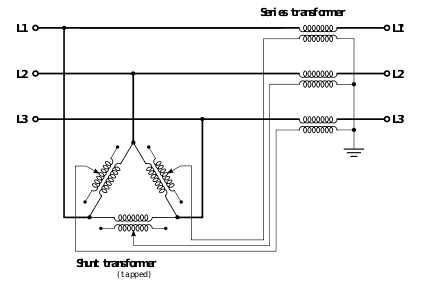
425px-Qb-3ph.svg.png

source wiki: http://en.wikipedia.org/wiki/Quadrature_booster

Any vector diagram or word explanations will help. Also, what size diameter coils must be used on the series transformer? I would imagine really huge if it's seriesed with a transmission line?

Thanks
 
Engineering news on Phys.org
Draw your phasor triangle.
Then think back to eighth grade geometry.
In an equilateral triangle, the bisector of any angle is perpendicular to and bisects the opposite side.Phase B's real current is perpendicular to phase AC's voltage, and so on around the three vertices.
There's the 90 degrees.
Observe that's how they connected the transformers.

So they "tweak" the apparent phase difference between ends of the line.

tim9000 said:
I would imagine really huge if it's seriesed with a transmission line?
i never saw one of those transformers in real life. From the picture at WIKI , the insulators are what you'd expect.
Maybe someone here has been inside one.
 
Actually come to think of it I don't know if I ever found out, or just meant to find out how a Delta to Wye shifts by 30o, because I certainly can't remember now. (If you wanted to explain that a bit too that'd be brilliant)
Ok, from what you said "
In an equilateral triangle, the bisector of any angle is perpendicular to and bisects the opposite side.
Phase B's real current is perpendicular to phase AC's voltage, and so on around the three vertices.
There's the 90 degrees."
I assume you chose Phase B just as an example phase from what you described I imagine it'd look something like this:
123.png

Sorry but I haven't used vector diagrams in ages, I perhaps understand (remember) less than you might (should) expect (sorry), do you think you could elaborate on the picture a bit, because I wasn't comfortable enough to label it myself, I was thinking the outside equilateral sides were the Delta phase voltage angles, but were the verticies? The series transformer on the side bucking the existing phase voltages?
I still haven't gotten past the mental block between where I am and understanding it.
Thanks
 
Last edited:
three phase is easier than it looks. Tutorials are everywhere.
i suspect you're past this one, but it looks like a decent refresher
http://www.electronics-tutorials.ws/accircuits/phasors.html
acp50.gif


From one at https://mysite.du.edu/~jcalvert/tech/threeph.htm
not recommending it, just this image showed up early in the search

wyedelta.gif


o would be neutral
a b and c the three terminals

Assuming unity power factor
the current in line b is in phase with Vob
which is perpendicular to Vca
and so forth

so a voltage that's in or 180° out of phase with Ib gets added to Vca
is what they're up to. Bear in mind that's a small voltage compared to system voltage, for what they're doing is controlling voltage drop across a wire.

I'm not a power systems guy, have only worked around some. So i'll hope a genuine one helps us with the power flow calcs, it'd save some stumbling.
 
H'mm, almost there. I don't like the idea of talking about current's too.
So would it also be fair to say the voltage pulled off the 'AC' line voltage (does not stand for Alternating Current here lol), is just perpendicular to VOB?
[Anyway the current in VOB is in-phase with the VOB at unity isn't it?]

I'm not entirely sure what you meant by "tweeking the apparent phase differences of the ends of the line"? But wouldn't the net result just be that the magnitude of VOB would be greater?

Interesting, thanks for the explanation so far!
 
tim9000 said:
So would it also be fair to say the voltage pulled off the 'AC' line voltage (does not stand for Alternating Current here lol), is just perpendicular to VOB?
Sure.
tim9000 said:
I'm not entirely sure what you meant by "tweeking the apparent phase differences of the ends of the line"? But wouldn't the net result just be that the magnitude of VOB would be greater?

Remember this thing is part of a power system.

Its purpose is to control the current through a line connecting two locations.
The voltage drop along the line is small compared to the voltage on the line itself.

I was working it in my head last night.
Think single phase for a minute:
Current through the line is
(Voltage between its ends)/Zline
They are adding to the term (Voltage between its ends) a small voltage at 90 degrees.
Their intent is to force current sharing between that and some other line connecting the two places.
So Vob is pretty well fixed by the power system
tim9000 said:
But wouldn't the net result just be that the magnitude of VOB would be greater?
What they added is a small voltage in phase with VOB.
If i understand this thing, those windings in series with the line aren't current measuring CT's they're voltage adding transformers.
By adding a voltage out of phase they shift the phase of term (Voltage between its ends) . Hence the current through it.
That's what wiki says they're up to.
 
Last edited:
jim hardy said:
Current through the line is
(Voltage between its ends)/Zline
They are adding to the term (Voltage between its ends) a small voltage at 90 degrees.
Their intent is to force current sharing between that and some other line connecting the two places.
So Vob is pretty well fixed by the power system
By adding a voltage out of phase they shift the phase of term (Voltage between its ends) . Hence the current through it.

Ok, so if you want more current down B phase, you add a small voltage 90 degrees to B. So when they take Vca off the Delta, and add it to Vb you're adding a 90 deg out of phase voltage and that causes more current to flow down B phase?

You're explanation should be added to the wiki page.
 
You'd probably do all three phases so as to shift current from one whole transmission line to another, or to route power around a region.

Have you seen this page? The power grid is a huge interconnected dynamic system with power flowing every which way.
Watch it in motion.
 
tim9000 said:
Ok, so if you want more current down B phase, you add a small voltage 90 degrees out of phase to B. So when they take Vca off the Delta, and add it to Vb you're adding a 90 deg out of phase voltage and that causes more current to flow down B phase?
jim hardy said:
You'd probably do all three phases so as to shift current from one whole transmission line to another, or to route power around a region.
Yeah, but I meant just in the realm of keeping with your Phase B observation/example.

jim hardy said:
Have you seen this page?
Which page are you talking about? This thread?
Yeah from what little exposure I have had to power system diagrams they do seem chaotic on first glance lol
 
  • #10
tim9000 said:
Which page are you talking about? This thread?
oops this graphic of US grid.. it's like watching a mobile swing in the breeze

http://fnetpublic.utk.edu/gradientmap.html

cdgradgen.php?1429977001978.png
 
Last edited by a moderator:
  • #11
jim hardy said:
oops this graphic of US grid.. it's like watching a mobile swing in the breeze

http://fnetpublic.utk.edu/gradientmap.html
Ah that's cool, yeah I've been meaning to look into the 'droop characteristic' of how busses balance themselves by changing the frequency slightly or something, all I remember hearing is that the characteristic means that nothing needs to be controlled, it does it inherently. *I am aware that statement is probably conflating different aspects, and is wrong lol*

So just for my final piece of mind, was I correct in my understanding of a single phase examination (of B phase)
'if you want more current down B phase, you add a small voltage 90 degrees out of phase to B. So when they take Vca off the Delta, and add it to Vb you're adding a 90 deg out of phase voltage and that causes more current to flow down B phase line?'

Cheers!
 
Last edited by a moderator:
  • #12
tim9000 said:
So just for my final piece of mind, was I correct in my understanding of a single phase examination (of B phase)
'if you want more current down B phase, you add a small voltage 90 degrees out of phase to B. So when they take Vca off the Delta, and add it to Vb you're adding a 90 deg out of phase voltage and that causes more current to flow down B phase line?'

Absolutely !

maybe more current, maybe less, depending on the phase difference between the substations at the two ends of the line.
Observe they have flexibility to add it 90 deg leading or 90 degree lagging, depending on bus transformer tap ..

it's a control system...needs to be symmetric
 

Similar threads

  • · Replies 12 ·
Replies
12
Views
3K
  • · Replies 3 ·
Replies
3
Views
2K
Replies
11
Views
2K
Replies
2
Views
3K
Replies
64
Views
8K
  • · Replies 1 ·
Replies
1
Views
7K
  • · Replies 12 ·
Replies
12
Views
2K
  • · Replies 5 ·
Replies
5
Views
2K
  • · Replies 4 ·
Replies
4
Views
4K
  • · Replies 13 ·
Replies
13
Views
6K