Quantum Cascade Lasers: Intersubband Transitions

Click For Summary
SUMMARY

Quantum Cascade Lasers (QCLs) primarily utilize intersubband transitions in the conduction band for mid-infrared and far-infrared lasing applications. While interband transitions can be employed for lasing, they operate at higher energy levels, making them unsuitable for mid-infrared lasers. The discussion highlights that QCLs can also be designed using valence band transitions, particularly in materials like Si/SiGe, where valence band offsets are larger. However, the effective mass of electrons is typically smaller than that of holes, making conduction band transitions more favorable for QCL designs.

PREREQUISITES
  • Understanding of Quantum Cascade Lasers (QCLs)
  • Knowledge of intersubband and interband transitions
  • Familiarity with semiconductor materials, specifically Si/SiGe
  • Concept of effective mass in semiconductor physics
NEXT STEPS
  • Research the design principles of Quantum Cascade Lasers (QCLs)
  • Explore the role of effective mass in semiconductor transitions
  • Investigate the applications of valence band transitions in laser technology
  • Learn about the fabrication techniques for Si/SiGe heterostructures
USEFUL FOR

Researchers, optical engineers, and physicists interested in laser technology, particularly those focusing on mid-infrared applications and semiconductor physics.
Goodver
Messages
101
Reaction score
1
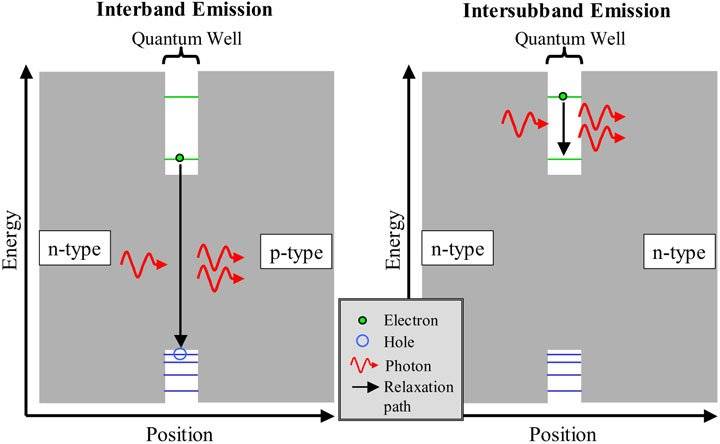
Why for quantum cascade lasers used only intersubband transitions in the conduction band. Although in a heterostructure there are also quantized levels in the valence band, which I think also can be used for lasing?

Thank you.

59_image1.jpg
 
Physics news on Phys.org
Of course you can use interband transitions for lasers. There are several dozens of designs for doing that. The main point of quantum cascade lasers is a different one: You want to have a laser in the mid-infrared or far-infrared. Interband transitions are much higher in energy and so one cannot use the interband emission to get a laser in the mid-infrared. Intersubband transitions are in the mid-ir, but it is not quite easy to get these transitions to lase. So the cascade laser concept is a very specialized design to create a laser in some selected wavelength range.
 
Thank you Cthugha. However this does not answer why intersubband transitions in the VALENCE BAND are not used. As far as I know, only intersubband transitions in the conduction band are used for lasing.
 
Oh, sorry. That is what you mean.

Well, one can use valence band to create a QCL. This basically means you switch to hole injection instead of electron injection. QCLs based on valence band transitions are used, e.g. in Si/SiGe. Here the valence band offsets are larger than the conduction band offsets and also the effective mass of the electron along the tunneling direction is quite large. Accordingly one would need really thin tunnel barriers to get the tunneling process to work. The effective hole mass is lower, so in this material system hole sublevels will be used.

However, in most materials the effective mass of the electron is smaller than that of the hole, so it is more "natural" to design a QCL based on transitions of the electron.
 
  • Like
Likes   Reactions: mfb and Goodver

Similar threads

  • · Replies 4 ·
Replies
4
Views
3K
  • · Replies 3 ·
Replies
3
Views
2K
  • · Replies 2 ·
Replies
2
Views
2K
  • · Replies 1 ·
Replies
1
Views
2K
  • · Replies 0 ·
Replies
0
Views
2K
  • · Replies 1 ·
Replies
1
Views
2K
  • · Replies 7 ·
Replies
7
Views
2K
  • · Replies 4 ·
Replies
4
Views
2K
  • · Replies 10 ·
Replies
10
Views
3K
  • · Replies 0 ·
Replies
0
Views
2K