malawi_glenn said:
not in quantum mechanics, that is the point of tunneling.
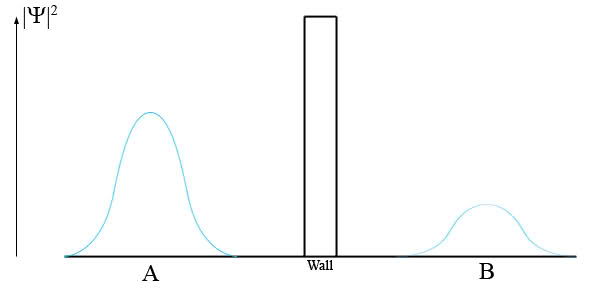
Say a free charged particle is prepared (with specific kinetic energy E) and at some later time it is shown to be inside a wide barrier (of constant potential V>E), by a process of elimination (i.e., by operations/measurements performed only on the regions in front and behind of the barrier, so as to not disturb the particle directly).
If we just wait, then measure the particle's energy after it has left the barrier, will it now have KE V>E (consistent with the knowledge that it was definitely "in" the barrier, and if so then was energy correspondingly subtracted from the mechanism that was used to check that it wasn't outside of the barrier)?
Or, if the particle's total energy at all times remains constant (implying negative KE in the barrier), what speed will we measure for it (say, if we equalise the electric potential outside, to widen the barrier, then measure how far the particle propagates in some time period)?
Mathematically, do we just zero out the reflected/transmitted parts of a wave-packet, renormalise and wait-see what its evolution limits to?
I suppose a similar question is, if a single particle from a collimated beam passes a single slit, and is detected at a high angle of diffraction, how is momentum conserved? (And does the aperture just zero out part of the wave-function for particles that get through, or strictly does the aperture entangle with every particle that it changes the wave-function of?)