Question about a figure in relativity textbook

Click For Summary

Discussion Overview

The discussion revolves around the interpretation of a figure in the textbook "Spacetime Physics" by Taylor & Wheeler, which illustrates the trajectory of a ball thrown in a room that is either on a ledge or in free fall. Participants are examining the implications of free fall on the perceived trajectory of the ball and whether the textbook's illustration accurately represents the physics involved.

Discussion Character

  • Debate/contested
  • Technical explanation
  • Conceptual clarification

Main Points Raised

  • One participant questions the accuracy of the textbook's illustration, arguing that the ball should follow a straight line trajectory in free fall, independent of the room's motion.
  • Another participant suggests that the ball's trajectory should be drawn at 1-second intervals to clarify its motion, emphasizing that the ball's path is determined solely by gravity once launched.
  • Some participants note that the initial angle of the ball's launch in the textbook may not correspond correctly with the diagram, leading to confusion about its trajectory.
  • A participant acknowledges that the book's diagram may not clearly indicate the direction of the ball, which is crucial for understanding the relativity of perception in this context.
  • There is agreement among some participants that if the ball is indeed thrown from right to left, the diagram in the book is incorrect and should reflect this accurately.
  • Another participant agrees that an observer in the room would not perceive vertical movement due to the acceleration of the room, but also points out that the ball has an initial vertical velocity component.

Areas of Agreement / Disagreement

Participants express disagreement regarding the accuracy of the textbook's illustration and its implications for the ball's trajectory. While some agree on the need for clearer representation of the ball's direction, there is no consensus on the correct interpretation of the physics involved.

Contextual Notes

The discussion highlights potential limitations in the textbook's diagram, including unclear initial conditions and the representation of the ball's trajectory in relation to the room's motion. These factors contribute to the ongoing debate about the accuracy of the illustration.

DocZaius
Messages
365
Reaction score
11
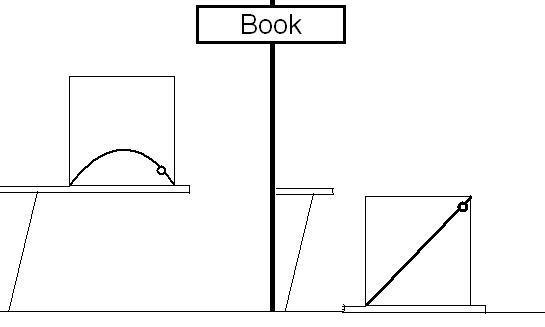
Figure 2-4 in "Spacetime Physics" by Taylor & Wheeler

The figure illustrates the effects of free float on the perceived trajectory of a ball thrown in a room that is on a ledge and then in a room that is sawed free from the ledge.

In both cases, the ball is launched at the same speed and direction, and sprays ink on the side wall of the room. In all cases, the ball is thrown from right to left. Here is the illustration the book shows.
book.JPG


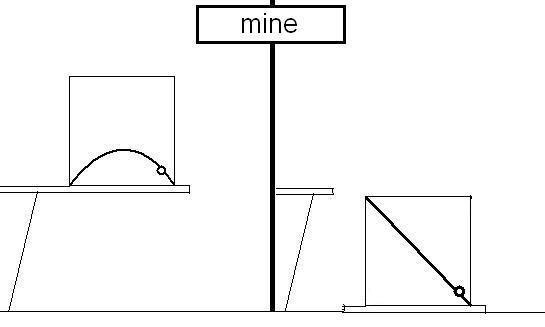
I have trouble with that illustration since it seems to me the ball would not make that ink trajectory in the free fall situation. To me it would seem to make this trajectory:
mine.JPG


Can someone tell me why the book is right and I am wrong? To me it seems that once the ball is launched, it does not care if the house is free falling or not - it will arrive at the same spot relative to the stable side of the cliff. Why would it end up where the book says it does? Also, once the ball is launched in a free float situation, it seems it will behave as if having been launched int he same manner in the middle of space, and follow a straight line 45 degree angle trajectory to the opposite top corner of the room.
 
Last edited:
Physics news on Phys.org
In the right half of the second pic, you have the ball starting out in the upper left hand corner of the room at an angle of minus 45 degrees to the vertical. That can't be right as the two sides have to correspond at t=0, where the ball is in the lower left side of the room thrown at an angle of plus 45 degrees.

It might help to draw the positions of both the ball and the room at 1 second intervals. Note that the ball must follow the same trajectory in between the times where it's launched and where it hits the floor of the room, no matter what the room does, since there's no other force on the ball but gravity.
 
Daverz said:
In the right half of the second pic, you have the ball starting out in the upper left hand corner of the room at an angle of minus 45 degrees to the vertical. That can't be right as the two sides have to correspond at t=0, where the ball is in the lower left side of the room thrown at an angle of plus 45 degrees.

It might help to draw the positions of both the ball and the room at 1 second intervals. Note that the ball must follow the same trajectory in between the times where it's launched and where it hits the floor of the room, no matter what the room does, since there's no other force on the ball but gravity.

In every diagram, the ball is thrown from the bottom right side of the room towards the left side at a +45 degree angle. This includes the right half of the second pic. Imagine the ball spraying ink on the back side of the room during its trajectory.

edit: Actually this made me realize that the book had the ball thrown from the bottom left side of the room. I wish it had shown direction of ball in the diagram. My diagram is accurate if the ball has been thrown from the bottom right side of the room. So that solves the problem - the book did not properly show ball direction in a diagram that tackles the relativity of perception (an important time to be explicit about conditions).
 
Last edited:
DocZaius said:
In every diagram, the ball is thrown from the bottom right side of the room towards the left side at a +45 degree angle. This includes the right half of the second pic. Imagine the ball spraying ink on the back side of the room during its trajectory.

edit: Actually this made me realize that the book had the ball thrown from the bottom left side of the room. I wish it had shown direction of ball in the diagram. My diagram is accurate if the ball has been thrown from the bottom right side of the room. So that solves the problem - the book did not properly show ball direction in a diagram that tackles the relativity of perception (an important time to be explicit about conditions).


I agree. If the book states the ball is going from right to left then the diagram is incorrect (it should look like your diagram).
 
DocZius;
I agree with you. The person in the room would accelerate with the ball, and not see any vertical movement, only horizontal motion.
 
phyti said:
DocZius;
I agree with you. The person in the room would accelerate with the ball, and not see any vertical movement, only horizontal motion.

But the ball has an initial component of velocity in the vertical direction.
 

Similar threads

  • · Replies 34 ·
2
Replies
34
Views
10K
  • · Replies 35 ·
2
Replies
35
Views
3K
Replies
25
Views
13K
Replies
2
Views
1K
  • · Replies 8 ·
Replies
8
Views
2K
  • · Replies 51 ·
2
Replies
51
Views
4K
  • · Replies 12 ·
Replies
12
Views
5K
  • · Replies 3 ·
Replies
3
Views
2K
  • · Replies 116 ·
4
Replies
116
Views
10K
  • · Replies 38 ·
2
Replies
38
Views
11K