ygolo
- 29
- 0
My question deals not with the Lorentz Tranformation itself, but the matrix representation of it:
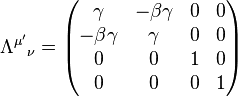
I see readily how the space-time 4-vector: [tex]x^{\mu}=\left( c \ast t, x, y, z\right)[/tex] transforms approptiately so that [tex]x^{\acute{\mu}}=\Lambda_{v}^{\acute{\mu}} \ast x^{\mu}=\left( \gamma \ast \left( c \ast t - \beta \ast x\right), \gamma \ast \left( x- \beta \ast c \ast t \right), y, z\right)[/tex].
I also see how a properly aligned Energy-Momentum 4-vector [tex]p^{\mu}=\left( \frac{E}{c}, \left|\vec{p}\right|, 0, 0\right)[/tex] transforms appropriately so that [tex]p^{\acute{\mu}}=\Lambda_{v}^{\acute{\mu}} \ast p^{\mu}=\left( \gamma \ast \left(\frac{E}{c} - \beta \ast \left|\vec{p}\right| \right), \gamma \ast \left( \left|\vec{p}\right| - \beta \ast \frac{E}{c} \right), 0, 0 \right)[/tex].
It is rather simple to use the transformed position four-vector to get the inverse of the velocity addition formula: [tex]\acute{v}=\frac{v-v_s}{1-\left(\frac{v_s \ast v}{c^2}\right)}[/tex]
...and its not too much harder to use [tex]v = \frac{\left|\vec{p}\right| \ast c^2}{E}[/tex], and the result of the Energy-momentum 4-vector, to arrive at the same formula.
However, if I use an appropriately aligned the velocity 4-vector, [tex]\zeta^{\mu}=\left(\gamma \ast c, \gamma \ast \left|\vec{v}\right|, 0, 0 \right)[/tex], I am not able to get the correct formulas. I am not even able to get the result that the speed of light is constant.
I don't know if there is some algabraic trickery needed, or if there is something more fundamental I am missing (I suspect that I am missing something fundamental).
So I ask if someone can do one of the following:
I see readily how the space-time 4-vector: [tex]x^{\mu}=\left( c \ast t, x, y, z\right)[/tex] transforms approptiately so that [tex]x^{\acute{\mu}}=\Lambda_{v}^{\acute{\mu}} \ast x^{\mu}=\left( \gamma \ast \left( c \ast t - \beta \ast x\right), \gamma \ast \left( x- \beta \ast c \ast t \right), y, z\right)[/tex].
I also see how a properly aligned Energy-Momentum 4-vector [tex]p^{\mu}=\left( \frac{E}{c}, \left|\vec{p}\right|, 0, 0\right)[/tex] transforms appropriately so that [tex]p^{\acute{\mu}}=\Lambda_{v}^{\acute{\mu}} \ast p^{\mu}=\left( \gamma \ast \left(\frac{E}{c} - \beta \ast \left|\vec{p}\right| \right), \gamma \ast \left( \left|\vec{p}\right| - \beta \ast \frac{E}{c} \right), 0, 0 \right)[/tex].
It is rather simple to use the transformed position four-vector to get the inverse of the velocity addition formula: [tex]\acute{v}=\frac{v-v_s}{1-\left(\frac{v_s \ast v}{c^2}\right)}[/tex]
...and its not too much harder to use [tex]v = \frac{\left|\vec{p}\right| \ast c^2}{E}[/tex], and the result of the Energy-momentum 4-vector, to arrive at the same formula.
However, if I use an appropriately aligned the velocity 4-vector, [tex]\zeta^{\mu}=\left(\gamma \ast c, \gamma \ast \left|\vec{v}\right|, 0, 0 \right)[/tex], I am not able to get the correct formulas. I am not even able to get the result that the speed of light is constant.
I don't know if there is some algabraic trickery needed, or if there is something more fundamental I am missing (I suspect that I am missing something fundamental).
So I ask if someone can do one of the following:
- Derive the velocity addition formula (or its inverse) by using the velocity 4-vector and the matrix reprecentation of the Lorentz Transformation
- Explain why it is misguided to attempt this.