Question about current flow and diode?

Ascendant78
Messages
327
Reaction score
0
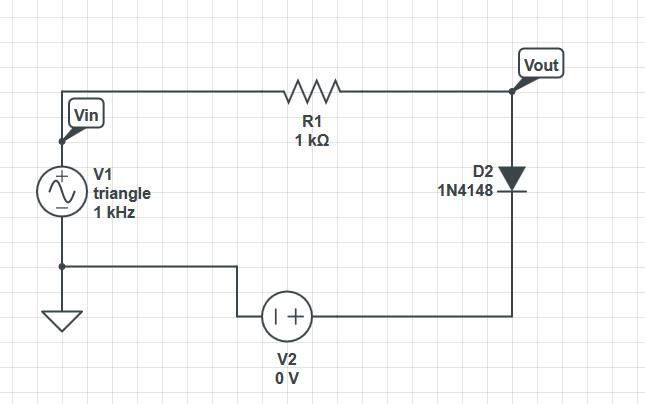
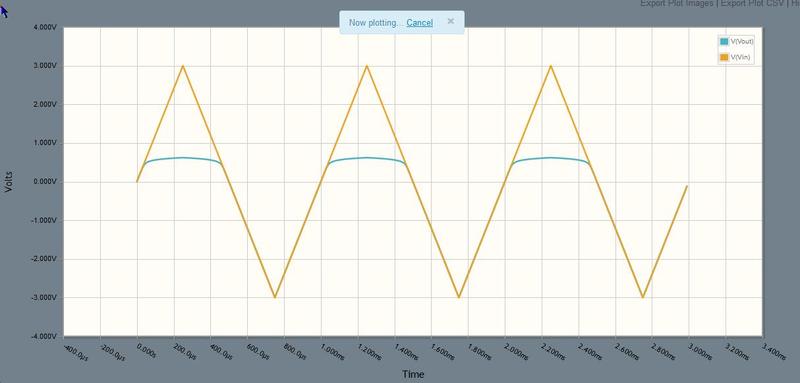
Ok, I'm trying to simulate a circuit containing a diode and I am a bit confused. I thought the arrow direction on the diode symbol shows which direction the current is able to flow through it. However, in my simulation, it is showing that the diode is limiting current flow in the exact opposite direction. Here are the images
Screen_Shot009.jpg


Screen_Shot010.jpg


Can someone please make sense of this to me? Do diodes actually block current in the direction of the arrow on their symbol? This just doesn't seem right to me.
 
Engineering news on Phys.org
jedishrfu said:
Current flows in the direction of the arrow in the diode.

https://en.m.wikipedia.org/wiki/Diode
Conventional current flows in the direction of the arrow in the diode.

Electron current flows in the other direction
 
  • Like
Likes Dr. Funkytron, Ascendant78 and jedishrfu
it is showing that the diode is limiting current flow in the exact opposite direction
The diode doesn't start conducting until the voltage across it reaches around 0.7v ( for silicon). As V1 increases positive, the IR takes up the rest of the voltage.
 
  • Like
Likes Ascendant78
That's what I thought, but then why is my voltage dropping when it is positive? I would think with this setup, the diode should allow the positive to flow, but impede the negative?
 
You are not looking at current flow, you are looking at voltage.

If the diode were an open circuit, then Vin and Vout would always be equal ( a full triangle wave).

Put in the diode, and Vout cannot go above 0.7V because the diode turns on and conducts current at that point, clamping the voltage at ~0.7V.

Look at the current through V2 (or anywhere for that matter).
 
  • Like
Likes Dr. Funkytron, jedishrfu, davenn and 1 other person
Oh, ok I get it now. I was simply looking at it wrong. Thank you.
 
meBigGuy said:
You are not looking at current flow, you are looking at voltage.

If the diode were an open circuit, then Vin and Vout would always be equal ( a full triangle wave).

Put in the diode, and Vout cannot go above 0.7V because the diode turns on and conducts current at that point, clamping the voltage at ~0.7V.

Look at the current through V2 (or anywhere for that matter).

nice explanation ... I should have known that haha :wink:Dave
 

Similar threads

  • · Replies 2 ·
Replies
2
Views
2K
Replies
3
Views
2K
  • · Replies 4 ·
Replies
4
Views
2K
Replies
7
Views
2K
  • · Replies 6 ·
Replies
6
Views
3K
  • · Replies 14 ·
Replies
14
Views
3K
  • · Replies 7 ·
Replies
7
Views
4K
Replies
12
Views
2K
  • · Replies 11 ·
Replies
11
Views
4K
  • · Replies 9 ·
Replies
9
Views
2K