Question about Momentum and torque

Join the discussion
Ask a follow-up here, or get your own question answered by working scientists, mathematicians and engineers — people, not an autocomplete.
Real named experts · corrections over time · the nuance an AI answer skips
10 replies · 1K views
kozmosnak
Messages
5
Reaction score
1
Thread moved from the technical forums to the schoolwork forums
Homework Statement
The force on the rope
Relevant Equations
Momentum and Troqhe balance equations
TL;DR Summary: I have this Question, and I have no idea, how am I supposed to set the Forces to create a balance since they are not perpendicular to the moving arm.

I have this question I have spend a lot of time on. It basically shows two sticks which are connected in the middle to create a Hourglass shape and on the top side there is a ball which has the mass of 1G (it is known just not a number)

Each of the sticks has their own mass which is G2. Right at the top there is a rope that holds two ends of the stick together so it won’t collapse. All the measurements that was given is on the attachment file.

What I need to figure out is how much Force the rope has. Even though one can see the answers right below it doesn’t make it understandable. Thank you everyone for helping <3

image.jpg
 
Last edited by a moderator:
Physics news on Phys.org
kozmosnak said:
how am I supposed to set the Forces to create a balance since they are not perpendicular to the moving arm.
So take the components which are perpendicular to the arm.
You can assume there is no friction and that the system is symmetric.
Draw the Free Body Diagram for one stick and post it.
 
haruspex said:
So take the components which are perpendicular to the arm.
You can assume there is no friction and that the system is symmetric.
Draw the Free Body Diagram for one stick and post it
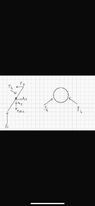
I have drawn it but cant get any further
 

Attachments

  • IMG_1424.png
    IMG_1424.png
    5.2 KB · Views: 85
haruspex said:
Use the FBD of the ball to determine ##F_k##.
Use the symmetry to determine ##A_y##.
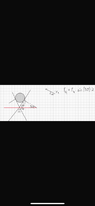
So the force Fk is Fg1 which is to see G

G1/sin(30)*2=Fk
 

Attachments

  • IMG_1425.png
    IMG_1425.png
    4.3 KB · Views: 85
Steve4Physics said:
@kozmosnak, if you take moments (torques) about the centre (where the sticks cross) you don't need ##A_x## or ##A_y##.
Yes but the problem I’m facing is that the forces are not perpendicular to the moving arm. They have angles that’s why I am confused. For example the rope force is horizontal but the axis is there with a 60 degree angle how can I add them up
 
Steve4Physics said:
@kozmosnak, if you take moments (torques) about the centre (where the sticks cross) you don't need ##A_x## or ##A_y##.
Yes but the problem I’m facing is that the forces are not perpendicular to the moving arm. They have angles that’s why I am confused. For example the rope force is horizontal but the axis is there with a 60 degree angle how can I add them hp
 
kozmosnak said:
Yes but the problem I’m facing is that the forces are not perpendicular to the moving arm. They have angles that’s why I am confused. For example the rope force is horizontal but the axis is there with a 60 degree angle how can I add them hp
Look at the diagram carefully:
1736344441592.jpeg

If you are unfamiliar with this try watching the video:
 
kozmosnak said:
So the force Fk is Fg1 which is to see G

G1/sin(30)*2=Fk
Yes.
kozmosnak said:
Yes but the problem I’m facing is that the forces are not perpendicular to the moving arm. They have angles that’s why I am confused. For example the rope force is horizontal but the axis is there with a 60 degree angle how can I add them hp
See if https://www.physicsforums.com/insights/frequently-made-errors-mechanics-moments/ helps.