Question about semi-major axis of an ellipse

  • Context: High School 
  • Thread starter Thread starter TrifidBlue
  • Start date Start date
  • Tags Tags
    Axis Ellipse
Click For Summary
SUMMARY

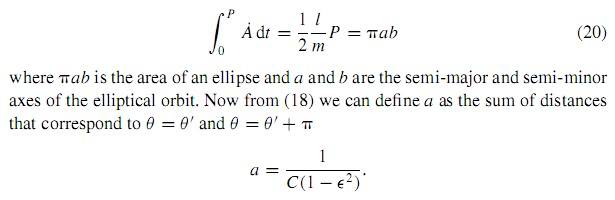
The semi-major axis of an ellipse is defined as a = 1/(C(1 - ε²)), where C is a constant and ε represents the eccentricity of the ellipse. The discussion clarifies that the distances between points on the ellipse are derived from the equations 1/r = C(1 - ε cos(θ - θ')) and 1/r = C(1 + ε cos(θ - θ' - π). The total distance calculation leads to the conclusion that the semi-major axis is half of the derived total distance, confirming the formula provided. This correction is essential for accurate understanding of elliptical geometry.

PREREQUISITES
  • Understanding of elliptical geometry
  • Familiarity with mathematical constants and variables (C, ε)
  • Knowledge of trigonometric functions and their applications
  • Basic algebra for manipulating equations
NEXT STEPS
  • Study the properties of ellipses in analytical geometry
  • Learn about eccentricity and its role in defining conic sections
  • Explore the derivation of the equations for conic sections
  • Investigate applications of ellipses in physics and engineering
USEFUL FOR

Mathematicians, physics students, and anyone interested in the geometric properties of ellipses and their applications in real-world scenarios.

TrifidBlue
Messages
16
Reaction score
0
I hope this the right place to post my question...

2.jpg


1-2.jpg


should it be, "we can define a as half the sum of distances..."?
please correct and explain if I'm mistaken
thanks
 
Last edited:
Mathematics news on Phys.org
You are mistaken.

When [itex]\theta= \theta'[/itex], [itex]1/r= C(1- \epsilon cos(\theta- \theta')=[/itex][itex]C(1- \epsilon cos(0))=[/itex][itex]C(1- \epsilon)[/itex] so that [itex]r= 1/(C(1-\epsilon)[/itex].

When [itex]\theta= \theta'+ \pi[/itex], [itex]1/r= C(1+\epsilon cos(\theta- \theta- \pi)=[/itex][itex]C(1- \epsilon cos(\pi))=[/itex][itex]C(1+ \epsilon)[/itex] so that [itex]r= 1/(C(1+\epsilon)[/itex].

The total distance between those points is [itex]1/C(1+\epsilon)+[/itex][itex]1/C(1- \epsilon)[/itex][itex]= (1/C)(1/(1+\epsilon)+ 1/(1- \epsilon))[/itex]. Getting the common denominator, [itex](1+\epsilon)(1-\epsilon)= 1-\epsilon^2[/itex], we have
[tex](1/C)\frac{1- \epsilon+ 1+ \epsilon}{1- \epsilon^2}= (1/C)\frac{2}{1- \epsilon^2}[/tex]

Half of that is
[tex]a= \frac{1}{C(1- \epsilon^2)}[/tex]
 
Last edited by a moderator:
HallsofIvy said:
You are mistaken.

When [itex]\theta= \theta'[/itex], [itex]1/r= C(1- \epsilon cos(\theta- \theta')=[/itex][itex]C(1- \epsilon cos(0))=[/itex][itex]C(1- \epsilon)[/itex] so that [itex]r= 1/(C(1-\epsilon)[/itex].

When [itex]\theta= \theta'+ \pi[/itex], [itex]1/r= C(1+\epsilon cos(\theta- \theta- \pi)=[/itex][itex]C(1- \epsilon cos(\pi))=[/itex][itex]C(1+ \epsilon)[/itex] so that [itex]r= 1/(C(1+\epsilon)[/itex].

The total distance between those points is [itex]1/C(1+\epsilon)+[/itex][itex]1/C(1- \epsilon)[/itex][itex]= (1/C)(1/(1+\epsilon)+ 1/(1- \epsilon))[/itex]. Getting the common denominator, [itex](1+\epsilon)(1-\epsilon)= 1-\epsilon^2[/itex], we have
[tex](1/C)\frac{1- \epsilon+ 1+ \epsilon}{1- \epsilon^2}= (1/C)\frac{2}{1- \epsilon^2}[/tex]

Half of that is
[tex]a= \frac{1}{C(1- \epsilon^2)}[/tex]

and that's what I've said :confused:
thank you
 

Similar threads

  • · Replies 9 ·
Replies
9
Views
2K
  • · Replies 5 ·
Replies
5
Views
4K
  • · Replies 2 ·
Replies
2
Views
2K
  • · Replies 1 ·
Replies
1
Views
2K
  • · Replies 4 ·
Replies
4
Views
3K
  • · Replies 5 ·
Replies
5
Views
2K
  • · Replies 2 ·
Replies
2
Views
2K
  • · Replies 3 ·
Replies
3
Views
2K
  • · Replies 4 ·
Replies
4
Views
2K
  • · Replies 2 ·
Replies
2
Views
3K