Question about sinusoidal steady-state analysis

Click For Summary

Discussion Overview

The discussion revolves around a problem related to sinusoidal steady-state analysis in a circuit. Participants are attempting to reconcile their solutions with provided answers, expressing uncertainty about the correctness of both their calculations and the given solutions.

Discussion Character

  • Homework-related
  • Debate/contested
  • Technical explanation

Main Points Raised

  • One participant expresses difficulty in solving part (b) of the problem and questions how to achieve the provided answer.
  • Another participant suspects inaccuracies in the problem statement, noting discrepancies between their own results and the provided solution values.
  • Concerns are raised about the phase relationship between capacitor and resistor currents, with one participant suggesting that the original working shows them in phase rather than the expected 90° out of phase.
  • Participants discuss potential errors in data substitution and the clarity of handwritten submissions, with one participant admitting to inserting a wrong value.
  • There is a suggestion that the book's answers may be incorrect, with one participant affirming that their solution appears correct despite the discrepancies with the book.
  • Participants emphasize the importance of clear presentation of mathematical work, recommending the use of LaTeX for better readability.

Areas of Agreement / Disagreement

There is no consensus on the correctness of the provided answers or the participants' solutions. Multiple competing views exist regarding the accuracy of the problem statement and the calculations involved.

Contextual Notes

Participants mention potential issues with the clarity of the problem statement and the accuracy of the provided solutions, as well as the need for clearer presentation of mathematical work. Specific assumptions and definitions are not fully explored or agreed upon.

Who May Find This Useful

This discussion may be useful for students working on sinusoidal steady-state analysis, particularly those facing similar challenges in reconciling their solutions with textbook answers.

e0ne199
Messages
56
Reaction score
5
hello everyone, i have a problem related with sinusoidal steady-state analysis, the problem is like this :
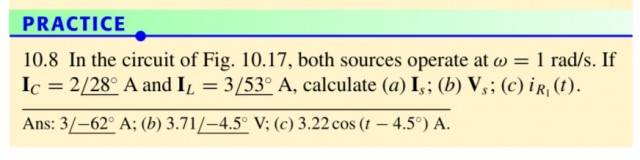
20181122-001735.jpg

the circuit for the question is like this :
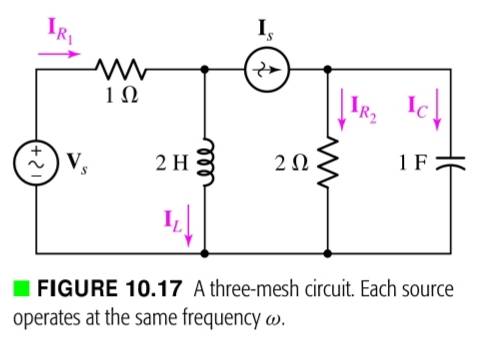
20181122-001756.jpg

i am still unable to find the answer for the question (b), the answer i got is not the same as the one provided by the question above, my attempt to get the solution is like this :
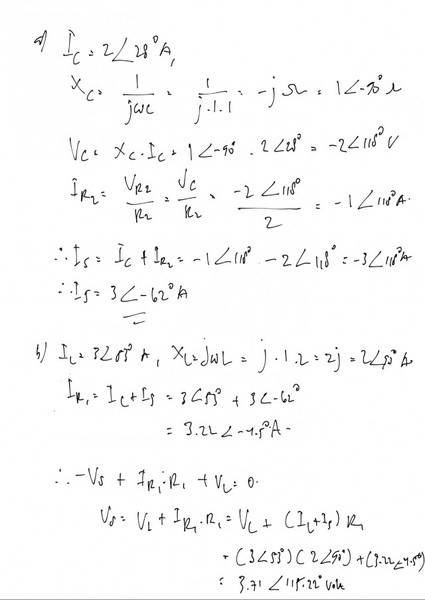
20181122-015606.jpg

do you know how to get the same answer as the one provided by the question above? thanks before
 

Attachments

  • 20181122-001735.jpg
    20181122-001735.jpg
    15.1 KB · Views: 855
  • 20181122-001756.jpg
    20181122-001756.jpg
    15.2 KB · Views: 923
  • 20181122-015606.jpg
    20181122-015606.jpg
    24 KB · Views: 709
Physics news on Phys.org
I suspect that there's something wrong with the problem statement in that the given solution values are not correct. I certainly didn't arrive at their values.

edit: fixed a minor typo
 
Last edited:
e0ne199 said:
how to get the same answer as the one provided by the question above?
##I_S\ =\ I_C\ +\ I_{R_2}##
Capacitor and resistor currents here should be 90° out of phase, but your working shows them in phase. It looks like you are substituting wrong data for ##I_C##. As does the book.

And I think at some stage you have mistaken your scribbled digit 3 for an 8?
 
NascentOxygen said:
##I_S\ =\ I_C\ +\ I_{R_2}##
Capacitor and resistor currents here should be 90° out of phase, but your working shows them in phase. It looks like you are substituting wrong data for ##I_C##. As does the book.

And I think at some stage you have mistaken your scribbled digit 3 for an 8?

haha lol you are right, i did insert a wrong value after looking at it again...so that means i am still unable to solve question (a) too...anyway is the answer from the question wrong or is there another way to solve it?
 
anyway this is the revision for my answer :
20181122-213140.jpg

could you point out which is wrong for the solution i have just made above?
 

Attachments

  • 20181122-213140.jpg
    20181122-213140.jpg
    24.3 KB · Views: 593
gneill said:
I suspect that there's something wrong with the problem statement in that the given solution values are not correct. I certainly didn't arrive at their values.

edit: fixed a minor typo
i have tried to find the exact same answer as the one provided by the question but i am still unable to get it until now and i am starting to think that probably my approach is wrong ... is my way to get the answer wrong or is it the answer itself which is wrong?? i hope you could correct anything wrong in my question..
 
e0ne199 said:
could you point out which is wrong for the solution i have just made above?
Your solution looks correct. The book's answers are not correct.

May I point out that I had to struggle quite a bit to make out some of your handwriting, particularly the tiny, squished together numbers for some of the angles. I might have replied sooner if I didn't have to "sleuth" through your handwriting. In future, please make sure that your submissions are easily readable, even on small screens like phones or tablets. Better yet, type in your equations. LaTeX syntax is supported here, and the edit toolbar contains icons for making subscripts, superscripts, and access to many math symbols via the ##\Sigma## icon.
 
  • Like
Likes   Reactions: BvU
gneill said:
Your solution looks correct. The book's answers are not correct.

May I point out that I had to struggle quite a bit to make out some of your handwriting, particularly the tiny, squished together numbers for some of the angles. I might have replied sooner if I didn't have to "sleuth" through your handwriting. In future, please make sure that your submissions are easily readable, even on small screens like phones or tablets. Better yet, type in your equations. LaTeX syntax is supported here, and the edit toolbar contains icons for making subscripts, superscripts, and access to many math symbols via the ##\Sigma## icon.
thx for the reply, i will do it in my future post
 
Thank you, it would be greatly appreciated by our homework helpers. :smile:
 

Similar threads

  • · Replies 3 ·
Replies
3
Views
3K
  • · Replies 3 ·
Replies
3
Views
2K
  • · Replies 6 ·
Replies
6
Views
3K
Replies
2
Views
2K
  • · Replies 4 ·
Replies
4
Views
4K
  • · Replies 14 ·
Replies
14
Views
4K
  • · Replies 3 ·
Replies
3
Views
4K
  • · Replies 2 ·
Replies
2
Views
1K
  • · Replies 4 ·
Replies
4
Views
2K
  • · Replies 7 ·
Replies
7
Views
2K