Discussion Overview
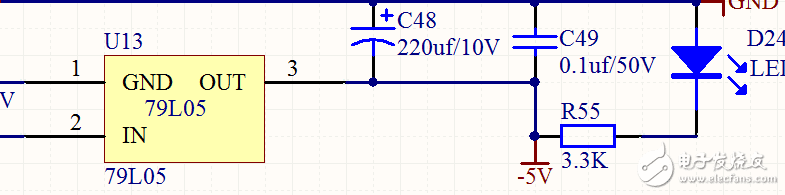
The discussion revolves around the performance of the 79L05 voltage regulator, particularly in relation to output voltage and the effects of filter capacitance. Participants explore the implications of using different capacitance values and the potential issues related to circuit configuration.
Discussion Character
- Technical explanation
- Debate/contested
Main Points Raised
- One participant reports that using a large output filter capacitance (220µF) caused the 79L05 to overheat and output only -2V, while reducing the capacitance to 47µF resolved the issue, resulting in a stable -5V output.
- Another participant suggests the possibility of the first capacitor being connected backwards, which could lead to excessive current draw.
- A participant notes that the negative regulator's output stage has higher output impedance compared to positive regulators, which may affect stability with certain capacitor types.
- There is a discussion about the need for minimum equivalent series resistance (ESR) for stability in negative regulators, contrasting it with positive regulators.
- One participant proposes experimenting with the larger capacitor by adding a resistor in series to see if it improves performance.
- Another participant comments on the similarities in internal schematics between positive and negative regulators, noting that negative regulators are often low dropout by default.
Areas of Agreement / Disagreement
Participants express varying views on the causes of the output voltage issues and the role of capacitor characteristics, with no consensus reached on the definitive solution or explanation.
Contextual Notes
Some participants mention the importance of capacitor ESR and its impact on regulator performance, but the discussion does not resolve the specific conditions or assumptions regarding the circuit setup.