Questions about bjt amplifier circuit

Click For Summary
SUMMARY

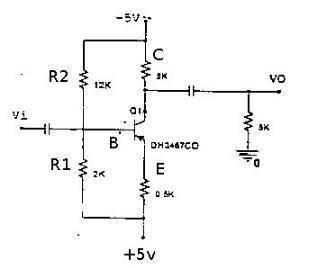
The discussion centers on the common emitter BJT amplifier circuit, specifically addressing the calculation of output voltage ripple using the equation V_{O(p-p)}=2I_{CQ} (R_L || R_C). Participants clarify that the output resistance is determined by R_{out} = R_{C} || R_{L}, and that the emitter does not need to be grounded for the configuration to be valid. The importance of drawing the small signal model is emphasized to avoid confusion regarding equivalent resistance and output characteristics. Additionally, the distinction between large signal analysis and small signal analysis is highlighted as crucial for accurate understanding.

PREREQUISITES
  • Understanding of BJT amplifier configurations, specifically common emitter.
  • Familiarity with small signal analysis in electronic circuits.
  • Knowledge of equivalent resistance calculations in parallel circuits.
  • Basic concepts of AC and DC analysis in amplifiers.
NEXT STEPS
  • Study small signal models for BJT amplifiers to enhance circuit analysis skills.
  • Learn about Thevenin's theorem and its application in amplifier circuits.
  • Explore large signal analysis techniques for BJT amplifiers.
  • Review output ripple calculations and their significance in amplifier design.
USEFUL FOR

Electronics students, circuit designers, and engineers working with BJT amplifiers who seek to deepen their understanding of amplifier configurations and analysis techniques.

green-fresh
Messages
14
Reaction score
0
hi all i have some questions about a commen emmiter bjt amplifier circuit .
if i had this circuit :
attachment.php?attachmentid=36036&stc=1&d=1306749925.jpg


and i want to find the ripple of voltage in outout :
i will use this equation :
V_{O(p-p)}=2I_{CQ} (R_L || R_C)

but why i putR_L || R_C not R_L || R_C + R_E or how i conclude that this is the equivalent resistance at output .
is this connected with thevnin equivalent circuit at output if so !how.
and is it right that i can here in this problem put one power source (10v) without any change on answers.
thanks .

p.s: this isn't a homwork.
 

Attachments

  • pic91.jpg
    pic91.jpg
    6.8 KB · Views: 1,278
Engineering news on Phys.org
ummm

that's not what I would consider a common emitter configuration.
common emitter ( base or collector) usually infers that that "leg" E, B or C is connected to 0V, either directly or via a resistor
Your cct isn't showing either of those 2 usual configurations, rather its working off a split supply + and - 5V

be interesting to see what more learned people say :)

Dave
 
The input is the base, the output is the collector. What else could it be other than a common emitter? RL is in parallel with RC as far as and AC signal is concerned.
 
davenn said:
ummm

that's not what I would consider a common emitter configuration.
common emitter ( base or collector) usually infers that that "leg" E, B or C is connected to 0V, either directly or via a resistor
Your cct isn't showing either of those 2 usual configurations, rather its working off a split supply + and - 5V

be interesting to see what more learned people say :)

Dave

They call it common emitter because the emitter is common to both the input and output, that doesn't imply that the emitter must sit at ground.
 
  • Like
Likes cabraham
green-fresh said:
and i want to find the ripple of voltage in outout :

By that do you mean the small signal(AC) component of the output?

but why i put
RL||RC
not
RL||RC+RE
or how i conclude that this is the equivalent resistance at output .

You should really draw the small signal model of this amplifier and show us what you come up with, if you're doing that wrong this may the source of your confusion. On the other hand, if you're not drawing the small signal model that may be the source of your confusion.

After doing so it should be obvious that,

R_{out} = R_{c}//R_{L}
 
jegues said:
They call it common emitter because the emitter is common to both the input and output, that doesn't imply that the emitter must sit at ground.

ahhhhh ok, appreciate that, we live and learn. I guess my misunderstanding comes from always seeing common E, B or C when one of them is tied to GND (0V) in either of the 2 manners I commented on.
The emitter tied to a V rail threw me a curve ball

thanks jegues and averagesupernova

Dave
 
jegues said:
By that do you mean the small signal(AC) component of the output?
yes this is what i mean.
jegues said:
You should really draw the small signal model of this amplifier and show us what you come up with, if you're doing that wrong this may the source of your confusion. On the other hand, if you're not drawing the small signal model that may be the source of your confusion.

After doing so it should be obvious that,

R_{out} = R_{c}//R_{L}

yea exactly this is what i must do and like what i asked:
green-fresh said:
is this connected with thevnin equivalent circuit at output
i find after googling about small signal model that i must at AC consider every capacitor as "short circuit" and also the power source soR_L andR_C have two commen point (one at C and one at GRD)so

R_{out} = R_{c}//R_{L}.
confusion solved thanks very much:
davenn,jegues,Averagesupernova
 
green-fresh said:
and i want to find the ripple of voltage in outout :
i will use this equation :
V_{O(p-p)}=2I_{CQ} (R_L || R_C)

BTW. That is neither the output ripple nor is it the small signal output. It is an approximation to the maximum possible peak to peak output voltage assuming a mid point bias. That comes from a large signal analysis. Start by trying to understand the small signal analysis and basic bias point calculations first.
 

Similar threads

  • · Replies 1 ·
Replies
1
Views
2K
  • · Replies 10 ·
Replies
10
Views
3K
  • · Replies 9 ·
Replies
9
Views
2K
  • · Replies 11 ·
Replies
11
Views
7K
  • · Replies 1 ·
Replies
1
Views
2K
  • · Replies 4 ·
Replies
4
Views
2K
  • · Replies 5 ·
Replies
5
Views
3K
  • · Replies 8 ·
Replies
8
Views
2K
  • · Replies 10 ·
Replies
10
Views
3K
  • · Replies 7 ·
Replies
7
Views
7K